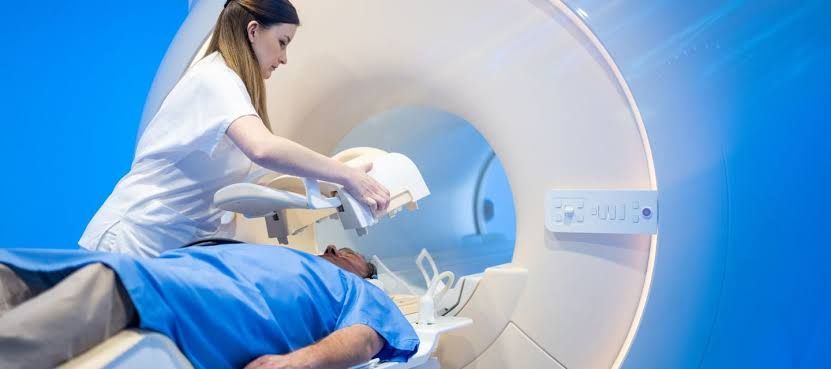
Principles of MRI Scanning
Magnetic Resonance Imaging (MRI) is a non-invasive imaging technique that utilizes strong magnetic fields and radiofrequency waves to generate detailed images of the internal structures of the body. The fundamental principles of MRI are based on the behavior of atomic nuclei, particularly hydrogen nuclei, in a magnetic field. When placed in a strong magnetic field, these nuclei align with the field. A radiofrequency pulse is then applied, causing the nuclei to absorb energy and move to a higher energy state. Once the pulse is turned off, the nuclei return to their original state, releasing energy in the process. This released energy is detected and used to create images.
The key components involved in MRI scanning include:
- Magnetic Field (B0): A strong external magnetic field aligns hydrogen nuclei within tissues.
- Radiofrequency Pulses: These pulses excite the aligned nuclei, causing them to emit signals as they relax back to equilibrium.
- Relaxation Times: The two primary relaxation times relevant in MRI are T1 (longitudinal relaxation time) and T2 (transverse relaxation time), which describe how quickly protons return to their equilibrium states after excitation.
T1-Weighted Imaging (T1 MRI)
T1-weighted imaging emphasizes differences in T1 relaxation times among various tissues. In T1-weighted images, fat appears bright while fluids such as cerebrospinal fluid (CSF) appear dark. This contrast arises because different tissues recover from excitation at different rates; tissues with shorter T1 times recover more quickly and thus appear brighter on T1-weighted images.
- Repetition Time (TR): Typically short (400-700 ms), allowing for adequate recovery of longitudinal magnetization.
- Echo Time (TE): Usually short (<30 ms), minimizing T2 effects.
T1-weighted images are particularly useful for visualizing anatomical structures and certain pathologies due to their ability to highlight fat-containing tissues.
T2-Weighted Imaging (T2 MRI)
In contrast, T2-weighted imaging focuses on differences in T2 relaxation times among tissues. In these images, fluids appear bright due to their longer T2 relaxation times, while fat appears darker compared to its appearance on T1-weighted images.
- Repetition Time (TR): Long (>2000 ms), allowing sufficient time for longitudinal magnetization recovery.
- Echo Time (TE): Longer than that used in T1 sequences (60-120 ms), capturing signals when differences in T2 relaxation times are most pronounced.
T2-weighted images are beneficial for identifying edema or other fluid-filled structures since these areas will show up prominently against darker surrounding tissues.
Fluid-Attenuated Inversion Recovery (FLAIR)
FLAIR is a specialized MRI sequence that combines elements of both T1 and T2 imaging but specifically suppresses the signal from fluids like CSF. This suppression allows for better visualization of lesions or abnormalities adjacent to fluid-filled spaces by eliminating the bright signal from CSF that can obscure pathology.
- FLAIR uses an inversion recovery technique where an initial inversion pulse is applied before standard imaging sequences.
- The TR and TE values can vary but are typically set to enhance tissue contrast while suppressing fluid signals.
FLAIR sequences are particularly useful in detecting lesions associated with multiple sclerosis or other conditions where subtle changes near CSF spaces need clear visualization without interference from bright fluid signals.
In summary, each MRI sequence—T1, T2, and FLAIR—serves distinct purposes based on their unique physics principles and image contrasts, allowing clinicians to obtain comprehensive insights into various medical conditions through careful selection of imaging parameters.
Normal MRI Scan of the Head, Brain, and Spine
Magnetic Resonance Imaging (MRI) is a non-invasive diagnostic tool that provides detailed images of the internal structures of the body, particularly useful for examining the brain and spine.
- Normal MRI of the Head and Brain:
- An MRI scan of the head typically captures images of the brain, cranial nerves, and surrounding structures. The normal brain appears symmetrical with distinct regions such as the cerebral cortex, cerebellum, and brainstem clearly visible. The cerebrospinal fluid (CSF) spaces around the brain should be well-defined and free from any abnormalities. Normal findings include:
- No evidence of tumors or lesions.
- Clear differentiation between gray matter (the outer layer) and white matter (inner layer).
- Absence of edema (swelling) or hemorrhage.
- Normal size and shape of ventricles.
- An MRI scan of the head typically captures images of the brain, cranial nerves, and surrounding structures. The normal brain appears symmetrical with distinct regions such as the cerebral cortex, cerebellum, and brainstem clearly visible. The cerebrospinal fluid (CSF) spaces around the brain should be well-defined and free from any abnormalities. Normal findings include:
- Normal MRI of the Spine:
- An MRI scan of the spine evaluates vertebrae, intervertebral discs, spinal cord, and surrounding soft tissues. A normal spinal MRI shows:
- Proper alignment of vertebrae without signs of degeneration or fractures.
- Healthy intervertebral discs that are well-hydrated with no herniation.
- A normal spinal canal width without stenosis (narrowing).
- Absence of tumors or abnormal growths along the spinal cord.
- An MRI scan of the spine evaluates vertebrae, intervertebral discs, spinal cord, and surrounding soft tissues. A normal spinal MRI shows:
Differentiation Between Plain and Contrast MRI
- Plain MRI (Non-Contrast MRI):
- A plain MRI does not utilize any contrast agents to enhance image quality. It relies solely on the natural properties of tissues to produce images. This type is effective for many conditions where significant abnormalities are not expected or where large structures can be assessed adequately. For example:
- Identifying large tumors or structural abnormalities in both brain and spine.
- Evaluating conditions like degenerative disc disease or spinal stenosis.
- A plain MRI does not utilize any contrast agents to enhance image quality. It relies solely on the natural properties of tissues to produce images. This type is effective for many conditions where significant abnormalities are not expected or where large structures can be assessed adequately. For example:
- Contrast MRI:
- In contrast MRIs, a gadolinium-based contrast agent is administered to enhance imaging detail. This agent helps highlight differences in tissue characteristics by increasing signal intensity in certain areas. Contrast MRIs are particularly beneficial for:
- Detecting small tumors that may not be visible on plain scans.
- Assessing vascular malformations or infections where enhanced visibility is crucial.
- Evaluating inflammatory conditions such as multiple sclerosis by highlighting lesions more effectively than plain MRIs.
- In contrast MRIs, a gadolinium-based contrast agent is administered to enhance imaging detail. This agent helps highlight differences in tissue characteristics by increasing signal intensity in certain areas. Contrast MRIs are particularly beneficial for:
The decision to use a contrast agent depends on various factors including clinical indications, patient history, and specific diagnostic needs as determined by healthcare providers.
In summary, while both plain and contrast MRIs provide valuable information about brain and spinal health, contrast MRIs offer enhanced visualization that can aid in identifying smaller lesions or subtle changes in tissue composition.
Reading MRI Scans of Major Pathologies
Below is a detailed examination of how to read MRI scans for major pathologies such as brain tumors, hydrocephalus, cerebral infarctions, spinal injuries, and cervical and lumbar disk herniation.
1. Brain Tumors
When interpreting MRI scans for brain tumors, several key features are assessed:
- Location: Tumors can be located in different regions of the brain (e.g., frontal lobe, temporal lobe). The location can help determine the type of tumor.
- Signal Characteristics: Tumors typically appear hyperintense (bright) on T2-weighted images and may appear hypointense (dark) on T1-weighted images. Contrast-enhanced images can show areas of enhancement indicating blood-brain barrier disruption.
- Mass Effect: Look for signs of mass effect such as midline shift or edema surrounding the tumor.
- Type of Tumor: Common types include gliomas (which may have irregular borders), meningiomas (often well-defined), and metastatic lesions (which may present with multiple foci).
2. Hydrocephalus
Hydrocephalus refers to an accumulation of cerebrospinal fluid (CSF) within the ventricles:
- Ventricular Size: On MRI, enlarged ventricles are a hallmark sign. Measure the ventricular size relative to the brain parenchyma.
- Periventricular Edema: Look for associated periventricular edema which indicates increased intracranial pressure.
- Aqueductal Stenosis: Assess the aqueduct of Sylvius; narrowing here can lead to obstructive hydrocephalus.
3. Cerebral Infarctions
Cerebral infarctions result from reduced blood flow to specific areas of the brain:
- Acute Phase Appearance: In acute infarction, diffusion-weighted imaging (DWI) shows hyperintensity in affected areas due to cytotoxic edema.
- Chronic Phase Changes: Over time, infarcted areas may become cystic or show gliosis on T2-weighted images.
- Location and Vascular Territories: Identify which vascular territory is affected based on the location of the infarction.
4. Spinal Injuries
Spinal injuries can vary widely in appearance depending on severity:
- Fractures/Dislocations: Look for vertebral body fractures or dislocations that may cause spinal canal compromise.
- Soft Tissue Injury: Assess for hematoma or edema around the spinal cord which may indicate contusion or laceration.
- Alignment Issues: Evaluate spinal alignment; any significant deviation could indicate instability.
5. Cervical and Lumbar Disk Herniation
Disk herniations occur when intervertebral disks protrude into adjacent neural structures:
- Herniation Type Identification: Determine if it is a bulging disk or a more severe extrusion/sequestration based on morphology seen on axial cuts.
- Nerve Root Compression Signs: Look for compression signs such as displacement of nerve roots or changes in signal intensity around them.
- Location Specificity: In cervical herniations, check C5-C6 and C6-C7 levels; in lumbar herniations, L4-L5 and L5-S1 are common sites.
In summary, reading MRI scans involves understanding normal anatomy versus pathological changes across various conditions. Each pathology has distinct characteristics that aid in diagnosis.