
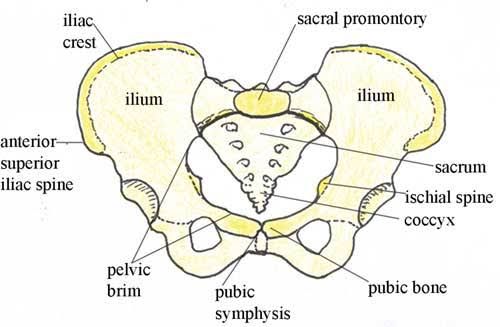
Basic Anatomy of the Female Bony Pelvis
The female bony pelvis is a complex structure that plays a crucial role in supporting the body and facilitating childbirth. It consists of several bones, joints, and associated structures that work together to form a basin-like shape at the base of the spine.
1. Structure of the Female Pelvis
The female pelvis is made up of five main bones:
- Hip Bones (Coxal Bones): Each hip bone consists of three fused bones: the ilium, pubis, and ischium. These bones form the pelvic girdle and provide support for the upper body while connecting to the lower limbs.
- Ilium: The largest part of the hip bone, it has a broad, fan-shaped structure that can be felt on either side of the hips.
- Pubis: This bone connects with its counterpart at the pubic symphysis, forming the front portion of the pelvis.
- Ischium: Known as the “sit bones,” these are located at the lower part of each hip bone and bear weight when sitting.
- Sacrum: The sacrum is formed by five fused vertebrae and connects to the lumbar spine above. It provides stability and supports body weight.
- Coccyx: Commonly referred to as the tailbone, it consists of four fused vertebrae and serves as an attachment point for ligaments and muscles.
2. Joints in the Pelvis
Several joints connect these bones:
- Pubic Symphysis: A cartilaginous joint where the two pubic bones meet at the front.
- Sacroiliac Joints: These joints connect each ilium to the sacrum, allowing for slight movement which aids in shock absorption during walking or running.
3. Functionality Related to Childbirth
The anatomy of the female pelvis is specifically adapted for childbirth. The pelvic inlet (the upper opening) is generally wider in females compared to males, allowing enough space for a baby to pass through during delivery. The pelvic cavity also accommodates various reproductive organs.
During pregnancy, hormonal changes cause ligaments around these joints to relax, enabling further expansion necessary for childbirth. This adaptability highlights how pelvic anatomy has evolved alongside reproductive functions.
4. Muscles Associated with the Pelvis
While not part of the bony structure itself, muscles play an essential role in supporting pelvic organs:
- Levator Ani Muscles: This group includes three muscles (puborectalis, pubococcygeus, iliococcygeus) that support pelvic organs and help control bowel movements.
- Coccygeus Muscle: This smaller muscle assists in supporting pelvic structures.
In summary, understanding the basic anatomy of the female bony pelvis involves recognizing its structural components—hip bones (ilium, pubis, ischium), sacrum, coccyx—along with their functional roles related to support and childbirth.
Anatomy of the Pelvic Inlet, Cavity, and Outlet
Pelvic Inlet
The pelvic inlet is the upper opening of the true pelvis and serves as a critical boundary between the greater (false) pelvis and the lesser (true) pelvis. It is defined by several anatomical landmarks:
- Posterior Border: The sacral promontory, which is the anterior projecting edge of the first sacral vertebra, along with the sacral wings (ala).
- Lateral Borders: The arcuate line on the inner surface of each ilium and the pectineal line on the superior pubic ramus.
- Anterior Border: The pubic symphysis, where the two pubic bones meet.
The shape of the pelvic inlet is generally oval in females, which facilitates childbirth by providing a wider passage for fetal delivery. This structure is crucial for obstetric considerations as it determines not only the size but also the shape of the birth canal.
Pelvic Cavity
The pelvic cavity lies below the pelvic inlet and above the pelvic outlet. It contains various organs related to both urinary and reproductive systems. The boundaries of this cavity are defined as follows:
- Superior Boundary: The pelvic inlet.
- Inferior Boundary: The pelvic outlet.
- Lateral Walls: Formed by the hip bones and their associated muscles.
- Anterior Wall: Composed primarily of the pubic bones.
- Posterior Wall: Formed by the sacrum and coccyx.
Within this cavity reside important structures such as:
- The bladder
- Uterus
- Ovaries
- Fallopian tubes
- Rectum
The pelvic cavity plays a vital role in supporting these organs while allowing for movement and flexibility during activities like walking or childbirth.
Pelvic Outlet
The pelvic outlet is located at the lower end of the true pelvis and marks its exit point. It has distinct borders that define its anatomy:
- Posterior Border: The tip of the coccyx.
- Lateral Borders: The ischial tuberosities (the bony protrusions you sit on) and inferior margins of the sacrotuberous ligaments.
- Anterior Border: The pubic arch, formed by the inferior borders of both ischiopubic rami.
In females, this outlet tends to be larger compared to males due to evolutionary adaptations for childbirth. Notably, it features a wider sub-pubic angle (greater than 80–90 degrees), which allows for easier passage during delivery.
Overall, understanding these anatomical features—pelvic inlet, cavity, and outlet—is essential for comprehending female reproductive health, obstetrics, and potential complications during childbirth.
Diameters of the Pelvis and Their Obstetric Importance
The female pelvis is a complex structure that plays a crucial role in childbirth. Its dimensions, particularly the diameters, are essential for understanding how well a fetus can pass through the birth canal during delivery. The following are the key diameters of the female pelvis, along with their obstetric significance:
1. Pelvic Inlet (Brim) Diameter
- Description: The pelvic inlet is the upper opening of the true pelvis. It is bordered by the pubic symphysis anteriorly, the iliopectineal lines laterally, and the sacral promontory posteriorly.
- Key Diameters:
- Transverse Diameter: Measures approximately 13.5 cm and is considered one of the most important measurements because it is generally the widest part of the inlet.
- Anteroposterior Diameter: Measures about 11 cm at its maximum.
- Obstetric Importance: A wider pelvic inlet facilitates easier passage for the fetal head during labor. If this diameter is too narrow, it may lead to obstructed labor or necessitate surgical intervention such as a cesarean section.
2. Mid-Pelvis (Pelvic Cavity) Diameters
- Description: The mid-pelvis refers to the space between the pelvic inlet and outlet.
- Key Diameters:
- Transverse Diameter: Approximately 12 cm.
- Oblique Diameter: Ranges from about 11 to 12 cm.
- Obstetric Importance: These diameters are critical as they determine whether there is enough space for fetal rotation and descent during labor. Narrowing in this area can complicate delivery and increase risks for both mother and child.
3. Pelvic Outlet Diameter
- Description: The pelvic outlet is defined by the inferior border of the pubic symphysis anteriorly, ischial tuberosities laterally, and coccyx posteriorly.
- Key Diameters:
- Transverse Diameter: Approximately 11 cm.
- Anteroposterior Diameter (Coccygeal-Pubic Distance): About 9 to 10 cm.
- Obstetric Importance: This diameter must be sufficient to allow for fetal shoulders to pass through during delivery. A constricted outlet can lead to difficulties in childbirth, potentially requiring interventions.
4. Diagonal Conjugate
- Description: This measurement extends from the lower margin of the pubic symphysis to the sacral promontory.
- Key Measurement: Typically measures around 12.5 cm.
- Obstetric Importance: The diagonal conjugate provides an estimate of other conjugates (like true conjugate) which are vital in assessing whether a vaginal delivery will be feasible.
5. True Conjugate
- Description: This measurement runs from the upper margin of the pubic symphysis to the sacral promontory but cannot be measured directly during physical examination; it must be calculated based on other measurements (usually subtracting about 1.5 cm from diagonal conjugate).
- Key Measurement: Generally around 11 cm or less indicates potential issues with delivery.
- Obstetric Importance: A smaller true conjugate suggests a higher risk for obstructed labor or cephalopelvic disproportion.
In summary, understanding these diameters helps healthcare providers assess whether a woman can deliver vaginally or if she may require surgical assistance due to anatomical constraints within her pelvis.
Basic Anatomy of the Fetal Skull
The fetal skull is a complex structure that plays a crucial role in protecting the developing brain and facilitating birth. It is composed of several bones that are not fully fused at birth, allowing for flexibility during delivery. The main components of the fetal skull include:
- Frontal Bones: The frontal bone forms the forehead and is initially divided into two halves in the fetus. These halves typically fuse into a single bone by around eight years of age.
- Parietal Bones: There are two parietal bones located on either side of the skull, which together occupy a significant portion of the cranial vault. They meet at the sagittal suture.
- Occipital Bone: This bone forms the back and base of the skull and connects with the cervical vertebrae (the neck bones).
- Temporal Bones: There are two temporal bones, one on each side of the head, located near the ears. These bones contribute to both the sides and base of the skull.
- Sutures: The fetal skull features several sutures—fibrous joints that connect these bones:
- Metopic Suture: This suture runs from the top of the head down to the middle of the forehead, where it connects the two frontal bones.
- Coronal Suture: Extending from ear to ear, this suture connects each frontal bone with a parietal bone.
- Sagittal Suture: This suture runs from front to back along the midline, connecting both parietal bones.
- Lambdoid Suture: Located at the back of the head, this suture connects each parietal bone with the occipital bone.
- Fontanelles: These are soft spots on an infant’s skull where sutures intersect, allowing for growth and flexibility:
- Anterior Fontanelle: Found at the junction where both frontal and parietal bones meet; it remains soft until about 18 months to 2 years old.
- Posterior Fontanelle: Located at the junction between parietal and occipital bones; it usually closes within several months after birth.
The design of these structures allows for significant changes in shape during childbirth as well as accommodating rapid brain growth in early life.
Diameters of the Fetal Skull
The fetal skull is a complex structure composed of several bones that are interconnected by sutures. Understanding the diameters of the fetal skull is crucial in obstetrics, particularly during labor and delivery, as these measurements can influence the mode of delivery and help assess potential complications. The diameters can be categorized into anteroposterior (longitudinal) and transverse dimensions.
Anteroposterior Diameters
- Suboccipitobregmatic Diameter (9.5 cm): This is the presenting anteroposterior diameter when the fetal head is well flexed, typically seen in occipitotransverse or occipitoanterior positions. It extends from the undersurface of the occipital bone at its junction with the neck to the center of the anterior fontanelle.
- Occipitofrontal Diameter (11 cm): This diameter is measured when the head is deflexed, as in an occipito-posterior presentation. It runs from the external occipital protuberance to the glabella (the area between the eyebrows).
- Supraoccipitomental Diameter (13.5 cm): This is the longest anteroposterior diameter and occurs during a brow presentation. It extends from the vertex of the head to the chin.
- Submentobregmatic Diameter (9.5 cm): This diameter is relevant in face presentations and measures from the junction of the neck and lower jaw to the center of the anterior fontanelle.
Transverse Diameters
- Biparietal Diameter (9.5 cm): This is considered the largest transverse diameter and measures across both parietal bones.
- Bitemporal Diameter (8 cm): This represents the shortest transverse diameter, extending between both temporal bones.
Average Head Circumference
The average circumference of a term fetal head, measured in the occipitofrontal plane, is approximately 34.5 cm.
Understanding these diameters helps healthcare providers anticipate how well a fetus can navigate through the birth canal during delivery and assess any potential risks associated with different presentations or positions of the fetus.
Molding of the Fetal Head
Molding of the fetal head refers to the temporary alteration in the shape of a newborn’s head that occurs during childbirth, particularly during vaginal delivery. This phenomenon is primarily due to the pressure exerted on the baby’s head as it passes through the birth canal. The skull of a newborn is composed of several soft and flexible bones that are not yet fused together, allowing for some degree of deformation under pressure.
Mechanism of Molding
The molding process is facilitated by the presence of cranial sutures—flexible joints between the skull bones—and fontanelles, which are soft spots on a baby’s head. These structures allow for movement and overlap of the skull bones during delivery. When a baby is born head-first, the pressure from contractions and resistance from the maternal pelvis can cause these bones to shift and overlap, resulting in an oblong or elongated shape rather than a perfectly round one.
The extent of molding can vary based on several factors:
- Duration of Labor: Longer labors may result in more significant molding due to prolonged pressure.
- Fetal Presentation: Babies born in a breech position (buttocks or feet first) typically do not experience molding, as their heads do not engage with the birth canal in the same way.
- Maternal Factors: The age and parity (number of previous births) of the mother can influence molding; for instance, first-time mothers may have infants with more pronounced molding compared to those who have given birth before.
Associated Conditions
In addition to simple molding, other conditions may arise during delivery that affect head shape:
- Caput Succedaneum: This condition involves fluid accumulation in the scalp due to pressure during labor, leading to swelling that can further distort head shape.
- Cephalohematoma: This occurs when blood collects beneath the periosteum (the membrane covering skull bones), often resulting from trauma during delivery. Both caput succedaneum and cephalohematoma typically resolve within days after birth.
Physiological vs. Pathological Molding
While most cases of head molding are physiological and resolve quickly without intervention, there are instances where abnormal configurations may occur. Abnormal molding can lead to complications such as cerebral injury if excessive pressure causes significant overlap or deformation beyond normal limits. Medical professionals differentiate between physiological molding—which does not harm brain function—and pathological configurations that could indicate potential injury or developmental issues.
Recovery and Prognosis
Fortunately, most newborns recover from head molding within a few days as they adjust to life outside the womb. The flexibility of their skulls allows them to return to a more rounded shape naturally as fluid dissipates and cranial sutures realign. Monitoring by healthcare providers ensures that any concerning signs are addressed promptly.
In summary, fetal head molding is a common occurrence during vaginal deliveries characterized by temporary changes in head shape due to external pressures experienced during childbirth. Understanding this process helps parents and caregivers recognize what is typical versus what may require medical attention.