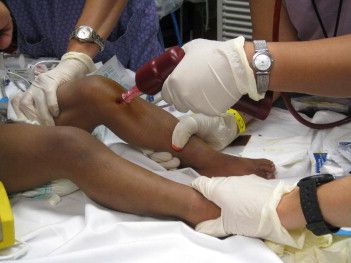
The ability to secure immediate vascular access is paramount in critical emergencies, particularly in scenarios characterized by profound hypovolemic shock, cardiac arrest, or status epilepticus where traditional peripheral intravenous (IV) access is unattainable (a “cannot cannulate, cannot ventilate” equivalent, or CICO). Intraosseous (IO) access, the injection of non-collapsible bone marrow vasculature, provides a reliable and rapid alternative that achieves systemic drug delivery comparable to central venous access.
Modern emergency medicine relies heavily on powered IO insertion systems (such as the EZ-IO, FAST1, or NIO), which utilize a motorized driver to penetrate the dense cortical bone efficiently and safely.
Rationale, Indications, and Contraindications
Indications for IO Access (Adult & Pediatric)
IO access is indicated for patients requiring immediate vascular access for fluid resuscitation, blood products, or medication administration when two or more attempts at peripheral IV access have failed, or when immediate access is required to save life or limb (e.g., cardiac arrest, critical trauma, shock) and there is no time for peripheral attempts.
Contraindications
- Fracture: IO insertion must not be attempted in an extremity with a documented or suspected fracture proximal to the insertion site, as this could lead to extravasation into the soft tissues.
- Prior Injury: Significant trauma or surgical procedure near the insertion site (e.g., orthopedic hardware, prosthetic joints).
- Infection: Cellulitis or known infection overlying the insertion site.
- Prior IO Attempts: Do not attempt insertion in the same bone where a successful or unsuccessful IO attempt has been made within the last 24–48 hours.
- Osteogenesis Imperfecta (Relative Contraindication): Due to increased risk of fracture.
Equipment Preparation
Successful IO placement requires meticulous preparation of specialized equipment. Providers must ensure that the specific needle set selected matches the patient’s age and anatomical site due to variations in cortical bone thickness.
| Equipment Item | Purpose/Specification |
|---|---|
| Powered Driver | Fully charged battery, operational status checked. |
| IO Needle Set | Appropriate length: Pink (15mm, pediatric/thin cortex), Blue (25mm, standard adult), Yellow (45mm, obese/thick cortex). |
| Antiseptic Solution | Chlorhexidine or Povidone-iodine swabs/solution. |
| Syringes | 10 mL Luer-lock syringe for aspiration and initial flush. |
| IV Fluids/Tubing | Pressure infusion bag or rapid infuser recommended for initial bolus. |
| Lidocaine 2% (Non-Preserved) | Required for pain management in conscious/semiconscious patients. |
| Needle Stabilization Device | Proprietary device to secure the IO catheter to the skin. |
| Personal Protective Equipment (PPE) | Gloves, eye protection, gown (as required). |
Anatomical Site Selection and Preparation
The most common sites for powered IO insertion are the proximal tibia and the proximal humerus. Site selection depends on patient anatomy, accessibility, and provider preference, though the humerus is increasingly preferred in adults due to higher flow rates and proximity to central circulation.
1. Proximal Tibia (Primary Site for Pediatrics and Standard Adult Site)
The proximal tibia is typically chosen due to its broad, flat surface and easily accessible landmarks.
- Landmarks: Locate the tibial tuberosity (the bump below the knee). Measure approximately two finger-widths (3 cm) below the patella, staying one finger-width medial to the tibial tuberosity.
- Insertion Point: This point is on the flat, medial aspect of the tibial surface.
- Needle Angle: Insert the needle at a 90-degree angle to the skin surface, aiming slightly away from the growth plate (if applicable).
2. Proximal Humerus (Preferred Adult Site)
The deltoid tuberosity of the humerus provides excellent access to the marrow cavity and is often utilized during cardiac arrest given the superior flow rates.
- Landmarks:
- Place the patient’s arm in adduction (at the side) with the palm resting over the abdomen (internal rotation).
- Locate the surgical neck by identifying the greater tubercle (the most lateral aspect of the shoulder).
- Palpate down the midline of the humerus. The insertion site is approximately 1 to 2 cm above the surgical neck, on the most prominent bulge of the greater tubercle.
- Alternative Method: Place a hand over the shoulder, with the elbow touching the body. The insertion point is directly under the provider’s knuckles.
- Insertion Point: Directly over the prominence of the greater tubercle.
- Needle Angle: Insert the needle at a slight posterior angle (approximately 45 to 60 degrees relative to the long axis of the humerus) toward the elbow, to ensure penetration into the marrow cavity and away from the joint capsule.
Preparation
- Aseptic Technique: Cleanse the selected site aggressively with an antiseptic solution (e.g., Chlorhexidine) using concentric circles, maintaining a sterile field. Allow the antiseptic to dry fully.
- Needle Selection: Choose the appropriate needle size (15mm, 25mm, or 45mm) based on the depth of tissue over the insertion site. The needle tip must protrude at least 5mm beyond the skin surface after the needle shoulder reaches the bone.
Step-by-Step Powered Insertion Technique
The following steps detail the actual mechanized insertion process after site selection and preparation are complete.
Step 1: Loading the Driver and Patient Positioning
Confirm the powered driver is ready and the selected needle set is securely attached. If using the proximal humerus, ensure the arm remains internally rotated and adducted to stabilize the site.
Step 2: Placement and Alignment
Place the needle tip squarely on the insertion site. Ensure the driver is held firmly, stabilized against the bone, and positioned perpendicular (90 degrees) to the skin (or the appropriate angle for humoral access). The provider’s hand should be placed along the axis of the driver, applying initial firm pressure.
Step 3: Penetration
- Initiate Power: Activate the powered driver while maintaining continuous, firm downward pressure. Do not apply excessive force, but maintain enough pressure to engage the tip into the cortex.
- Controlled Insertion: Allow the drill to advance the needle. The penetration should be rapid and controlled.
- Tactile Feedback: The provider will feel a distinct decrease in resistance—a “give” or “pop”—as the needle tip passes through the hard cortical bone and enters the softer, cancellous marrow cavity. This tactile feedback signifies successful placement.
- Stopping the Device: Immediately release the trigger/power source once the tactile feedback is felt. The needle hub should be firmly seated against the skin.
Step 4: Separating the Stylet and Catheter
- Remove the Driver: Detach the powered driver from the needle hub.
- Remove the Stylet: While stabilizing the IO catheter (the cannula), firmly pull the stylet straight out. The stylet must be disposed of immediately in a sharps container as it is highly contaminated.
Confirmation, Securing, and Flow Management
Successful placement requires strict verification and, crucially, immediate pain management if the patient has any level of consciousness.
Step 5: Verification of Placement
The IO catheter is confirmed to be in the marrow space if the following criteria are met:
- Catheter Stability: The catheter stands firmly upright without manual support.
- Aspiration Confirmation: Attempt to aspirate a small amount of dark red blood or bone marrow into a syringe. (Note: Aspiration failure does not automatically indicate poor placement, especially in dehydrated patients, but successful aspiration is definitive confirmation.)
- Fluid Infusion: Administer a rapid, small bolus (5–10 mL) of saline. There should be no extravasation, swelling, blanching, or leakage around the insertion site.
Step 6: Pain Management (Lidocaine Administration)
Infusion of fluids into the bone marrow causes significant pain due to the pressure within the non-distensible cavity. Pain management is mandatory for conscious patients.
- Lidocaine Protocol: Administer 40 mg (2 mL of 2% non-preserved Lidocaine) slowly over 60–120 seconds.
- Dwell Time: Allow the Lidocaine to sit for 60 seconds.
- Second Flush: Following the dwell time, flush the catheter rapidly with a 5–10 mL saline bolus to distribute the local analgesic.
- Maintenance: If pain persists during subsequent infusions, additional 20 mg (1 mL) boluses may be administered slowly.
Step 7: Securing the Line
Attach the provided stabilization device and dressing to the IO catheter hub to prevent dislodgement. Connect the IV extension tubing and secure the line to the limb using tape or gauze. Initiate the required fluid or medication infusion, ideally utilizing a pressure bag for rapid administration.
Complications and Post-Procedure Care
While IO access is generally safe, providers must be aware of potential complications:
- Extravasation/Compartment Syndrome: The most common complication, resulting from failed cortical penetration or slippage during infusion. This can lead to compartment syndrome if large volumes are infused into the soft tissue.
- Osteomyelitis: Risk of bone infection is low but possible, emphasizing the need for strict aseptic technique.
- Needle Bending/Breakage: Extremely rare with powered devices, but possible if excessive lateral force is applied during insertion.
Removal Protocol
The IO catheter is intended for temporary, emergency use only and should be replaced by a peripheral or central IV line as soon as possible. IO catheters should generally not remain in place for longer than 24 hours (maximum dwell time varies by device and jurisdiction, but 24 hours is the common standard). Removal must be performed using a sterile, standardized technique, typically involving attaching a Luer lock syringe to the hub and pulling the catheter straight out in line with the long axis of the bone.
Conclusion
Powered intraosseous insertion is a life-saving skill that transforms the management of critically ill or injured patients lacking immediate IV access. Mastery of anatomical landmarks, adherence to aseptic technique, and proper verification are essential to ensuring safe and effective utilization of this critical vascular route. This procedure, however, requires significant hands-on training and cannot be learned solely through didactic instruction.
References
- American Heart Association (AHA) and International Liaison Committee on Resuscitation (ILCOR) Guidelines. Consensus Statements on Vascular Access in Cardiac Arrest and Pediatric Resuscitation.
- National Association of Emergency Medical Services Physicians (NAEMSP). Position Statement: Intraosseous Vascular Access.
- Hannon, E. E., et al. Pediatric Intraosseous Cannulation: Techniques and Success Rates. Journal of Emergency Medicine, 2020.
- Vidacare/Teleflex Medical (Manufacturer Documentation). EZ-IO® Operational Training Manuals and Clinical Insertion Guidelines.
- US Department of Defense Tactical Combat Casualty Care (TCCC) Guidelines. Recommendations for Vascular Access in Prolonged Field Care.