Hemostasis, the physiological process that prevents and stops bleeding, is a critical function for maintaining vascular integrity. At its core lies coagulation, a complex and highly regulated cascade involving a series of plasma proteins known as clotting factors. This intricate system ensures prompt clot formation at sites of injury while preventing widespread, inappropriate clotting. Understanding the role of these factors and the distinct pathways initiating coagulation is fundamental to appreciating the body’s remarkable ability to self-repair and prevent exsanguination.
Enlisting the Clotting Factors: A Cast of Essential Proteins
Coagulation is driven by a carefully orchestrated sequence of reactions involving thirteen primary clotting factors, along with several cofactors and accessory proteins. Most of these factors are proenzymes (zymogens) that circulate in an inactive form and are sequentially activated into functional enzymes, typically serine proteases. Below is a comprehensive list, identified by their Roman numerals and common names, detailing their fundamental roles:
- Factor I (Fibrinogen): A soluble plasma protein that, when activated by thrombin, polymerizes to form the insoluble fibrin meshwork, the structural backbone of the blood clot.
- Factor II (Prothrombin): A vitamin K-dependent proenzyme that is converted to thrombin (Factor IIa), a central enzyme in the coagulation cascade that activates numerous other factors.
- Factor III (Tissue Factor – TF): Not a plasma protein, but a lipoprotein receptor found on the surface of subendothelial cells (e.g., fibroblasts, smooth muscle cells). It is exposed upon vascular injury and initiates the extrinsic pathway.
- Factor IV (Calcium Ions – Ca²⁺): Essential inorganic cofactors required for many enzymatic reactions within both intrinsic and extrinsic pathways, particularly for the assembly of enzyme complexes on phospholipid surfaces.
- Factor V (Proaccelerin / Labile Factor): A non-enzymatic cofactor that significantly enhances the activity of Factor Xa in converting prothrombin to thrombin. It is activated by thrombin itself, creating a positive feedback loop.
- Factor VII (Proconvertin / Stable Factor): A vitamin K-dependent proenzyme that, when activated (VIIa) by the TF-VII complex, is the primary initiator of the extrinsic pathway by activating Factor X and Factor IX.
- Factor VIII (Antihemophilic Factor): A non-enzymatic cofactor that is activated by thrombin (VIIIa) and dramatically enhances the efficiency of Factor IXa in activating Factor X within the intrinsic pathway. It circulates in a complex with von Willebrand Factor (vWF).
- Factor IX (Christmas Factor): A vitamin K-dependent proenzyme that, when activated (IXa), forms a critical complex with Factor VIIIa to activate Factor X in the intrinsic pathway.
- Factor X (Stuart-Prower Factor): A vitamin K-dependent proenzyme that represents the convergence point of the intrinsic and extrinsic pathways. When activated (Xa), it forms the prothrombinase complex, converting prothrombin to thrombin.
- Factor XI (Plasma Thromboplastin Antecedent – PTA): A proenzyme that is activated (XIa) by Factor XIIa (or thrombin) and subsequently activates Factor IX in the intrinsic pathway.
- Factor XII (Hageman Factor): A proenzyme that is activated (XIIa) upon contact with negatively charged surfaces (e.g., collagen, activated platelets) and initiates the intrinsic pathway by activating Factor XI.
- Factor XIII (Fibrin-Stabilizing Factor): A proenzyme that is activated by thrombin (XIIIa) and cross-links the fibrin monomers, stabilizing the initial soft clot into a more robust and insoluble hard clot.
- Prekallikrein (PK) & High Molecular Weight Kininogen (HMWK): Although not assigned Roman numerals, these are crucial accessory proteins in the contact activation phase of the intrinsic pathway, interacting with Factor XII.
The Role of Clotting Factors in Coagulation: A Cascade of Amplification
The coagulation process is best understood as a “cascade” or “waterfall” model, where each activated factor acts as an enzyme to activate the next factor in the sequence, leading to a dramatic amplification. This sequential activation generates a burst of thrombin, which is the central enzyme responsible for converting fibrinogen into fibrin, the structural unit of the clot.
The primary role of clotting factors is to collectively achieve the rapid and localized formation of a stable fibrin clot. This involves several key principles:
- Enzymatic Activation: Most factors are zymogens that undergo proteolytic cleavage to become active serine proteases (e.g., Factor II → Factor IIa).
- Cofactor Enhancement: Non-enzymatic cofactors (e.g., Factors V, VIII, III, HMWK) bind to the active enzymes, dramatically increasing their catalytic efficiency and speed of reaction.
- Phospholipid Surfaces: Many critical reactions occur on the negatively charged phospholipid surfaces of activated platelets. These surfaces provide a crucial platform for the assembly of enzyme-cofactor complexes (e.g., intrinsic tenase and prothrombinase complexes), localizing the clotting process to the site of injury and preventing systemic coagulation.
- Amplification: A single activated molecule early in the cascade can activate multiple molecules of the next factor, leading to an exponential increase in activated factors as the cascade progresses, culminating in a large burst of thrombin.
- Positive and Negative Feedback: Thrombin, the end-product of much of the cascade, activates several upstream factors (V, VIII, XI, XIII), creating positive feedback loops that accelerate its own production. Simultaneously, the body employs natural anticoagulants (e.g., antithrombin, protein C, protein S) to limit and eventually terminate the cascade, preventing excessive clotting.
Steps Involved in Intrinsic and Extrinsic Pathways for Coagulation
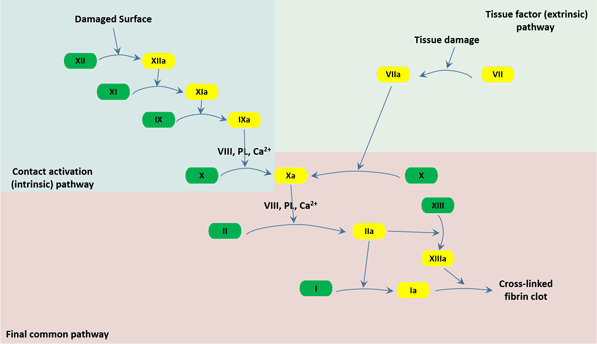
The coagulation cascade is traditionally divided into two primary initiation pathways—the extrinsic (tissue factor) pathway and the intrinsic (contact activation) pathway—which converge into a common pathway leading to fibrin formation. Although the cell-based model of coagulation offers a more contemporary view, the traditional cascade model remains invaluable for illustrating the sequential activation of factors.
The Extrinsic Pathway (Tissue Factor Pathway)
The extrinsic pathway is often considered the primary physiological initiator of coagulation, triggered by external trauma to the blood vessel wall. It is the faster of the two pathways.
- Trigger: Vascular injury leads to the exposure of Tissue Factor (Factor III), a transmembrane lipoprotein that is normally sequestered in subendothelial cells (e.g., fibroblasts, smooth muscle cells) and adventitial cells surrounding blood vessels.
- Formation of TF-VIIa Complex: Circulating Factor VII (a zymogen) binds to the exposed Tissue Factor. This binding induces a conformational change in Factor VII, facilitating its activation to Factor VIIa. This activation can be initiated by exposed TF itself, or by small amounts of Factor Xa or Thrombin (IIa) that may already be present.
- Activation of Factor X: The TF-VIIa complex directly activates Factor X to Factor Xa. This is the rate-limiting step and the primary function of the extrinsic pathway.
- Activation of Factor IX (Amplification): The TF-VIIa complex also activates Factor IX to Factor IXa. This provides a crucial link to the intrinsic pathway, amplifying thrombin generation.
The Intrinsic Pathway (Contact Activation Pathway)
The intrinsic pathway is initiated by internal damage to the blood vessel or by contact with foreign surfaces, such as medical devices. It is a slower pathway but contributes significantly to the amplification and sustained production of thrombin.
- Trigger: Exposure of negatively charged surfaces, such as subendothelial collagen (exposed upon injury) or activated platelet surfaces.
- Contact Activation: Factor XII (Hageman factor) binds to these negatively charged surfaces and undergoes a conformational change that promotes its activation to Factor XIIa. This process is greatly facilitated by Prekallikrein (PK) and High Molecular Weight Kininogen (HMWK). Factor XIIa then activates prekallikrein to kallikrein, which in turn reciprocally activates more Factor XII.
- Activation of Factor XI: Factor XIIa activates Factor XI to Factor XIa.
- Activation of Factor IX: Factor XIa activates Factor IX to Factor IXa.
- Formation of Intrinsic Tenase Complex: Factor IXa, in the presence of its cofactor Factor VIIIa (which is activated by initial thrombin generated by the extrinsic pathway or Factor Xa), calcium ions (Factor IV), and the phospholipid surface of activated platelets, forms a powerful enzyme complex called the intrinsic tenase complex.
- Activation of Factor X: The intrinsic tenase complex (IXa-VIIIa-Ca²⁺-PL) efficiently activates Factor X to Factor Xa.
The Common Pathway
Both the extrinsic and intrinsic pathways converge at the activation of Factor X, leading into the common pathway, which culminates in the formation of a stable fibrin clot.
- Formation of Prothrombinase Complex: Factor Xa (generated by either the extrinsic or intrinsic pathway), in the presence of its cofactor Factor Va (activated by Factor Xa or thrombin), calcium ions (Factor IV), and the phospholipid surface of activated platelets, forms the prothrombinase complex.
- Conversion of Prothrombin to Thrombin: The prothrombinase complex (Xa-Va-Ca²⁺-PL) is a highly efficient enzyme that rapidly converts Prothrombin (Factor II) to Thrombin (Factor IIa). This is a critical amplification step.
- Conversion of Fibrinogen to Fibrin: Thrombin (Factor IIa), the central enzyme, cleaves specific peptides from Fibrinogen (Factor I), converting it into fibrin monomers. These monomers spontaneously self-assemble to form an unstable, soluble fibrin polymer (the “soft clot”).
- Activation of Factor XIII: Thrombin (Factor IIa) also activates Factor XIII to Factor XIIIa.
- Fibrin Polymer Stabilization: Factor XIIIa, in the presence of calcium, catalyzes the formation of covalent cross-links between the fibrin monomers, strengthening the fibrin meshwork and transforming the soft clot into a robust, insoluble, and mechanically stable hard clot. This final step significantly enhances the clot’s resistance to mechanical stress and enzymatic degradation.
Conclusion
The coagulation cascade is a testament to the sophistication of physiological regulation. The intricate interplay of clotting factors, their precise sequential activation, and the crucial role of cofactors and phospholipid surfaces ensure rapid, localized, and effective hemostasis. While the extrinsic pathway provides the initial spark, the intrinsic pathway amplifies the response, leading to a sustained and robust generation of thrombin. This culminates in the formation of a stable, cross-linked fibrin clot, essential for preventing blood loss. Disruptions in any part of this delicate balance, whether due to genetic deficiencies (e.g., hemophilia, factor V Leiden) or acquired conditions, can lead to severe bleeding disorders or thrombotic tendencies, highlighting the vital importance of this biological system.
References
- Hoffman, M., & Monroe, D. M. (2001). A cell-based model of hemostasis. Thrombosis and Haemostasis, 85(5), 958–965.
- Colman, R. W., Clowes, A. W., George, J. N., & Marder, V. J. (Eds.). (2018). Hemostasis and Thrombosis: Basic Principles and Clinical Practice (7th ed.). Wolters Kluwer.
- Kumar, V., Abbas, A. K., & Aster, J. C. (2021). Robbins Basic Pathology (11th ed.). Elsevier.
- Palta, S., Sunder, S., & Sehgal, S. (2014). An overview of coagulation disorders. Indian Journal of Anesthesia, 58(5), 515–523.
- Luo, S. T., & Chen, K. (2020). The coagulation cascade: Physiology and pharmacology. Journal of Pharmacopuncture, 23(4), 183–193.