The Electron Transport Chain (ETC), also known as the respiratory chain, stands as the terminal and most prolific stage of aerobic cellular respiration, responsible for generating the vast majority of adenosine triphosphate (ATP) – the primary energy currency of the cell. Far from a simple series of reactions, the ETC is a meticulously organized system of protein complexes and mobile electron carriers embedded within the inner mitochondrial membrane, designed to harness the energy released from the stepwise transfer of electrons to drive the synthesis of ATP. Understanding its intricate organization is crucial to appreciating its efficiency and indispensability for life.
The Mitochondrial Setting: A Foundation for Energy Production
The ETC’s function is inextricably linked to its cellular localization within the mitochondria, often dubbed the “powerhouses” of the cell. Specifically, the entire machinery of the ETC is judiciously positioned within the inner mitochondrial membrane. This membrane is characterized by its high degree of folding into cristae, significantly increasing its surface area to accommodate numerous ETC components. This specialized membrane is largely impermeable to ions, including protons, a critical feature for establishing the electrochemical gradient essential for ATP synthesis. The inner mitochondrial membrane thus divides the mitochondrion into two distinct compartments: the matrix, the innermost fluid-filled space where the Krebs cycle occurs, and the intermembrane space, the region between the inner and outer mitochondrial membranes. This spatial separation is fundamental to the ETC’s mechanism.
The Principal Players: An Ensemble of Protein Complexes and Mobile Carriers
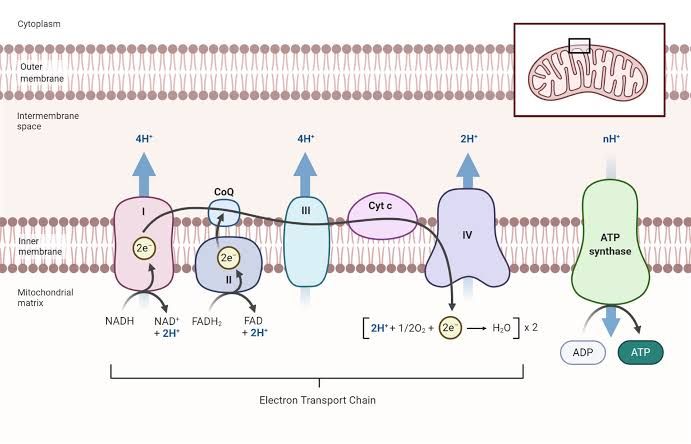
The electron transport chain is comprised of five distinct multiprotein complexes, labeled I through V, along with two mobile electron carriers. Each component is precisely arranged to facilitate a unidirectional flow of electrons and a vectorial pumping of protons.
- Complex I (NADH Dehydrogenase): The largest of the complexes, responsible for accepting electrons from NADH.
- Complex II (Succinate Dehydrogenase): Unique in its dual role, also forming part of the Krebs cycle, accepting electrons from FADH2.
- Ubiquinone (Coenzyme Q or CoQ): A small, lipid-soluble mobile carrier that ferries electrons between Complexes I/II and Complex III.
- Complex III (Cytochrome bc1 Complex): Accepts electrons from ubiquinone and transfers them to cytochrome c.
- Cytochrome c: A small, water-soluble protein that acts as a mobile carrier, transferring electrons between Complex III and Complex IV.
- Complex IV (Cytochrome c Oxidase): The terminal complex, accepting electrons from cytochrome c and transferring them to molecular oxygen.
- Complex V (ATP Synthase): While not directly involved in electron transport, it is the crucial enzyme that utilizes the proton gradient established by Complexes I, III, and IV to synthesize ATP.
Electron Flow and Proton Pumping: The Engine of Life
The organization of the ETC is best understood by tracing the path of electrons and the concomitant pumping of protons.
1. Electron Entry Points – Complexes I and II
The journey of electrons into the ETC begins primarily from two key donor molecules generated during glycolysis and the Krebs cycle: NADH and FADH2.
- Complex I (NADH Dehydrogenase):
- Organization: This L-shaped enzyme is composed of over 40 polypeptide subunits, featuring a flavin mononucleotide (FMN) prosthetic group and multiple iron-sulfur (Fe-S) clusters. One arm of the ‘L’ extends into the mitochondrial matrix, while the other is embedded within the inner membrane.
- Mechanism: NADH, produced in the matrix, delivers two electrons to Complex I. These electrons are first transferred to FMN, reducing it to FMNH2. From FMNH2, the electrons pass through a series of Fe-S clusters within the complex, moving deeper into the membrane. This sequential transfer of electrons releases energy, which Complex I utilizes to pump four protons (H+) from the mitochondrial matrix into the intermembrane space. The electrons are then transferred to ubiquinone (CoQ), reducing it to ubiquinol (CoQH2).
- Complex II (Succinate Dehydrogenase):
- Organization: This smaller complex consists of four subunits and is unique because it is the only enzyme of the Krebs cycle that is also directly part of the ETC. It contains a covalently bound flavin adenine dinucleotide (FAD) prosthetic group and several Fe-S clusters. It is entirely embedded within the inner mitochondrial membrane, without directly protruding into the intermembrane space.
- Mechanism: FADH2, generated during the conversion of succinate to fumarate in the Krebs cycle, remains bound to Complex II. It delivers two electrons to the FAD group, reducing it to FADH2. These electrons are then passed through a series of Fe-S clusters within Complex II. Unlike Complex I, III, and IV, Complex II does not pump protons across the inner membrane. The electrons are subsequently transferred to ubiquinone (CoQ), similar to Complex I, once again reducing it to ubiquinol (CoQH2).
2. The Mobile Link – Ubiquinone (CoQ)
- Organization: Ubiquinone is a small, hydrophobic molecule that resides freely within the lipid bilayer of the inner mitochondrial membrane. Its lipid solubility allows it to diffuse rapidly within the membrane, acting as a crucial mobile shuttle for electrons.
- Mechanism: CoQ collects electrons from both Complex I (from NADH) and Complex II (from FADH2) in the form of CoQH2. It then physically diffuses through the membrane to deliver these electrons to Complex III. This dual input mechanism highlights CoQ’s central role in integrating electron flow from different metabolic pathways.
3. The Q-cycle and Proton Pumping – Complex III (Cytochrome bc1 Complex)
- Organization: Complex III is a large dimer, with each monomer containing cytochromes b, cytochrome c1, and a Rieske iron-sulfur protein. It spans the inner mitochondrial membrane.
- Mechanism: CoQH2 delivers its two electrons to Complex III. This transfer is more complex and involves a process known as the Q-cycle. In essence, CoQH2 gives one electron to the Rieske Fe-S protein and the other to cytochrome b. The electron from the Rieske protein then moves to cytochrome c1 and finally to cytochrome c. The electron from cytochrome b passes through two heme groups within cytochrome b. This intricate electron movement through the Q-cycle results in the pumping of four protons across the inner membrane into the intermembrane space for every two electrons delivered by CoQH2. The Q-cycle also regenerates one molecule of CoQ, which can then return to accept more electrons from Complexes I or II.
4. Another Mobile Carrier – Cytochrome c
- Organization: Cytochrome c is a small, highly conserved protein that is peripherally associated with the outer surface of the inner mitochondrial membrane (facing the intermembrane space). Unlike CoQ, it is water-soluble.
- Mechanism: Cytochrome c accepts a single electron from Complex III. It then diffuses along the surface of the inner membrane to deliver its electron to Complex IV. Being a one-electron carrier, two molecules of cytochrome c are required to transfer the two electrons delivered by CoQH2 from Complex III to Complex IV.
5. Oxygen as the Final Acceptor – Complex IV (Cytochrome c Oxidase)
- Organization: Complex IV is a large transmembrane protein complex containing multiple polypeptide subunits, including two heme centers (heme a and heme a3) and two copper centers (CuA and CuB). It spans the inner mitochondrial membrane.
- Mechanism: Cytochrome c delivers its electrons, one at a time, to Complex IV. The electrons pass through the copper centers (CuA) and heme a, then to heme a3 and CuB. This is where the crucial final step of electron transport occurs: molecular oxygen (O2) acts as the final electron acceptor. Complex IV binds an O2 molecule and, utilizing four electrons (delivered sequentially from four molecules of cytochrome c) and four protons from the mitochondrial matrix, reduces O2 to two molecules of water (H2O). This reduction of oxygen is highly exergonic. Concomitantly, Complex IV pumps two protons from the matrix into the intermembrane space for every two electrons it processes (which ultimately reduces half an O2 molecule to one H2O molecule).
The Proton Motive Force: Connecting Electron Transport to ATP Synthesis
The sequential transfer of electrons through Complexes I, III, and IV is coupled to the active pumping of protons (H+) from the mitochondrial matrix to the intermembrane space. This creates an electrochemical gradient across the inner mitochondrial membrane, known as the proton motive force (PMF). The PMF has two components:
- Chemical Potential Energy (ΔpH): The difference in pH across the membrane, with the intermembrane space becoming more acidic (higher H+ concentration) than the matrix.
- Electrical Potential Energy (ΔΨ): The difference in electrical charge across the membrane, with the intermembrane space becoming more positively charged relative to the matrix.
This potent gradient represents a significant store of potential energy, much like water held behind a dam. The inner mitochondrial membrane’s impermeability to protons is crucial for maintaining this gradient.
ATP Synthesis: The Role of Complex V (ATP Synthase)
The potential energy stored in the proton motive force is then harnessed by Complex V, also known as ATP synthase, to synthesize ATP through a process called chemiosmosis.
- Organization: ATP synthase is a remarkable molecular machine composed of two main functional units:
- F0 unit: Embedded within the inner mitochondrial membrane, forming a proton channel. It consists of multiple subunits, including a c-ring that rotates as protons pass through.
- F1 unit: Protrudes into the mitochondrial matrix and contains the catalytic sites for ATP synthesis. It consists of five types of polypeptide chains (α3β3γδε), with the α and β subunits forming the catalytic core.
- Mechanism: Protons, driven by the PMF, flow back down their electrochemical gradient from the intermembrane space to the mitochondrial matrix, passing through the F0 unit’s proton channel. This flow of protons causes the c-ring of the F0 unit to rotate. The rotation of the c-ring, in turn, drives the rotation of a central stalk (γ and ε subunits) within the F1 unit. The rotating stalk induces conformational changes in the β subunits of the F1 unit, which operate through a mechanism called the binding-change mechanism. These conformational changes sequentially lead to:
- Binding of ADP and Pi (inorganic phosphate).
- Catalysis of ATP formation.
- Release of newly synthesized ATP. The continuous flow of protons thus fuels the continuous production of ATP. It is estimated that approximately 3-4 protons are required to pass through ATP synthase for the synthesis of one ATP molecule.
Conclusion
The organization of the Electron Transport Chain is a marvel of biological engineering. From the precise positioning of multiprotein complexes within the inner mitochondrial membrane to the strategic roles of mobile electron carriers, every component is integrated into a highly efficient system. The stepwise transfer of electrons, primarily from NADH and FADH2, through Complexes I, III, and IV, is meticulously coupled to the vectorial pumping of protons, establishing a potent proton motive force. This electrochemical gradient, maintained by the specialized inner mitochondrial membrane, then drives the rotational catalysis of ATP synthase (Complex V), converting the potential energy of the proton gradient into the chemical energy stored in ATP. This intricate, highly ordered, and spatially optimized arrangement ensures the efficient capture of energy from glucose oxidation, making the ETC the cornerstone of aerobic energy metabolism and vital for sustaining life.
References
- Berg, J. M., Tymoczko, J. L., Gatto Jr, G. J., & Stryer, L. (2015). Biochemistry (8th ed.). W. H. Freeman and Company.
- Lodish, H., Berk, A., Kaiser, C. A., Krieger, M., Bretscher, A., Ploegh, H., Amon, A., & Scott, M. P. (2016). Molecular Cell Biology (8th ed.). W. H. Freeman and Company.
- Nelson, D. L., Cox, M. M., & Lehninger, A. L. (2017). Lehninger Principles of Biochemistry (7th ed.). W. H. Freeman and Company.
- Voet, D., Voet, J. G., & Pratt, C. W. (2016). Fundamentals of Biochemistry: Life at the Molecular Level (5th ed.). John Wiley & Sons.