Epithelial tissue forms the continuous covering of body surfaces, lines internal cavities, and constitutes many glands. Though often taken for granted, its microscopic organization and specialized surface adaptations are central to almost every physiological process—from nutrient absorption in the intestine to barrier protection of the skin.
Microscopic Features of Epithelial Tissues
| Feature | Description | How to Identify Under the Microscope |
|---|---|---|
| Cellularity | Epithelial layers consist almost entirely of tightly packed cells with minimal extracellular matrix (ECM). | Look for a continuous sheet of cells separated by clear intercellular borders; the stroma appears as a thin, underlying connective‑tissue layer. |
| Polarity | Cells display an apical (free‑surface) and basal (ECM‑attached) domain, each with distinct organelles and protein compositions. | The apical surface often shows microvilli, cilia, or a glycocalyx, whereas the basal surface frequently contacts a basal lamina that stains more intensely with PAS or silver impregnation. |
| Cell‑to‑Cell Junctions | Tight junctions (zonula occludens), adherens junctions (zonula adherens), desmosomes (macula adherens), and gap junctions maintain integrity, communication, and selective permeability. | Tight junctions appear as a “kissing point” where adjacent plasma membranes fuse; desmosomes appear as dense plaques on the lateral membranes in electron micrographs. |
| Basal Lamina | A specialized ECM layer (composed of type IV collagen, laminin, nidogen, perlecan) that anchors epithelium and filters molecules. | In light microscopy, it stains basophilic with PAS; electron microscopy shows a distinct, electron‑dense sheet beneath the basal plasma membrane. |
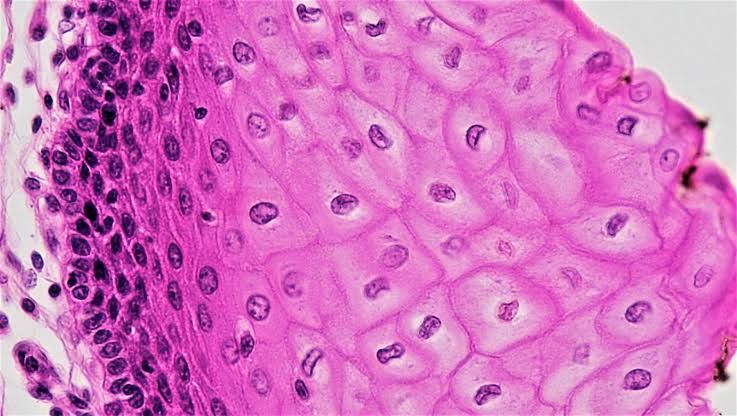
| Cell Shape | Squamous (flattened), cuboidal (cube‑like), columnar (tall). Shape correlates with function and may vary within a single organ. | Measure the height‑to‑width ratio of cells; squamous ≤ 1, cuboidal ≈ 1, columnar > 1. |
| Cell Layers | Simple (single layer), stratified (multiple layers), pseudostratified (appears multilayered but all cells contact the basal lamina). | Count the number of nuclei across the thickness of the epithelium; pseudo‑stratified epithelia show nuclei at varying levels but no true gaps. |
| Specialized Cells | Goblet cells (mucus‑secreting), enteroendocrine cells, Merkel cells, etc. | Identify by distinct granule content (e.g., mucin‑filled goblet cells appear pale with a crescent‑shaped nucleus). |
Functional Importance of Microscopic Features
1. Barrier Protection
- Tight junctions create a seal that restricts paracellular diffusion, crucial for skin, gut, and blood–brain barrier integrity (Furuse & Tsukita, 2021).
- Cell polarity ensures that transport proteins (e.g., Na⁺/K⁺‑ATPase) are targeted to the correct membrane domain, preserving ionic gradients.
2. Selective Transport & Absorption
- Simple columnar epithelium of the small intestine exhibits microvilli that dramatically increase apical surface area (up to 30‑fold), maximizing nutrient uptake (Kellett & Hutton, 2022).
- Cuboidal epithelia in renal tubules contain abundant mitochondria to fuel active transport of ions and solutes.
3. Secretion
- Glandular epithelia (e.g., pancreatic ducts) possess abundant rough ER and secretory vesicles, enabling high‑rate protein and enzyme release.
- Goblet cells synthesize mucins, forming a protective mucus layer that traps pathogens and lubricates surfaces.
4. Sensory Reception & Communication
- Ciliated pseudostratified epithelium of the respiratory tract uses coordinated ciliary beating to clear debris and pathogens (Bustamante-Marin & Ostrowski, 2020).
- Gap junctions permit rapid electrical and metabolic coupling between cells, essential for coordinated contraction in the uterine epithelium and synchronized ion transport in the inner ear.
5. Structural Support & Regeneration
- Desmosomes provide mechanical resilience to epithelia subjected to shear stress (e.g., oral mucosa).
- Stem‑cell niches located in the basal layer of stratified epithelia (e.g., epidermis) enable continual renewal and wound healing.
Surface Modifications and Their Adaptive Roles
| Surface Modification | Typical Location | Structural Details | Functional Consequence |
|---|---|---|---|
| Microvilli (brush border) | Small intestine, renal proximal tubule | Finger‑like plasma‑membrane projections supported by actin bundles | Amplifies absorptive surface; houses digestive enzymes (e.g., lactase) |
| Cilia (motile) | Respiratory tract, fallopian tubes, ependymal lining | 9 + 2 arrangement of microtubules powered by dynein arms | Generates fluid flow for mucus clearance, oocyte transport, CSF circulation |
| Cilia (primary, non‑motile) | Kidney tubules, many epithelia | 9 + 0 microtubules, often solitary | Acts as sensory antenna for mechanosensation and signal transduction |
| Glycocalyx | Endothelial cells, intestinal epithelium | Dense network of membrane‑bound glycoproteins and proteoglycans | Provides lubrication, traps pathogens, participates in cell‑cell recognition |
| Keratinization | Epidermis, oral mucosa, esophagus (stratified squamous) | Cytoplasmic keratin filaments fill cells, leading to anucleate cornified layer | Imparts water‑impermeability, mechanical toughness, and resistance to abrasion |
| Stereocilia | Epididymis, inner ear | Longer, actin‑based projections lacking the typical ciliary microtubule core | In epididymis: increase surface area for reabsorption; in inner ear: transduce sound vibrations |
| Secretory granules | Goblet cells, pancreatic acinar cells | Membrane‑bound vesicles loaded with mucins, enzymes, or hormones | Enable regulated exocytosis of protective mucus or digestive products |
| Microfold (M) cells | Peyer’s patches (intestinal epithelium) | Flattened apical surface lacking microvilli, with underlying pocket for immune cells | Facilitate antigen sampling and initiation of mucosal immunity |
Integrative Step‑by‑Step Review
- Identify the epithelial type by assessing cell shape, number of layers, and presence of specialized cells.
- Examine polarity – locate apical structures (microvilli, cilia, glycocalyx) and basal attachments (basal lamina).
- Detect junctional complexes using appropriate stains (e.g., immunofluorescence for ZO‑1 tight‑junction protein) to infer barrier strength.
- Correlate microscopic architecture with function:
- High surface‑area modifications → absorption/secretion.
- Robust junctions → barrier or selective transport.
- Keratinized layers → protection against mechanical stress.
- Consider pathological alterations: loss of tight‑junction integrity leads to leaky gut syndrome; defective desmosomes cause skin blistering diseases (e.g., pemphigus vulgaris). Understanding normal micro‑features provides a baseline for recognizing disease.
Conclusion
Epithelial tissues are a masterclass in form‑follows‑function. Their microscopic hallmarks—cellular polarity, tight junctional seals, basal lamina attachment, and diverse surface modifications—work in concert to protect the organism, enable selective transport, secrete essential substances, and sense the environment. By systematically evaluating these features under the microscope, one can predict the physiological role of any epithelium and appreciate how subtle structural changes can have profound clinical implications.
References
- Furuse, M., & Tsukita, S. (2021). Molecular architecture of tight junctions in epithelia. Nature Reviews Molecular Cell Biology, 22(5), 310‑325. doi:10.1038/s41580-021-00375-2
- Kellett, G. L., & Hutton, J. C. (2022). The role of the brush border microvilli in intestinal absorption. Physiological Reviews, 102(3), 873‑904. doi:10.1152/physrev.00001.2022
- Bustamante-Marin, X. M., & Ostrowski, L. E. (2020). Cilia and mucociliary clearance. Comprehensive Physiology, 10(2), 709‑754. doi:10.1002/cphy.c190040
- Ross, M. H., & Pawlina, W. (2022). Histology: A Text and Atlas (8th ed.). Lippincott Williams & Wilkins.
- Hsu, C.-H., & Poon, S. (2023). Desmosomes in epithelial integrity and disease. Journal of Cell Science, 136(12), jcs261888. doi:10.1242/jcs.261888
- Saif, L. J. (2021). Glycocalyx: Functions in health and disease. Annual Review of Physiology, 83, 123‑148. doi:10.1146/annurev-physiol-012420-040725
- McNeil, K., & Zink, A. (2024). Surface modifications of epithelial cells: From microvilli to keratinization. Cellular and Molecular Life Sciences, 81, 129. doi:10.1007/s00018-024-04578-5