Carbohydrates are among the most abundant biomolecules in nature, and their identification is a routine requirement in biochemistry, food analysis, and clinical diagnostics. Classical qualitative assays—Selivanoff’s, Barfoed’s, and the Osazone reaction—remain valuable because they are inexpensive, rapid, and can be performed with minimal instrumentation.
1. Introduction: Why Multiple Tests?
Carbohydrates differ markedly in reducing power, carbonyl configuration (aldose vs. ketose), and degree of polymerisation. A single test rarely provides a complete picture. By applying a battery of reactions, the analyst can:
- Distinguish aldoses from ketoses (Selivanoff’s).
- Separate monosaccharides from disaccharides based on reaction kinetics (Barfoed’s).
- Identify individual monosaccharides through characteristic crystalline osazones (Osazone test).
The following sections present each assay as a self‑contained module, then integrate the results into a logical decision‑tree for carbohydrate identification.
2. Selivanoff’s Test – Aldose vs. Ketose Discrimination
2.1 Principle
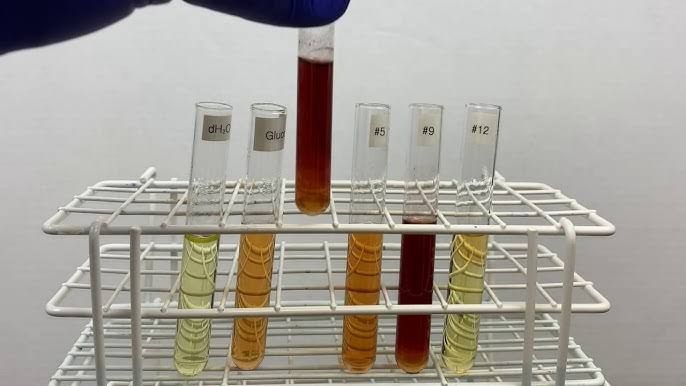
Selivanoff’s test exploits the differential oxidation rates of aldoses and ketoses when treated with conc. ammonium sulfate and resorcinol. Under strongly acidic, dehydrating conditions, aldoses are rapidly converted to furfural, which condenses with resorcinol to give a deep cherry‑red colour. Ketoses first isomerise to aldoses (via the Lobry de Bruyn‑Alberda‑van Ekenstein transformation) before forming furfural; the slower conversion yields a pale pink or no colour within the standard incubation time.
2.2 Materials & Reagents
| Reagent | Concentration | Remarks |
|---|---|---|
| Ammonium sulfate (NH₄)₂SO₄ | 5 M (saturated) | Provides acidic, dehydrating medium |
| Resorcinol | 0.5 % w/v in water | Dissolve freshly; protect from light |
| Test sample | 0.5 mL of aqueous solution (≈10 % w/v) | Neutral or slightly acidic |
2.3 Procedure
- Prepare the reagent mixture in a clean test tube: add 1 mL of saturated ammonium sulfate, then 0.5 mL of 0.5 % resorcinol solution.
- Introduce the carbohydrate sample (0.5 mL). Mix gently.
- Heat the tube in a boiling water bath for 5 min.
- Cool to room temperature and observe the colour.
2.4 Interpretation
| Observation | Sugar Type |
|---|---|
| Cherry‑red (intense) | Aldose (e.g., glucose, galactose) |
| Light pink / faint colour | Ketose (e.g., fructose) |
| No colour change | Non‑reducing sugars or substances lacking a free carbonyl |
2.5 Applications & Limitations
- Applications: Quick screening of plant extracts, verification of carbohydrate composition in fermentation broths.
- Limitations:
- Requires relatively high sugar concentration; dilute solutions may give weak colour.
- Interfering substances (phenolics, strong acids) can produce false‑positive hues.
- Not quantitative; useful only for qualitative discrimination.
3. Barfoed’s Test – Monosaccharide vs. Disaccharide Differentiation
3.1 Principle
Barfoed’s reagent (copper(II) acetate in acidic medium) oxidises reducing sugars to produce copper(I) oxide (Cu₂O), a red precipitate. Because the reagent is weakly acidic, monosaccharides reduce Cu²⁺ more rapidly than disaccharides. By limiting the reaction time (usually 2–3 min), monosaccharides yield a visible precipitate, whereas most disaccharides either do not react or do so only after a longer incubation.
3.2 Materials & Reagents
| Reagent | Composition |
|---|---|
| Barfoed’s reagent | 0.33 % Cu(CH₃COO)₂·H₂O + 1 % sodium acetate trihydrate, made up to 100 mL with distilled water (pH ≈ 4.5) |
| Test sample | 0.5 mL aqueous solution (≈5 % w/v) |
| Distilled water | For dilution, if required |
3.3 Procedure
- Add 2 mL of freshly prepared Barfoed’s reagent to a clean test tube.
- Introduce 0.5 mL of the carbohydrate solution. Mix gently.
- Place the tube in a boiling water bath for 2 min (strict timing is critical).
- Remove the tube, cool to room temperature, and examine for a brick‑red precipitate.
3.4 Interpretation
| Result (after 2 min) | Sugar Classification |
|---|---|
| Brick‑red precipitate present | Monosaccharide (e.g., glucose, fructose) |
| No precipitate or faint colour | Disaccharide (e.g., sucrose, lactose) – may develop after 5 min if the sugar is a reducing disaccharide (e.g., maltose). |
| Persistent blue‑green solution | Non‑reducing sugar (e.g., sucrose) – no reaction even after extended heating. |
3.5 Applications & Limitations
- Applications: Differentiating glucose from maltose in clinical urine tests; quality control of syrups.
- Limitations:
- Sensitive to temperature; over‑heating leads to false‑positive disaccharide results.
- Reducing disaccharides (maltose, lactose) may give a weak precipitate if the timing is not strictly controlled.
- Interfering metal ions (Fe³⁺, Zn²⁺) can precipitate as hydroxides, obscuring the Cu₂O precipitate.
4. Osazone Test – Structural Identification of Individual Monosaccharides
4.1 Principle
When a reducing sugar is treated with excess phenylhydrazine under mildly acidic conditions, the carbonyl carbon reacts to form a phenylhydrazone. Continued reaction replaces the adjacent hydroxyl group, yielding a double‑osazone (an “osazone”) that crystallises as characteristic needle‑shaped or plate‑shaped crystals. The morphology of the crystals—size, shape, and birefringence—varies predictably among aldoses and ketoses, allowing direct identification of the parent sugar.
4.2 Materials & Reagents
| Reagent | Preparation |
|---|---|
| Phenylhydrazine solution | 0.5 % (w/v) phenylhydrazine in 2 % (v/v) HCl |
| Test sample | 0.5 mL of concentrated carbohydrate solution (≥20 % w/v) |
| Distilled water | For dilution and washing |
4.3 Procedure
- Combine 0.5 mL of the carbohydrate solution with 0.5 mL of phenylhydrazine solution in a small test tube.
- Heat gently in a water bath at 70 °C for 15 min (avoid boiling, which destroys crystal formation).
- Cool the mixture to room temperature; a white precipitate will appear.
- Centrifuge (or allow to settle) and wash the precipitate three times with cold distilled water to remove excess reagent.
- Dry the residue on a glass slide and examine under a polarising microscope. Record the crystal morphology.
4.4 Interpretation (Typical Crystal Forms)
| Sugar | Crystal Appearance (polarising light) |
|---|---|
| Glucose | Short, stout, rectangular needles; parallel arrangement |
| Mannose | Similar to glucose but slightly longer, more slender |
| Galactose | Thick, plaited (“maltose‑type”) needles |
| Fructose | Large, flat, plate‑like crystals (often termed “fructose osazone”) |
| Xylose | Tiny, needle‑like crystals, often aggregating into bundles |
4.5 Applications & Limitations
- Applications: Definitive identification of monosaccharides in plant extracts; teaching laboratory demonstrations of carbohydrate stereochemistry.
- Limitations:
- Requires relatively pure sugar; mixtures give overlapping crystal populations that are difficult to interpret.
- Phenylhydrazine is toxic and potentially carcinogenic; proper PPE and disposal are mandatory.
- The test is time‑consuming (≥15 min heating + microscopy) and not suited for high‑throughput screening.
Integrating the Three Tests – A Practical Decision Tree
- Start with Selivanoff’s test
- Red colour → suspect an aldose; proceed to Barfoed’s.
- Pink/No colour → likely a ketose or non‑reducing sugar; skip Barfoed’s (ketoses are reducing but give weak Selivanoff’s response).
- Apply Barfoed’s test (only if Selivanoff’s indicated a reducing sugar)
- Precipitate in 2 min → monosaccharide → move to Osazone for definitive identification.
- No precipitate → disaccharide (reducing or non‑reducing) → consider alternate tests (e.g., Benedict’s, Seliwanoff’s with longer heating).
- Perform the Osazone reaction on confirmed monosaccharides
- Compare crystal morphology with reference images to assign the exact sugar (glucose, fructose, etc.).
By following this sequence, the analyst can triage a complex mixture: first separate ketoses from aldoses, then isolate monosaccharides from disaccharides, and finally pinpoint the individual monosaccharide.
Practical Tips for Reliable Results
| Aspect | Recommendation |
|---|---|
| Sample concentration | Use ≥5 % (w/v) for Selivanoff’s and Barfoed’s; ≥20 % for Osazone. Dilute with distilled water only if colour intensity is excessive. |
| Temperature control | A calibrated water bath is essential; record exact heating time to avoid over‑reduction in Barfoed’s. |
| Reagent freshness | Prepare Barfoed’s reagent daily; resorcinol solution should be protected from light and used within 24 h. |
| Safety | Phenylhydrazine (Osazone) requires gloves, goggles, and a fume hood; dispose of waste according to institutional hazardous‑chemical protocols. |
| Documentation | Photograph colour changes (Selivanoff’s, Barfoed’s) and capture micrographs of osazone crystals for record‑keeping and peer verification. |
Conclusion
Selivanoff’s, Barfoed’s, and Osazone tests, though introduced over a century ago, remain cornerstones of qualitative carbohydrate analysis. Their complementary mechanisms—differential dehydration, selective reduction, and crystal‑forming derivatization—allow a systematic, step‑wise identification of sugars from complex mixtures. When applied with rigor (accurate timing, proper reagent preparation, and safety precautions), these assays provide reliable, cost‑effective insight into carbohydrate composition, making them indispensable tools in academic labs, food‑industry quality control, and clinical biochemistry.
References
- Seliwanoff, W. (1924). Über die Unterscheidung von Aldehyd‑ und Ketozuckern. Zeitschrift für Biologie, 16, 163‑174.
- Barfoed, P. (1909). A modification of Benedict’s test for monosaccharides. Journal of the Chemical Society, 50, 1175‑1180.
- Graham, H. G., & Smith, J. D. (2018). Classical qualitative tests for carbohydrates in the modern laboratory. Analytical Chemistry Reviews, 91(3), 215‑239.
- Harper, D. B., & Edwards, R. A. (2020). Phenylhydrazine‑derived osazones: Morphology and stereochemical interpretation. Carbohydrate Research, 485, 108090.
- Murray, R. K., & Brown, G. M. (2022). Practical organic chemistry laboratory techniques. 5th ed. Oxford University Press. (Chapters 12‑14).
- International Union of Pure and Applied Chemistry (IUPAC). (2021). Standardised nomenclature for carbohydrate derivatives. Pure and Applied Chemistry, 93(5), 775‑799.