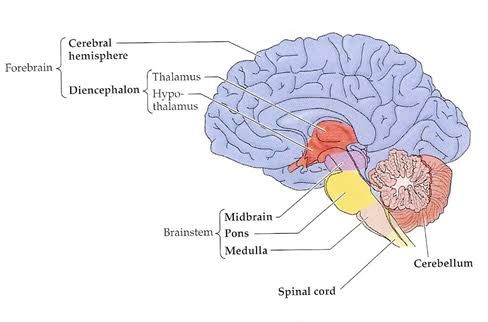
The midbrain, also known as the mesencephalon, is a vital component of the central nervous system, serving as a crucial bridge between the forebrain and the hindbrain. It plays a pivotal role in a multitude of functions, including motor control, sensory processing (especially visual and auditory reflexes), sleep-wake cycles, and the modulation of pain.
Detailed Anatomy of the Midbrain
The midbrain is the smallest and most rostral segment of the brainstem, situated dorsal to the pons and ventral to the diencephalon. It is approximately 2 cm in length and traverses the tentorial incisure, connecting the third ventricle (via the cerebral aqueduct) with the fourth ventricle.
Functionally and anatomically, the midbrain can be broadly divided into three main regions from dorsal to ventral:
- Tectum (Roof): This is the dorsal-most part of the midbrain, posterior to the cerebral aqueduct. It comprises four rounded eminences collectively known as the corpora quadrigemina:
- Superior Colliculi (plural): Two rostral eminences involved in visual reflexes, orientation of the head and eyes towards visual stimuli, and control of saccadic eye movements. They receive input from the retina, visual cortex, and spinal cord.
- Inferior Colliculi (plural): Two caudal eminences that are integral components of the auditory pathway. They receive input from the lateral lemniscus and project to the medial geniculate body of the thalamus, playing a role in sound localization and auditory reflexes.
- Tegmentum (Floor): Situated ventral to the cerebral aqueduct and dorsal to the substantia nigra. The tegmentum is a complex region containing numerous nuclei, ascending and descending fiber tracts, and the reticular formation. Key structures within the tegmentum include:
- Periaqueductal Gray (PAG): A gray matter region surrounding the cerebral aqueduct, heavily involved in pain modulation, fight-or-flight responses, and autonomic functions.
- Oculomotor Nuclear Complex: Comprising the main oculomotor nucleus (supplies extraocular muscles like superior, inferior, medial recti, inferior oblique, and levator palpebrae superioris) and the Edinger-Westphal nucleus (parasympathetic innervation to constrictor pupillae and ciliary muscles).
- Trochlear Nucleus: Situated more caudally than the oculomotor nucleus, it controls the superior oblique muscle. It is unique as its nerve (CN IV) exits dorsally and decussates before innervation.
- Red Nucleus: A prominent, reddish-pigmented nucleus (due to iron content) located in the rostral tegmentum. It is a major component of the extrapyramidal system, involved in motor coordination, particularly of the upper limbs, receiving input from the cerebellum and motor cortex, and giving rise to the rubrospinal tract.
- Mesencephalic Trigeminal Nucleus: Extends from the pons into the midbrain, containing primary sensory neurons for proprioception from the muscles of mastication, face, and teeth.
- Medial Longitudinal Fasciculus (MLF): A highly myelinated tract connecting the oculomotor, trochlear, abducens, and vestibular nuclei, crucial for coordinating conjugate eye movements and head movements.
- Other Ascending Tracts: Medial Lemniscus (transmits fine touch, vibration, proprioception), Spinothalamic Tracts (pain and temperature), Trigeminal Lemniscus (facial sensation).
- Reticular Formation: A diffuse network of neurons involved in arousal, sleep-wake cycles, and various vital functions.
- Crus Cerebri (Cerebral Peduncles): These are two large, ventral fiber bundles separated by the interpeduncular fossa. They contain major descending motor pathways:
- Corticospinal Tracts: Originate from the motor cortex, mediating voluntary control of contralateral skeletal muscles.
- Corticobulbar Tracts: Project to cranial nerve nuclei in the brainstem, controlling voluntary movements of head and neck muscles.
- Corticopontine Tracts: Convey motor information from the cortex to the pontine nuclei, which then project to the cerebellum, involved in motor planning and coordination.
- Substantia Nigra: A large, pigmented nucleus situated between the tegmentum and the crus cerebri. It has two parts:
- Pars Compacta: Contains dopaminergic neurons that project to the striatum (nigrostriatal pathway), crucial for initiating and modulating movement. Its degeneration is characteristic of Parkinson’s disease.
- Pars Reticulata: Functions as an output nucleus of the basal ganglia, inhibiting thalamic activity.
External and Internal Structure at Two Different Levels of the Midbrain
Understanding the midbrain’s internal organization is best approached by examining cross-sections at key levels.
1. Level of the Superior Colliculus (Rostral Midbrain)
This level is characterized by the presence of the superior colliculi dorsally and the emergence of the oculomotor nerve ventrally.
- External Structures:
- Dorsally: Two prominent superior colliculi are visible as rounded eminences. The pineal gland is often seen just rostral and superior to this level.
- Ventrally: The interpeduncular fossa separates the two crus cerebri. The oculomotor nerve (CN III) emerges from the interpeduncular fossa, medial to the crus cerebri.
- Laterally: The optic tracts are seen passing around the midbrain.
- Internal Structures (from dorsal to ventral):
- Tectum: The superior colliculi are prominent, organized into layers (strata) receiving visual input and participating in visuomotor reflexes. The brachium of the superior colliculus (superior brachium) connects it to the lateral geniculate body.
- Cerebral Aqueduct: Centrally located, surrounded by the periaqueductal gray (PAG).
- Tegmentum:
- Oculomotor Nuclear Complex: Just ventral to the PAG, comprising:
- Main Oculomotor Nucleus: Large, medial nucleus supplying most extraocular muscles.
- Edinger-Westphal Nucleus: Small, dorsomedial nucleus providing parasympathetic innervation for pupillary constriction and lens accommodation.
- Red Nucleus: A large, circular, reddish structure in the central tegmentum, medial to the substantia nigra. Descending fibers of the superior cerebellar peduncle decussate inferior to or at this level, then ascend to terminate in the red nucleus.
- Medial Longitudinal Fasciculus (MLF): Located dorsomedial to the oculomotor nucleus, just ventral to the PAG.
- Ascending Sensory Tracts: The medial lemniscus is located ventrolateral to the red nucleus, appearing as an oval bundle. The spinothalamic tracts are situated anterolateral to the medial lemniscus. The trigeminal lemniscus is near the spinothalamic tracts.
- Reticular Formation: Diffusely spread throughout the tegmentum.
- Oculomotor Nuclear Complex: Just ventral to the PAG, comprising:
- Substantia Nigra: A crescent-shaped band of pigmented neurons separating the tegmentum from the crus cerebri.
- Crus Cerebri (Cerebral Peduncles): Contain descending motor tracts in a specific order: corticopontine fibers occupy the medial and lateral fifths, while corticospinal and corticobulbar fibers occupy the middle three-fifths.
2. Level of the Inferior Colliculus (Caudal Midbrain)
This level is characterized by the inferior colliculi dorsally and the almost complete decussation of the superior cerebellar peduncles. The trochlear nerve emerges dorsally at this level.
- External Structures:
- Dorsally: The two inferior colliculi are prominent, smaller than their superior counterparts. The trochlear nerve (CN IV) emerges dorsally, just caudal to the inferior colliculi, and immediately decussates.
- Ventrally: The crus cerebri and interpeduncular fossa are still present, though the oculomotor nerve is typically absent at this level.
- Laterally: The brachium of the inferior colliculus (inferior brachium) ascends to the medial geniculate body.
- Internal Structures (from dorsal to ventral):
- Tectum: The inferior colliculi are clearly visible, serving as a critical relay in the auditory pathway, receiving input from the lateral lemniscus.
- Cerebral Aqueduct: Centrally located, surrounded by the periaqueductal gray (PAG).
- Tegmentum:
- Trochlear Nucleus: Small nucleus located ventrolateral to the PAG, giving rise to the trochlear nerve fibers.
- Mesencephalic Trigeminal Nucleus: Located laterally within the PAG and extending into the lateral tegmentum.
- Decussation of Superior Cerebellar Peduncles: This is a hallmark of the caudal midbrain, where the large fiber bundles from the cerebellum cross the midline extensively, forming a prominent “X” shape in the central tegmentum. These fibers then ascend to the contralateral red nucleus and thalamus.
- Red Nucleus: Less prominent or absent at this caudal level compared to the superior colliculus level.
- Medial Longitudinal Fasciculus (MLF): Still present, located dorsomedial to the trochlear nucleus.
- Ascending Sensory Tracts: The medial lemniscus and spinothalamic tracts maintain their relative positions, though perhaps appearing slightly more dorsal due to the prominent decussation of the superior cerebellar peduncles. The lateral lemniscus (auditory pathway) is also visible, ascending to the inferior colliculus.
- Reticular Formation: Continues to be diffusely present.
- Substantia Nigra: Continues to be present, separating the tegmentum from the crus cerebri.
- Crus Cerebri (Cerebral Peduncles): Carry the same descending motor tracts as at the superior colliculus level.
Applied Anatomy of the Midbrain
Damage or dysfunction of specific midbrain structures can lead to a variety of distinct neurological syndromes, highlighting the critical roles these pathways and nuclei play in motor control, sensory processing, and consciousness.
- Weber’s Syndrome (Ventral Midbrain Syndrome):
- Lesion Location: Ventral part of the crus cerebri and the fascicles of the oculomotor nerve as they pass through the crus.
- Clinical Features: Ipsilateral oculomotor nerve palsy (ptosis, mydriasis, strabismus with eye deviated down and out) due to damage to CN III fibers, and contralateral hemiplegia (weakness or paralysis of the arm and leg, and lower face) due to involvement of the corticospinal and corticobulbar tracts in the crus cerebri.
- Benedikt’s Syndrome (Paramedian Midbrain Syndrome):
- Lesion Location: Tegmentum, affecting the oculomotor nerve fascicles, red nucleus, and superior cerebellar peduncle.
- Clinical Features: Ipsilateral oculomotor nerve palsy (similar to Weber’s) combined with contralateral involuntary movements such as ataxia, chorea, and tremor (due to damage to the red nucleus and/or superior cerebellar peduncle, disrupting cerebellar output).
- Claude’s Syndrome:
- Lesion Location: Dorsal tegmentum, often sparing the red nucleus but affecting the superior cerebellar peduncle and oculomotor nerve.
- Clinical Features: Ipsilateral oculomotor nerve palsy and contralateral ataxia, often without the severe tremor seen in Benedikt’s.
- Parinaud’s Syndrome (Dorsal Midbrain Syndrome/Sylvian Aqueduct Syndrome):
- Lesion Location: Compression or damage to the superior colliculi and pretectal area (e.g., from pineal gland tumors, hydrocephalus, or multiple sclerosis plaques).
- Clinical Features: Characterized by a triad:
- Paralysis of upward gaze: Inability to look up, sometimes also impaired downward gaze.
- Pupillary abnormalities: Pseudo-Argyll Robertson pupils (light-near dissociation, where pupils react poorly to light but constrict well on convergence).
- Convergence-retraction nystagmus: Rapid jerking of the eyes inward and backward, often triggered by attempted upward gaze.
- Substantia Nigra Lesions (Parkinson’s Disease):
- Lesion Location: Degeneration of dopaminergic neurons in the substantia nigra pars compacta.
- Clinical Features: Leads to a characteristic motor disorder with bradykinesia (slowness of movement), rigidity, tremor at rest, and postural instability. The lack of dopamine disrupts the basal ganglia’s ability to initiate and modulate movement.
- Cerebral Aqueduct Stenosis/Obstruction:
- Lesion Location: Narrowing or blockage of the cerebral aqueduct, often congenital or due to tumors or inflammation.
- Clinical Features: Obstructive hydrocephalus, resulting in increased intracranial pressure, headache, nausea, vomiting, papilledema, and potential cognitive impairment.
- Damage to Superior Colliculi:
- Clinical Features: Impairment of visual reflexes, difficulty in orienting gaze towards visual stimuli, and problems with saccadic eye movements.
- Damage to Inferior Colliculi:
- Clinical Features: Disruption of auditory processing, difficulties in sound localization, and impaired auditory reflexes.
- Medial Longitudinal Fasciculus (MLF) Lesions:
- Lesion Location: Damage to the MLF, often seen in demyelinating diseases like multiple sclerosis.
- Clinical Features: Internuclear Ophthalmoplegia (INO), where one eye cannot adduct (move inward) on attempted lateral gaze, while the other eye exhibits nystagmus (involuntary eye movements). Convergence is usually spared.
Conclusion
The midbrain, though small, is an incredibly intricate and functionally diverse region of the brainstem. Its precise anatomical organization—encompassing the tectum, tegmentum, and crus cerebri—allows it to orchestrate critical visual and auditory reflexes, modulate pain, refine motor control, and contribute to eye movements and consciousness. A detailed understanding of its internal and external structures at various levels, coupled with an awareness of its applied anatomy, is indispensable for diagnosing and managing a wide array of neurological conditions that arise from lesions within this compact yet vital anatomical nexus.
References
- Snell, R. S. (2010). Clinical Neuroanatomy (7th ed.). Lippincott Williams & Wilkins.
- Standring, S. (2021). Gray’s Anatomy: The Anatomical Basis of Clinical Practice (42nd ed.). Elsevier.
- Kiernan, J. A., & Rajakumar, R. (2013). Barr’s The Human Nervous System: An Anatomical Viewpoint (10th ed.). Lippincott Williams & Wilkins.
- Blumenfeld, H. (2010). Neuroanatomy Through Clinical Cases (2nd ed.). Sinauer Associates.
- Purves, D., et al. (2018). Neuroscience (6th ed.). Sinauer Associates.