Phototransduction is the precise biological process by which the energy of light is converted into an electrical signal, initiating the cascade of neural events that ultimately leads to vision. Occurring primarily within the specialized photoreceptor cells (rods and cones) of the retina, this mechanism involves a sophisticated interplay of molecular structures and cellular communication, transforming photons into meaningful electrical impulses. Understanding phototransduction requires delving into the molecular architecture of light-sensitive proteins, the enzymatic cascades they initiate, and the subsequent neural processing by downstream retinal neurons. This article will systematically describe the basic mechanism, the structure and activation of rhodopsin, the detailed steps involved, and the crucial roles played by bipolar and ganglion cells.
The Basic Mechanism of Phototransduction
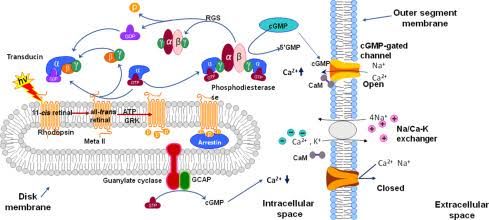
At its core, phototransduction is a G-protein coupled receptor (GPCR) cascade that elegantly converts a fleeting light stimulus into a sustained change in membrane potential. Unlike most sensory systems where a stimulus causes depolarization, light causes a hyperpolarization of the photoreceptor cell membrane. This unique “dark current” mechanism ensures high sensitivity. In the dark, photoreceptors are relatively depolarized due to the continuous influx of positive ions (Na+ and Ca2+) through cGMP-gated cation channels. The binding of a photon to the visual pigment (rhodopsin in rods, photopsins in cones) triggers a series of biochemical reactions that ultimately lead to a decrease in the intracellular concentration of cyclic guanosine monophosphate (cGMP). The reduction in cGMP causes the closure of these cation channels, halting the influx of positive ions. As the cell actively pumps out Na+ via the Na+/K+ ATPase, the membrane potential becomes more negative, resulting in hyperpolarization. This hyperpolarization then reduces the release of the neurotransmitter glutamate at the synaptic terminal, signaling the presence of light to subsequent retinal neurons.
Structure of Rhodopsin and Its Bleaching by Light
Rhodopsin, the primary visual pigment in rod photoreceptors, is a quintessential example of a G-protein coupled receptor, exquisitely designed for light detection. It resides embedded within the disc membranes of the photoreceptor outer segment, a region densely packed with these light-sensitive structures. Rhodopsin is composed of two main components:
- Opsin: A transmembrane protein belonging to the GPCR superfamily. It consists of seven alpha-helical segments that span the disc membrane, forming a hydrophobic pocket.
- 11-cis-retinal: A chromophore, derived from Vitamin A, covalently bound to a specific lysine residue (Lys296) within the seventh transmembrane helix of opsin via a Schiff base linkage. This chromophore is the actual light-absorbing molecule.
In the dark, 11-cis-retinal maintains its bent, 11-cis configuration within the opsin pocket. This conformation keeps opsin in an inactive state. The process of light absorption, termed “bleaching,” initiates the activation of rhodopsin:
Upon absorbing a single photon of light, the 11-cis-retinal molecule undergoes an instantaneous conformational change, isomerizing to its all-trans form. This photoisomerization is one of the fastest reactions in biology, occurring in femtoseconds. The transformation of 11-cis-retinal to all-trans-retinal forces a significant conformational change in the surrounding opsin protein. This series of rapid structural alterations progresses through several transient intermediate states (e.g., bathorhodopsin, lumirhodopsin, metarhodopsin I) before stabilizing into its active form, metarhodopsin II (Meta II).
Metarhodopsin II is the crucial active state of rhodopsin. In this conformation, the opsin protein exposes binding sites for the downstream signaling molecule, transducin (a heterotrimeric G-protein), thereby initiating the enzymatic cascade of phototransduction. The term “bleaching” refers to the change in color of the retina from a reddish-purple (due to rhodopsin) to colorless as rhodopsin is converted to its activated intermediates and eventually splits into all-trans-retinal and opsin, prior to regeneration through the visual cycle.
Steps Involved in Phototransduction
The conversion of a photon into an electrical signal is a multi-step, exquisitely regulated amplification cascade:
- Light Absorption and Rhodopsin Activation: A photon strikes the 11-cis-retinal molecule within rhodopsin. This causes the 11-cis-retinal to isomerize to all-trans-retinal. This isomerization induces a conformational change in opsin, transforming it into its active form, metarhodopsin II (R*). R* is now capable of interacting with and activating downstream signaling molecules.
- G-protein (Transducin) Activation: The activated rhodopsin (R*) acts as a guanine nucleotide exchange factor (GEF), interacting with and activating hundreds of molecules of the heterotrimeric G-protein called transducin (Gt). Transducin consists of an alpha (Gtα), beta (Gtβ), and gamma (Gtγ) subunit. R* facilitates the exchange of GDP for GTP on the Gtα subunit. The Gtα-GTP complex then dissociates from the Gtβγ subunits, becoming an active signaling molecule.
- Effector Enzyme Activation (cGMP Phosphodiesterase): The activated Gtα-GTP subunit now binds to and activates the effector enzyme, cGMP phosphodiesterase (PDE6). PDE6 is a tetramer with two catalytic (α, β) and two inhibitory (γ) subunits. Gtα-GTP binds to and displaces the inhibitory γ subunits of PDE6, thereby releasing the catalytic αβ subunits to become fully active.
- Hydrolysis of cGMP: The activated PDE6 rapidly hydrolyzes cGMP (cyclic guanosine monophosphate) into 5′-GMP (guanosine monophosphate). This enzymatic activity significantly and rapidly reduces the intracellular concentration of cGMP in the photoreceptor outer segment. This is a critical amplification step, as one R* molecule can activate many Gt molecules, and each activated PDE6 can hydrolyze thousands of cGMP molecules per second.
- Ion Channel Closure and Hyperpolarization: In the dark, high levels of cGMP keep cGMP-gated cation channels (primarily permeable to Na+ and Ca2+) open in the photoreceptor outer segment membrane, allowing a continuous “dark current” to flow into the cell, maintaining a relatively depolarized state (around -40 mV). As PDE6 hydrolyzes cGMP, its concentration falls, leading to the rapid closure of these cGMP-gated channels. The cessation of Na+ and Ca2+ influx, coupled with the continued efflux of K+ through other channels, causes the photoreceptor membrane potential to move towards a more negative value, i.e., it hyperpolarizes (e.g., to -70 mV). This hyperpolarization is the electrical signal of light detection.
- Decreased Neurotransmitter Release: The hyperpolarization of the photoreceptor cell propagates to its synaptic terminal. This hyperpolarization closes voltage-gated Ca2+ channels at the terminal. Reduced Ca2+ influx leads to a significant decrease in the release of the inhibitory neurotransmitter, glutamate, into the synaptic cleft. It is this reduction in glutamate release that signals the presence of light to the downstream bipolar cells.
Role of Bipolar and Ganglion Cells in Phototransduction
The signal generated by photoreceptors is not directly transmitted to the brain but undergoes significant processing within the retina itself, primarily by bipolar and ganglion cells, along with horizontal and amacrine cells.
1. Bipolar Cells: These are the second-order neurons in the retinal pathway, receiving direct synaptic input from photoreceptors (and horizontal cells) and transmitting signals to ganglion cells (and amacrine cells). Bipolar cells do not generate action potentials but respond with graded potentials (depolarization or hyperpolarization). Crucially, there are two main types of bipolar cells that process the decrease in glutamate release from photoreceptors differently:
- ON-Bipolar Cells: These cells are characterized by metabotropic glutamate receptors (mGluR6). In the dark, when photoreceptors release a high concentration of glutamate, mGluR6 receptors are activated. This activation inhibits the ON-bipolar cell by closing cation channels, causing it to hyperpolarize. In the presence of light, photoreceptors hyperpolarize and decrease glutamate release. This reduction in glutamate disinhibits the ON-bipolar cell, causing it to depolarize. Thus, ON-bipolar cells are excited by light increments.
- OFF-Bipolar Cells: These cells possess ionotropic glutamate receptors (e.g., AMPA/kainate receptors). In the dark, high glutamate release from photoreceptors excites OFF-bipolar cells by opening cation channels, causing them to depolarize. In the presence of light, decreased glutamate release leads to the closing of these channels, causing the OFF-bipolar cell to hyperpolarize. Thus, OFF-bipolar cells are excited by light decrements (or “darkness”).
This parallel processing by ON and OFF pathways is fundamental for detecting contrast—light-on-dark versus dark-on-light boundaries—a key feature of visual perception.
2. Ganglion Cells: These are the third-order neurons in the retinal pathway, receiving input from bipolar cells (and amacrine cells) and forming the final output of the retina. Unlike photoreceptors and bipolar cells, ganglion cells generate and propagate action potentials. Their axons bundle together to form the optic nerve, which transmits visual information to the brain.
- Ganglion cells also exhibit ON-center/OFF-surround or OFF-center/ON-surround receptive fields, meaning they respond most strongly to specific patterns of light and dark. For example, an ON-center ganglion cell will increase its firing rate when light falls on the center of its receptive field and decrease its firing rate when light falls on the surrounding area. Conversely, an OFF-center ganglion cell will increase its firing rate when darkness falls on its center.
- ON-bipolar cells synapse onto ON-ganglion cells, and OFF-bipolar cells synapse onto OFF-ganglion cells, preserving the contrast information. This complex circuitry allows the retina to perform significant spatial and temporal processing, extracting critical features of the visual scene before the information even reaches the brain.
Conclusion
Phototransduction is an extraordinary example of biological signal amplification and sensory transduction, transforming a single photon into a neural signal. Through the precise structural changes in rhodopsin, the intricate G-protein cascade involving transducin and cGMP phosphodiesterase, and the subsequent modulation of ion channels, photoreceptors convert light energy into a hyperpolarizing electrical signal. This signal is then meticulously processed by ON and OFF pathways of bipolar and ganglion cells, which filter and encode visual information for transmission to the brain via action potentials. This multi-layered system underscores the remarkable efficiency and sensitivity of the visual system, enabling us to perceive the world around us with incredible detail and dynamic range.
References
- Baylor, D. A. (1987). How photons start vision. Harvey Lectures, 81, 1-38.
- Palczewski, K. (2006). G protein-coupled receptor rhodopsin. Annual Review of Biochemistry, 75, 743-767.
- Pugh Jr, E. N., & Lamb, T. D. (1990). Cyclic GMP and single photon transduction in vertebrate rods. Journal of Vision, 10(5), 1-28.
- Standen, N. B., & Davies, N. W. (1993). Modulatory interaction of G-proteins with ion channels. Current Opinion in Neurobiology, 3(3), 329-333.
- Schnapf, J. L., & Baylor, D. A. (1987). How photoreceptor cells respond to light. Scientific American, 256(6), 40-47.