The liver, a vital organ situated in the upper right quadrant of the abdomen, performs an extraordinary array of metabolic, synthetic, and excretory functions critical for human life. Its remarkable capacity for regeneration and its complex microarchitecture underpin its diverse roles in digestion, detoxification, nutrient storage, and protein synthesis. Understanding the liver’s structure, from its macroscopic anatomy to its intricate cellular organization, is fundamental to appreciating its physiological capabilities and pathological responses.
General Hepatic Structure
The liver is the largest internal organ, typically weighing between 1.4 to 1.6 kg in adults. It is reddish-brown and has a relatively soft, pliable texture. Grossly, the liver is divided into two primary lobes: the larger right lobe and the smaller left lobe, separated on the anterior aspect by the falciform ligament, a peritoneal fold. Functionally, it is often further divided into eight segments based on its vascular and biliary supply, a system more relevant for surgical resections.
Blood Supply: The liver possesses a unique dual blood supply, which is crucial for its metabolic activities:
- Hepatic Artery: A branch of the celiac trunk, providing approximately 25% of the liver’s blood supply. This blood is oxygenated and rich in nutrients, supporting the metabolic demands of the hepatocytes themselves.
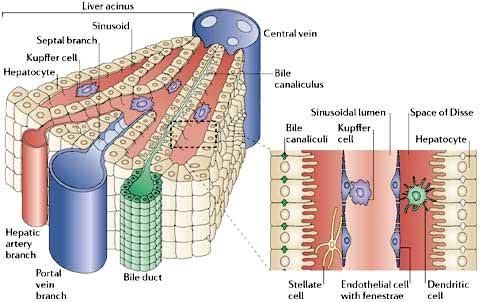
- Hepatic Portal Vein: Carrying about 75% of the blood flow to the liver, this vein is formed by the confluence of veins from the gastrointestinal tract, pancreas, and spleen. This blood is deoxygenated but rich in absorbed nutrients, hormones, and toxins from the digestive system, which the liver processes, metabolizes, or detoxifies before returning it to systemic circulation. Inside the liver, branches of both the hepatic artery and portal vein travel together through connective tissue septa. This mixed blood then flows into specialized capillaries called hepatic sinusoids, which percolate through the liver parenchyma. The blood ultimately collects into central veins, which coalesce to form the hepatic veins, draining into the inferior vena cava.
Bile Drainage: The liver is the sole organ responsible for producing bile, an alkaline fluid essential for fat digestion and the excretion of bilirubin, cholesterol, and other waste products. Hepatocytes secrete bile into microscopic channels called bile canaliculi. These canaliculi coalesce into progressively larger bile ductules (cholangioles) within the lobules, which then merge to form interlobular bile ducts (part of the portal triad). These ducts eventually unite to form the larger right and left hepatic ducts, which exit the liver and combine to form the common hepatic duct. The common hepatic duct joins with the cystic duct from the gallbladder to form the common bile duct, which ultimately empties into the duodenum.
The complex internal architecture of the liver, designed to maximize the interface between blood, hepatocytes, and bile ducts, is best understood by examining its microscopic organization into functional units known as hepatic lobules.
Concept of Three Hepatic Lobules
The intricate microarchitecture of the liver has led to different conceptual models of its functional units, each emphasizing a particular aspect of liver physiology or pathology. Traditionally, three main types of lobules are described: the classical hepatic lobule, the portal lobule, and the hepatic acinus (Rappaport’s lobule). These models are not mutually exclusive but rather complementary, providing different perspectives on hepatic function.
- The Classical Hepatic Lobule (Morphological Lobule): This is the traditional and most easily recognizable histological unit of the liver, particularly in cross-section. It is typically depicted as a hexagonal (or polygonal) prism of liver tissue. At the center of this hexagon lies a central vein (also known as a terminal hepatic venule), into which blood from the surrounding liver parenchyma drains. At each of the six corners of the hexagon, there is a portal triad (or portal canal), which contains a branch of the hepatic portal vein, a branch of the hepatic artery, and a bile ductule, all embedded within a small amount of connective tissue. According to this model, blood flows from the portal triads at the periphery of the lobule, through the hepatic sinusoids, and converges towards the central vein. Bile, conversely, flows in the opposite direction, from hepatocytes towards the bile ductules in the portal triads. This model is primarily anatomical and describes the general organization of hepatocytes around a central venous drainage point.
- The Portal Lobule (Exocrine/Bile Flow Lobule): While the classical lobule focuses on blood flow, the portal lobule emphasizes the exocrine function of the liver – bile secretion. This conceptual unit is triangular in shape, with a portal triad at its center and three central veins at its corners. The boundaries of the portal lobule are defined by imaginary lines connecting three adjacent central veins. In this model, all hepatocytes that drain their bile into a single portal triad constitute a portal lobule. This perspective highlights the flow of bile from the hepatocytes, through bile canaliculi, and into the bile ductules within the central portal triad. It is particularly useful for understanding conditions that affect bile drainage, such as biliary obstruction.
- The Hepatic Acinus (Rappaport’s Lobule/Physiological Lobule): Proposed by Rappaport, the hepatic acinus is considered the most physiologically relevant functional unit of the liver. It is diamond-shaped or oval, with its short axis defined by an imaginary line connecting two adjacent portal triads, and its long axis by a line connecting two adjacent central veins. Each acinus primarily consists of tissue supplied by a single terminal branch of the hepatic artery and portal vein, which are located at the center of the acinus (i.e., the portal triad). Blood flows centrifugally from this central vascular axis towards the two central veins at the periphery of the acinus. The hepatic acinus model emphasizes metabolic zonation and the gradient of oxygen and nutrient concentration across the liver parenchyma. It is divided into three zones based on their proximity to the incoming blood supply from the portal triad:
- Zone 1 (Periportal Zone): Closest to the portal triad, receiving the most oxygenated and nutrient-rich blood. Hepatocytes here are typically the most metabolically active, involved in oxidative metabolism, gluconeogenesis, and urea synthesis. They are also the first to encounter and detoxify toxins and regenerate after injury.
- Zone 2 (Midzonal/Intermediate Zone): An area of transition between Zone 1 and Zone 3, expressing characteristics of both.
- Zone 3 (Pericentral/Perivenous Zone): Farthest from the portal triad and closest to the central vein, receiving the least oxygenated and nutrient-poor blood. Hepatocytes here are more susceptible to ischemic injury and are primarily involved in glycolysis, lipogenesis, and drug detoxification via cytochrome P450 enzymes. This zone is often the first to show signs of damage in conditions like hypoxia or certain toxic exposures (e.g., carbon tetrachloride). The hepatic acinus model provides a clearer understanding of the liver’s metabolic gradients and how different zones respond to injury or physiological demands, making it crucial for studying liver pathology.
Histology of the Classical Hepatic Lobule
The classical hepatic lobule, as the foundational morphological unit, provides an excellent framework for understanding the microscopic organization of the liver. Its histological components are meticulously arranged to facilitate the liver’s diverse functions.
- Hepatocytes: These are the principal parenchymal cells of the liver, making up approximately 80% of the liver’s mass. Hepatocytes are large, polyhedral cells with one or two prominent, round nuclei. Their cytoplasm is typically eosinophilic (pink-staining) and abundant, reflecting a rich complement of organelles necessary for their metabolic activities. These include:
- Rough Endoplasmic Reticulum (RER): Extensive and involved in the synthesis of plasma proteins (e.g., albumin, clotting factors).
- Smooth Endoplasmic Reticulum (SER): Abundant and crucial for detoxification of drugs and xenobiotics, lipid and cholesterol synthesis, and glycogen metabolism.
- Mitochondria: Numerous, reflecting the high energy demands of hepatocytes.
- Golgi apparatus: Well-developed, involved in processing and packaging proteins and lipids for secretion (e.g., VLDLs, bile components).
- Lysosomes and Peroxisomes: Involved in intracellular digestion and metabolic detoxification, respectively. Hepatocytes are arranged in complex, anastomosing cords or plates (laminae) that typically radiate from the central vein towards the periphery of the lobule. Between these cords are the hepatic sinusoids.
- Central Vein (Terminal Hepatic Venule): Located at the very center of the classical lobule, this small venule serves as the primary drainage point for blood that has filtered through the hepatic sinusoids. It has a thin wall lined by endothelial cells and a minimal amount of connective tissue. Multiple central veins coalesce into sublobular veins, which eventually form the hepatic veins that drain into the inferior vena cava.
- Portal Triads (Portal Canals): Positioned at the corners of the hexagonal classical lobule, a portal triad is a connective tissue sheath containing three main structures, hence the “triad”:
- Branch of the Hepatic Portal Vein: The largest component, carrying nutrient-rich, deoxygenated blood from the gastrointestinal tract.
- Branch of the Hepatic Artery: A smaller, thick-walled arteriole supplying oxygenated blood to the liver parenchyma.
- Bile Ductule (Interlobular Bile Duct): Lined by cuboidal epithelial cells (cholangiocytes), this ductule collects bile from the bile canaliculi within the lobule and transports it towards larger bile ducts. Lymphatic vessels and nerves are also typically found within the portal triads.
- Hepatic Sinusoids: These are specialized, highly permeable capillaries that run between the cords of hepatocytes, connecting the portal triads to the central vein. Unlike typical capillaries, sinusoids are lined by a discontinuous, fenestrated endothelial layer (lacking a continuous basement membrane in many areas). This fenestrated endothelium allows for maximal exchange of blood plasma components with hepatocytes, facilitating nutrient uptake, protein secretion, and waste removal. The blood within the sinusoids is a mixture of arterial and portal venous blood.
- Kupffer Cells: These are resident macrophages found on the luminal surface of the sinusoidal endothelial cells. They are part of the mononuclear phagocyte system and play a crucial role in the liver’s immune defense. Kupffer cells phagocytose old and damaged red blood cells, bacteria, cellular debris, and foreign particles that enter the liver via the portal circulation, effectively clearing the blood.
- Hepatic Stellate Cells (Ito Cells): Also known as perisinusoidal cells, these cells are located in the Space of Disse, between the sinusoidal endothelium and the hepatocytes. In a healthy liver, their primary function is the storage of Vitamin A (retinol) in cytoplasmic lipid droplets. However, in response to liver injury or chronic inflammation, stellate cells become activated and transform into myofibroblast-like cells. In this activated state, they lose their Vitamin A stores, proliferate, and produce excessive amounts of extracellular matrix components, particularly collagen, contributing significantly to hepatic fibrosis and cirrhosis.
- Space of Disse (Perisinusoidal Space): This is a narrow, fluid-filled space situated between the sinusoidal endothelial lining and the basolateral (sinusoidal) surface of the hepatocytes. Microvilli from hepatocytes project into this space, greatly increasing the surface area for absorption and secretion. Plasma from the sinusoids freely filters through the fenestrations in the endothelial cells into the Space of Disse, allowing direct contact between plasma and the hepatocyte surface. This direct interaction is vital for uptake of nutrients and release of synthesized substances (like albumin) from hepatocytes into the bloodstream.
- Bile Canaliculi: These are minute channels formed by grooves in the plasma membranes of two adjacent hepatocytes. They are the initial collecting points for bile secreted by hepatocytes. Bile flows within these canaliculi, which form a network within the hepatocyte cords, eventually emptying into the bile ductules in the portal triads. Unlike larger bile ducts, bile canaliculi do not have their own distinct epithelial lining; their walls are simply the plasma membranes of the hepatocytes themselves, sealed by tight junctions to prevent bile leakage into the perisinusoidal space. This ensures the isolated flow of bile in a direction opposite to blood flow.
In conclusion, the liver’s general structure, coupled with its intricate microscopic organization into functional units like the classical hepatic lobule, reflects a highly optimized design for its myriad physiological roles. Each component, from the dual blood supply and specialized sinusoids to the diverse cell types and unique bile drainage system, works in concert to maintain homeostasis, process nutrients, and protect the body from harmful substances. The understanding of these structural models is paramount for comprehending hepatic function in health and disease.
References:
- Ross, M. H., & Pawlina, W. (2023). Histology: A Text and Atlas: With Correlated Cell and Molecular Biology (8th ed.). Wolters Kluwer.
- Moore, K. L., Dalley, A. F., & Agur, A. M. R. (2018). Clinically Oriented Anatomy (8th ed.). Wolters Kluwer.
- Guyton, A. C., & Hall, J. E. (2021). Textbook of Medical Physiology (14th ed.). Elsevier.
- Junqueira, L. C., & Carneiro, J. (2005). Basic Histology: Text & Atlas (11th ed.). McGraw-Hill Medical. (Note: While cited, newer editions if available would be preferred for the most current details, though fundamental concepts remain consistent.)