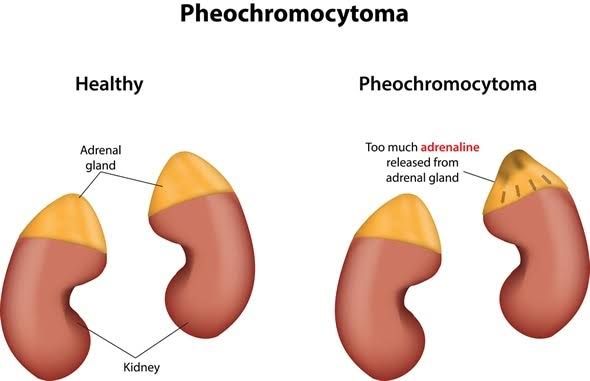
Pheochromocytoma is a rare neuroendocrine tumor originating from the chromaffin cells of the adrenal medulla. A similar tumor arising from outside the adrenal glands is known as a paraganglioma. These tumors are clinically significant because they secrete high levels of catecholamines—namely, norepinephrine and epinephrine. This excessive hormone production leads to a state of sympathomimetic overload, causing a range of dramatic and potentially life-threatening symptoms. While most pheochromocytomas are benign, their profound physiological effects necessitate prompt and accurate diagnosis, followed by meticulous management to prevent severe complications.
Clinical Features
The clinical presentation of pheochromocytoma is notoriously variable, often earning it the name “the great mimic.” Symptoms are typically paroxysmal (occurring in discrete episodes) but can also be sustained. The classic triad of symptoms, present in a significant number of patients, includes:
- Episodic Headaches: Often described as severe, throbbing, and pounding.
- Palpitations: A sensation of a rapid, forceful, or irregular heartbeat.
- Diaphoresis: Profuse, drenching sweating.
While this triad is classic, not all patients will present with all three symptoms. The most common clinical sign is hypertension, which can be either sustained (persistent high blood pressure) or paroxysmal. The episodic nature of the hypertension is a key clue, particularly in younger patients or those whose blood pressure is resistant to standard antihypertensive medications.
Other common clinical features stemming from catecholamine excess include:
- Cardiovascular: Tachycardia (rapid heart rate), chest pain, and orthostatic hypotension (a drop in blood pressure upon standing) due to volume depletion.
- Psychological: Severe anxiety, panic attacks, and a sense of impending doom.
- Gastrointestinal: Nausea, vomiting, abdominal pain, and constipation.
- Metabolic: Weight loss despite normal appetite, hyperglycemia (high blood sugar), and pallor (pale skin) due to vasoconstriction.
- Neurological: Tremors, visual disturbances, and occasionally, stroke.
These episodes, or “spells,” can be triggered by various stimuli, including physical exertion, stress, changes in posture, anethesia, certain medications (e.g., beta-blockers, tricyclic antidepressants), and foods high in tyramine. Historically, pheochromocytomas were associated with the “Rule of 10s”: 10% are bilateral, 10% are extra-adrenal, 10% are malignant, and 10% are hereditary. However, modern genetic testing has revealed that the hereditary component is much higher, with up to 40% of cases being linked to a germline mutation in one of several known susceptibility genes (e.g., RET, VHL, NF1, SDHB/C/D).
Investigations and Diagnosis
The diagnostic process for pheochromocytoma is a two-step approach: first, confirming biochemical evidence of catecholamine overproduction, and second, localizing the tumor through imaging.
Step 1: Biochemical Testing
The cornerstone of diagnosis is measuring catecholamines and their metabolites (metanephrines).
- Plasma Free Metanephrines or 24-Hour Urinary Fractionated Metanephrines: These are the initial tests of choice due to their high sensitivity (over 97%). Catecholamines are metabolized into metanephrines within the chromaffin cells themselves, and their release into the bloodstream is more continuous than the episodic secretion of the parent hormones. This makes them a more reliable marker. A blood sample for plasma metanephrines should ideally be drawn with the patient in a supine (lying down) position after 30 minutes of rest to avoid false positives from stress.
- 24-Hour Urinary Catecholamines and Vanillylmandelic Acid (VMA): While historically used, these tests have lower sensitivity and specificity compared to metanephrine testing and are now considered secondary options.
- Clonidine Suppression Test: In cases where biochemical results are borderline or equivocal, this dynamic test may be used. Clonidine, a central sympatholytic agent, normally suppresses catecholamine release from the nervous system. In a patient with a pheochromocytoma, the autonomous tumor continues to secrete catecholamines, so levels will not be suppressed.
Step 2: Tumor Localization
Once biochemical evidence is confirmed, imaging studies are performed to locate the tumor.
- Computed Tomography (CT): An abdominal and pelvic CT scan with intravenous contrast is typically the first-line imaging modality. Pheochromocytomas often have a characteristic appearance on CT, such as high attenuation and cystic or hemorrhagic changes.
- Magnetic Resonance Imaging (MRI): MRI is an excellent alternative to CT, especially for patients who should avoid radiation (e.g., pregnant women, children) or have allergies to CT contrast agents. Pheochromocytomas classically appear hyperintense (bright) on T2-weighted MRI sequences.
- Functional Imaging: If anatomical imaging (CT/MRI) is negative or if there is suspicion of metastatic or extra-adrenal disease, functional imaging is employed.
- ¹²³I-Metaiodobenzylguanidine (MIBG) Scintigraphy: MIBG is a compound structurally similar to norepinephrine and is taken up by chromaffin tissue. This scan can identify tumors throughout the body.
- Positron Emission Tomography (PET) Scan: PET scans, particularly with tracers like ¹⁸F-FDG or ⁶⁸Ga-DOTATATE, are increasingly used. They are highly sensitive, especially for detecting metastatic disease or tumors associated with certain genetic mutations (SDHB).
Management
The definitive treatment for pheochromocytoma is surgical resection. However, meticulous pre-operative medical management is the most critical phase of treatment to prevent a life-threatening intraoperative hypertensive crisis.
Pre-operative Medical Management
The primary goal is to block the effects of excess catecholamines. This process should be managed by a multidisciplinary team, including an endocrinologist, surgeon, and anesthesiologist.
- Alpha-Adrenergic Blockade: This is the essential first step and should be initiated 10-14 days before surgery. Alpha-blockers control hypertension and allow for the re-expansion of blood volume, which is often contracted due to chronic vasoconstriction.
- Phenoxybenzamine: A long-acting, non-selective, irreversible alpha-blocker. It is the traditional drug of choice.
- Selective Alpha-1 Blockers (e.g., Doxazosin, Prazosin): These are also effective and may have fewer side effects, such as reflex tachycardia.
- Beta-Adrenergic Blockade: This should only be initiated after adequate alpha-blockade has been achieved (typically 2-3 days later). If beta-blockers are given first, they will block beta-2 mediated vasodilation, leading to unopposed alpha-1 receptor stimulation from circulating catecholamines. This can cause a paradoxical and severe worsening of hypertension. Beta-blockers (e.g., propranolol, metoprolol) are used to control any reflex tachycardia caused by alpha-blockade.
- Volume Expansion: A high-sodium diet and liberal fluid intake are encouraged during the alpha-blockade period to restore normal blood volume and prevent severe hypotension after the tumor is removed.
Surgical Management
- Adrenalectomy: The surgical removal of the tumor is the definitive cure. For most adrenal pheochromocytomas, a minimally invasive laparoscopic adrenalectomy is the preferred approach, offering faster recovery and less post-operative pain. An open adrenalectomy may be necessary for very large (>6 cm) or invasive tumors.
Post-operative Care
Following surgery, patients are monitored closely in an intensive care or high-dependency unit. Common post-operative issues include hypotension (due to the sudden withdrawal of catecholamines) and hypoglycemia (as insulin levels, previously suppressed by catecholamines, may rebound). Lifelong annual biochemical follow-up is recommended to monitor for recurrence or the development of metastases.
Complications
If left undiagnosed or improperly managed, pheochromocytoma can lead to severe and fatal complications.
- Cardiovascular Complications: The most significant risks are related to severe hypertension, including hypertensive emergencies, myocardial infarction (heart attack), stroke, aortic dissection, and arrhythmias.
- Catecholamine-Induced Cardiomyopathy: Chronic exposure to high levels of catecholamines can be toxic to the heart muscle, leading to heart failure. This is often reversible after tumor removal.
- Pheochromocytoma Crisis: This is a rare but life-threatening emergency characterized by severe hypertension or hypotension, hyperthermia, encephalopathy, and multi-organ failure. It can be precipitated by surgery, childbirth, or certain drugs.
- Metastatic Disease: In approximately 10-15% of cases, the tumor is malignant and can metastasize to distant sites like the bones, liver, lungs, and lymph nodes. Management of malignant pheochromocytoma is challenging and may involve surgery, radionuclide therapy, chemotherapy, and targeted molecular therapies.
In conclusion, pheochromocytoma is a formidable clinical entity whose danger lies in its potent hormonal activity. A high index of suspicion based on its characteristic clinical features, followed by a logical sequence of biochemical testing and imaging, is crucial for diagnosis. With careful pre-operative pharmacological preparation and skilled surgical intervention, the prognosis for patients with benign pheochromocytoma is excellent.
References
- Lenders, J. W., Duh, Q. Y., Eisenhofer, G., Gimenez-Roqueplo, A. P., Grebe, S. K., Murad, M. H., … & Clark, O. H. (2014). Pheochromocytoma and paraganglioma: an endocrine society clinical practice guideline. The Journal of Clinical Endocrinology & Metabolism, 99(6), 1915-1942.
- Neumann, H. P., Young Jr, W. F., & Eng, C. (2019). Pheochromocytoma and paraganglioma. New England Journal of Medicine, 381(6), 552-565.
- Farrugia, F. A., & Charalampopoulos, A. (2019). Pheochromocytoma. Endocrine Regulations, 53(3), 191-212.
- Pacak, K. (2007). Preoperative management of the pheochromocytoma patient. Journal of Clinical Endocrinology & Metabolism, 92(11), 4069-4079.