Malaria remains one of the most significant infectious diseases globally, affecting millions of people each year, particularly in tropical and subtropical regions. Its complexity, from the parasite’s intricate life cycle to its diverse clinical presentations, makes a thorough understanding essential for healthcare professionals, researchers, and public health officials.
Defining Malaria and Classifying the Malarial Parasites
Definition: Malaria is a life-threatening, mosquito-borne infectious disease caused by protozoan parasites of the genus Plasmodium. The disease is transmitted to humans through the bites of infected female Anopheles mosquitoes. Its clinical presentation is characterized by cycles of fever, chills, sweats, and flu-like symptoms. If left untreated, certain forms of malaria can progress to severe illness and death.
Classification of Human Malarial Parasites: The Plasmodium genus contains over 200 species, but only five are well-established as primary causes of malaria in humans. These are classified based on their morphology, genetic makeup, and clinical characteristics.
- Plasmodium falciparum: This is the most virulent and deadly species. It is responsible for the majority of malaria-related deaths worldwide. P. falciparum has the ability to infect red blood cells (RBCs) of all ages, leading to very high levels of parasitemia (the concentration of parasites in the blood). Its unique ability to cause infected RBCs to stick to the walls of blood vessels is the primary cause of its severe complications.
- Plasmodium vivax: While generally less fatal than P. falciparum, P. vivax is the most geographically widespread species. It is a major cause of morbidity. A key feature of P. vivax is its ability to form dormant liver stages called hypnozoites, which can reactivate months or even years after the initial infection, causing relapses. It preferentially infects young red blood cells (reticulocytes).
- Plasmodium ovale: Morphologically and clinically similar to P. vivax, P. ovale also forms hypnozoites and can cause relapses. It is less common and generally causes a milder form of the disease. It is primarily found in West Africa and islands in the Western Pacific.
- Plasmodium malariae: This species is associated with a long-lasting, chronic infection that can persist in the blood for decades if untreated. It typically causes a quartan fever cycle (recurring every 72 hours) and has a preference for aging red blood cells. While rarely fatal, it can lead to chronic complications like nephrotic syndrome (a kidney disorder).
- Plasmodium knowlesi: Primarily a parasite of long-tailed and pig-tailed macaques, P. knowlesi is now recognized as a significant cause of zoonotic malaria in humans, particularly in Southeast Asia. It has a 24-hour replication cycle, leading to a rapid increase in parasitemia and the potential for severe, life-threatening disease similar to that caused by P. falciparum.
The Intricate Life Cycle of the Malarial Parasite
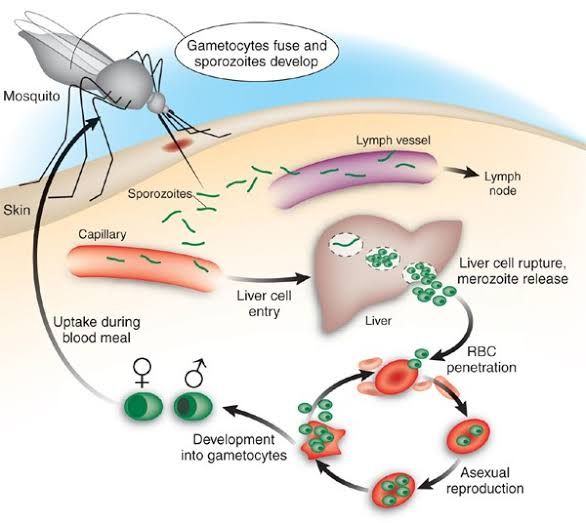
The Plasmodium life cycle is complex, involving two hosts: a human (intermediate host) and a female Anopheles mosquito (definitive host). The cycle consists of an asexual phase in humans and a sexual phase in mosquitoes.
Step 1: The Human Cycle (Asexual Reproduction – Schizogony)
- Inoculation and Exo-erythrocytic (Liver) Stage: The cycle begins when an infected female Anopheles mosquito takes a blood meal, injecting sporozoites from its salivary glands into the human bloodstream. Within minutes, these sporozoites travel to the liver and invade liver cells (hepatocytes).
- Liver Schizogony: Inside the hepatocytes, the sporozoites mature and undergo asexual multiplication, developing into a schizont. This process takes approximately 7-14 days. Each mature liver schizont ruptures to release thousands of merozoites into the bloodstream. In P. vivax and P. ovale, some sporozoites develop into dormant hypnozoites, which can remain in the liver for extended periods before reactivating.
Step 2: Erythrocytic (Blood) Stage
- Invasion of Red Blood Cells: The merozoites released from the liver invade red blood cells. Inside the RBC, the parasite develops through several stages: first into a “ring” stage, then into a mature trophozoite (the feeding stage), and finally into an erythrocytic schizont.
- Blood Schizogony: The schizont undergoes further asexual division, producing a new generation of 8-32 merozoites. The infected RBC eventually ruptures, releasing these new merozoites to infect other RBCs. This cyclical rupture of RBCs is responsible for the classic clinical symptoms of malaria, such as fever and chills. The duration of this cycle determines the fever pattern (e.g., 48 hours for P. vivax, 72 hours for P. malariae).
- Gametocytogenesis: After several asexual cycles, some merozoites differentiate into sexual forms known as gametocytes (male microgametocytes and female macrogametocytes). These gametocytes circulate in the bloodstream and are the only forms of the parasite that can infect a mosquito.
Step 3: The Mosquito Cycle (Sexual Reproduction – Sporogony)
- Ingestion and Fertilization: When a non-infected female Anopheles mosquito ingests blood from an infected human, it takes up the gametocytes. In the mosquito’s midgut, the gametocytes mature into gametes. The male gamete fertilizes the female gamete, forming a zygote.
- Oocyst Development: The zygote develops into a motile ookinete, which penetrates the mosquito’s midgut wall and develops into an oocyst.
- Sporozoite Formation and Migration: Inside the oocyst, thousands of sporozoites develop through a process called sporogony. When the oocyst matures and ruptures, it releases the sporozoites into the mosquito’s body cavity. These sporozoites migrate to the mosquito’s salivary glands, ready to be injected into a new human host during the mosquito’s next blood meal, thus completing the cycle.
Differentiating Benign vs. Malignant Tertian Malaria
The terms “benign” and “malignant” are historical but effectively distinguish between the clinical courses of P. vivax and P. falciparum infections.
| Feature | Benign Tertian Malaria (P. vivax) | Malignant Tertian Malaria (P. falciparum) |
|---|---|---|
| Causative Agent | Plasmodium vivax | Plasmodium falciparum |
| Fever Pattern | Classic tertian cycle: Fever spikes typically occur every 48 hours. The pattern is often predictable. | Irregular, erratic, or continuous fever. May be described as “sub-tertian.” High-grade fever is common. |
| Parasitemia Level | Low to moderate. P. vivax preferentially invades young RBCs (reticulocytes), limiting parasite density. | Can be extremely high (>250,000/µL). P. falciparum invades RBCs of all ages, allowing for explosive growth. |
| Relapses | Common. Dormant hypnozoites in the liver can reactivate weeks to years later, causing relapsing illness. | No true relapses. Recrudescence (re-emergence of parasites from the blood) can occur if treatment is inadequate. |
| Key Pathophysiology | Causes significant morbidity, fever, and anemia but rarely leads to severe, life-threatening complications. | Pathogenicity is driven by cytoadherence and sequestration. Infected RBCs adhere to the endothelium of small blood vessels, obstructing blood flow. |
| Severity & Mortality | Rarely fatal. Considered “benign” because it does not typically cause the severe, multi-organ complications seen in falciparum malaria. | High potential for severity and mortality. It is the cause of nearly all malaria-related deaths and is considered “malignant” due to its life-threatening complications. |
| Peripheral Blood Smear | Various developmental stages (rings, trophozoites, schizonts) are typically seen. | Primarily only early ring-stage parasites and gametocytes are seen. Mature forms are sequestered in deep tissues. |
Complications of Plasmodium falciparum
The severe complications of P. falciparum malaria are primarily due to the sequestration of parasitized RBCs in the microvasculature of vital organs, leading to ischemia, inflammation, and metabolic disturbances.
- Cerebral Malaria: This is the most severe neurological complication. Sequestration of parasitized RBCs in the cerebral capillaries obstructs blood flow and disrupts the blood-brain barrier. It is clinically defined as an unarousable coma not attributable to any other cause. Symptoms include seizures, altered consciousness, and abnormal posturing. It has a high mortality rate even with treatment.
- Severe Anemia: This results from a combination of factors: the massive destruction of infected RBCs, the accelerated removal of uninfected RBCs by the spleen, and bone marrow suppression, which impairs the production of new red blood cells.
- Acute Respiratory Distress Syndrome (ARDS): Sequestration in the pulmonary microvasculature leads to increased vascular permeability and fluid leakage into the alveoli (pulmonary edema). This causes severe breathing difficulty and hypoxemia, often requiring mechanical ventilation.
- Acute Kidney Injury (AKI): Caused by sequestration in the renal microvasculature and acute tubular necrosis. A classic but now rare manifestation is Blackwater Fever, characterized by massive intravascular hemolysis, which leads to the passage of dark red or black urine due to high levels of hemoglobin in the urine (hemoglobinuria).
- Metabolic Acidosis: This is a strong predictor of mortality. It results from a combination of impaired tissue perfusion (leading to lactic acid production from anaerobic glycolysis) and decreased clearance of lactate by the liver and kidneys.
- Hypoglycemia: Low blood sugar is a common and dangerous complication, resulting from increased glucose consumption by both the host (during fever) and the parasites, as well as impaired glucose production by the liver.
In conclusion, malaria is a multifaceted disease defined by the complex biology of its causative parasite. Understanding the distinctions between Plasmodium species, particularly the life-threatening nature of P. falciparum, is paramount for effective diagnosis, treatment, and global efforts to control and eliminate this devastating disease.
References
- World Health Organization (WHO). (2023). World Malaria Report 2023. Geneva: World Health Organization.
- Centers for Disease Control and Prevention (CDC). (2023). Malaria – Biology. Retrieved from https://www.cdc.gov/malaria/about/biology/index.html
- White, N. J., Pukrittayakamee, S., Hien, T. T., Faiz, M. A., Mokuolu, O. A., & Dondorp, A. M. (2014). Malaria. The Lancet, 383(9918), 723–735.
- Miller, L. H., Ackerman, H. C., Su, X. Z., & Wellems, T. E. (2013). Malaria biology and disease pathogenesis: insights for new treatments. Nature Medicine, 19(2), 156–167.
- Ashley, E. A., Pyae Phyo, A., & Woodrow, C. J. (2018). Malaria. The Lancet, 391(10130), 1608-1621.