Calcium is a fundamental mineral, indispensable not only for the structural integrity of the skeleton but also for a vast array of critical physiological processes. These include nerve impulse transmission, muscle contraction, blood coagulation, and intracellular signaling. Given its importance, the human body has evolved a sophisticated and tightly regulated system to maintain calcium concentrations in the blood and extracellular fluid within a very narrow range (typically 8.5-10.5 mg/dL). This process, known as calcium homeostasis, involves a dynamic interplay between dietary intake, intestinal absorption, renal excretion, and the vast calcium reservoir stored within our bones.
The Daily Journey of Calcium – Intake, Absorption, and Excretion
The foundation of calcium balance begins with its entry into and exit from the body. This process is primarily managed by the gastrointestinal (GI) tract and the kidneys, acting as the primary sites of regulation.
1. Daily Intake and Absorption in the Gastrointestinal Tract (GIT)
The average adult diet should contain approximately 1000-1200 mg of calcium per day, sourced from dairy products, leafy green vegetables, fortified foods, and certain types of fish. However, not all ingested calcium is utilized. The absorption of calcium from the food we eat is an inefficient but highly regulated process occurring predominantly in the duodenum and upper jejunum of the small intestine.
- Net Absorption: Typically, only about 30-40% of dietary calcium is absorbed into the bloodstream. For an intake of 1000 mg, this means approximately 350 mg is absorbed, while the remaining 650 mg is passed out in the feces. Additionally, about 150 mg of calcium is secreted back into the GIT via bile and other intestinal fluids, resulting in a net absorption of around 200 mg per day under normal conditions.
- Mechanisms of Absorption:
- Active, Transcellular Transport: This is the primary regulated pathway and is crucial when dietary calcium is low. It is dependent on Calcitriol, the active form of Vitamin D (1,25-dihydroxycholecalciferol). Calcitriol stimulates the intestinal epithelial cells to synthesize a calcium-binding protein called calbindin-D9k. Calcium enters the cell through specific channels, is bound by calbindin, and ferried across the cell to be actively pumped into the bloodstream by a plasma membrane Ca2+-ATPase (PMCA) pump. This entire process is upregulated by Parathyroid Hormone (PTH), which stimulates the kidneys to produce more Calcitriol.
- Passive, Paracellular Diffusion: When dietary calcium intake is high, calcium can move between the intestinal cells (paracellularly) down its concentration gradient. This pathway is not saturable and is less tightly regulated than the active transport system.
2. Excretion by the Kidneys
The kidneys provide the fine-tuning mechanism for calcium homeostasis, ensuring that blood calcium levels remain stable.
- Filtration and Reabsorption: An enormous amount of calcium is filtered from the blood by the glomeruli each day—approximately 10,000 mg. However, the body is extremely efficient at reclaiming it. Over 98% of this filtered calcium is reabsorbed back into the blood along the renal tubules.
- Regulation of Reabsorption: While a significant portion of reabsorption occurs passively in the proximal tubules, the critical regulatory step happens in the distal convoluted tubules and collecting ducts. This is where Parathyroid Hormone (PTH) exerts its primary renal effect. When blood calcium levels fall, PTH is released and acts on the distal tubules to increase the reabsorption of calcium, thereby reducing the amount lost in urine. Calcitriol also plays a supportive role in enhancing this reabsorption.
Ultimately, the kidneys excrete an amount of calcium in the urine (approximately 200 mg/day) that perfectly balances the net amount absorbed from the GIT, thus maintaining overall body calcium balance.
The Bone Bank – Distribution of Calcium in Bones
The skeleton acts as the body’s primary calcium reservoir, storing over 99% of its total calcium. This stored calcium exists in two distinct, functionally different pools.
- The Exchangeable Calcium Pool: This represents a small fraction (less than 1%) of total bone calcium. It consists of readily available calcium phosphate salts, such as amorphous calcium phosphate, that are loosely bound on the surfaces of bone crystals in contact with the bone fluid. This pool is located near the network of osteocytes and bone-lining cells. Its primary function is to provide a rapid buffering system, allowing for minute-to-minute stabilization of plasma calcium levels without requiring significant hormonal intervention or structural changes to the bone.
- The Stable Calcium Pool: This is the vast majority of bone calcium, which is tightly locked away in a crystalline structure known as hydroxyapatite [Ca10(PO4)6(OH)2]. This stable, mineralized matrix gives bone its rigidity and strength. Accessing calcium from this pool is a much slower process that requires active cellular work—specifically, bone resorption—and is under strict hormonal control.
The Cellular Workforce of Bone and Calcium Homeostasis
Bone is not a static structure but a dynamic, living tissue constantly undergoing a process of breakdown and rebuilding known as remodeling. This process is orchestrated by specialized bone cells, each with a distinct function in managing bone structure and calcium balance.
- Osteoblasts (The Bone Builders): These cells are responsible for bone formation. They synthesize and secrete the organic components of the bone matrix, primarily Type I collagen, which forms a scaffold known as osteoid. Osteoblasts then initiate the mineralization of this osteoid by depositing calcium and phosphate, which eventually crystallize into hydroxyapatite. Critically, osteoblasts also play a central role in regulating bone breakdown by responding to hormonal signals like PTH.
- Osteocytes (The Command and Control Center): As osteoblasts mature and become encased within the mineralized matrix they have created, they transform into osteocytes. They reside in small cavities called lacunae and extend long, cytoplasmic processes through tiny channels (canaliculi) to form a vast, interconnected network with other osteocytes and with cells on the bone surface. This network allows them to function as the primary mechanosensors of bone, detecting mechanical stress and strain. They are believed to direct bone remodeling by signaling to osteoblasts and osteoclasts. Furthermore, osteocytes are instrumental in the rapid transfer of calcium from the exchangeable pool to the blood.
- Osteoclasts (The Bone Resorbers): These are large, multinucleated cells derived from the same hematopoietic stem cell lineage as macrophages. Their sole function is to break down (resorb) bone tissue. They attach firmly to the bone surface, creating a sealed-off microenvironment. Within this zone, they pump out hydrogen ions (protons) to create a highly acidic environment that dissolves the mineral hydroxyapatite crystals. Simultaneously, they release proteolytic enzymes, such as cathepsin K, which digest the organic collagen matrix. This dual action effectively liberates stored calcium and phosphate into the bloodstream.
The Mechanism of Calcium Release from Bone into Blood
The release of calcium from the bone’s stable pool into the blood is the body’s most powerful defense against low blood calcium (hypocalcemia). This process is initiated and driven primarily by Parathyroid Hormone (PTH).
Step 1: The Trigger
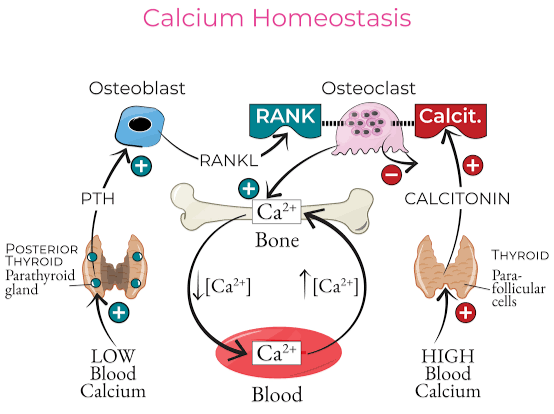
The parathyroid glands continuously monitor blood calcium levels via specialized Calcium-Sensing Receptors (CaSR) on their cell surfaces. When blood calcium drops below the normal range, these receptors are less activated, triggering the synthesis and secretion of PTH into the circulation.
Step 2: The Hormonal Response and Cellular Action
PTH acts on bone to release calcium through a two-phase mechanism:
- Rapid Phase (Osteocytic Osteolysis): This provides an initial, quick release of calcium. PTH stimulates the membrane pumps of osteocytes and osteoblasts. This action rapidly moves calcium ions from the bone fluid surrounding the exchangeable calcium pool, across the cellular syncytium, and into the extracellular fluid and blood. This process mobilizes readily available calcium without breaking down the bone matrix itself.
- Slow Phase (Osteoclastic Resorption): For a more sustained and powerful response, PTH initiates the breakdown of the stable bone matrix. This is an indirect mechanism. PTH does not bind to osteoclasts directly. Instead, it binds to receptors on osteoblasts and osteocytes. This binding stimulates these cells to produce two crucial signaling molecules:
- RANK Ligand (RANKL): A protein that is expressed on the surface of osteoblasts.
- Macrophage Colony-Stimulating Factor (M-CSF).
RANKL then binds to its receptor, RANK, located on the surface of osteoclast precursor cells. This binding, along with the presence of M-CSF, is the primary signal that drives these precursors to differentiate, fuse, and mature into fully active, bone-resorbing osteoclasts. These newly activated osteoclasts then begin the process of dissolving the bone matrix, releasing large quantities of calcium and phosphate into the blood, thereby restoring blood calcium levels to normal.
This elegant feedback loop ensures that the body can precisely mobilize its vast skeletal reserves to maintain the critical concentration of calcium required for life.