Radiography of the vertebral column is a fundamental component of diagnostic imaging, crucial for evaluating trauma, degenerative diseases, congenital abnormalities, and postoperative changes. A successful examination relies on the radiologic technologist’s deep understanding of anatomy, precise patient positioning, and meticulous application of radiographic principles.
Before any procedure, the technologist must perform essential preliminary steps:
- Verify Patient Identity: Confirm the patient’s identity using at least two identifiers.
- Confirm Clinical Indication: Understand the reason for the examination to tailor the procedure appropriately and ensure the correct views are acquired.
- Explain the Procedure: Clearly communicate instructions to the patient to gain their cooperation and alleviate anxiety.
- Adhere to Radiation Safety (ALARA): Always use the principles of As Low As Reasonably Achievable. This includes proper collimation, gonadal shielding when appropriate, and avoiding repeat exposures through careful technique.
Routine Radiographic Examinations
This section covers the standard projections for each segment of the vertebral column.
1. Cervical Spine (C-Spine)
A. Anteroposterior (AP) “Open Mouth” Projection (for C1-C2)
- Purpose: To visualize the atlas (C1) and axis (C2), including the dens (odontoid process) and atlantoaxial articulation.
- Patient Positioning:
- Position the patient supine or seated erect.
- Align the patient’s midsagittal plane (MSP) to the midline of the image receptor (IR).
- Adjust the patient’s head so that a line from the lower edge of the upper incisors to the tip of the mastoid process is perpendicular to the IR.
- Instruct the patient to open their mouth as wide as possible without moving the head.
- Central Ray (CR): Perpendicular to the IR, directed through the center of the open mouth.
- Image Criteria: The dens, lateral masses of C1, and atlantoaxial joints are clearly demonstrated without superimposition by the upper teeth or base of the skull.
B. AP Axial Projection (for C3-C7)
- Purpose: To visualize the vertebral bodies, intervertebral disk spaces, and surrounding soft tissues of the mid-to-lower cervical spine.
- Patient Positioning:
- Position the patient supine or seated erect with the MSP centered to the IR.
- Extend the chin slightly to prevent mandibular superimposition.
- Central Ray (CR): Directed at the C4 level (level of the thyroid cartilage) with a 15-20 degree cephalad angle.
- Image Criteria: C3 through T1 vertebral bodies are visible. Intervertebral disk spaces are open. The spinous processes are equidistant from the pedicles.
C. Lateral Projection
- Purpose: The most critical view for trauma assessment. Visualizes all seven cervical vertebrae, zygapophyseal joints, and intervertebral disk spaces.
- Patient Positioning:
- Position the patient seated or standing in a true lateral position. For trauma, this is performed as a horizontal beam lateral with the patient supine on the trauma board.
- Center the C-spine to the IR. The shoulder should be depressed as much as possible to visualize C7. Instruct the patient to hold weights or pull down on their arms.
- Ensure no rotation or tilt of the head.
- Central Ray (CR): Perpendicular to the IR, directed at the C4 level.
- Image Criteria: All seven cervical vertebrae and the C7-T1 junction must be visible. The vertebral bodies are seen in profile, and the zygapophyseal joints are superimposed.
2. Thoracic Spine (T-Spine)
A. AP Projection
- Purpose: To visualize the 12 thoracic vertebral bodies, intervertebral disk spaces, and costovertebral joints.
- Patient Positioning:
- Position the patient supine with the MSP centered to the IR.
- Ensure the pelvis and shoulders are level to prevent rotation.
- Flex the patient’s knees and hips to reduce the thoracic curvature for better visualization of the disk spaces.
- Central Ray (CR): Perpendicular to the IR, directed to the T7 level (midway between the jugular notch and the xiphoid process).
- Image Criteria: All 12 thoracic vertebrae are demonstrated. Spinous processes are aligned with the midline of the vertebral bodies.
B. Lateral Projection
- Purpose: To visualize the vertebral bodies in profile, intervertebral foramina (IVF), and intervertebral disk spaces.
- Patient Positioning:
- Position the patient in a left lateral recumbent position with knees flexed and arms forward at a 90-degree angle to the body.
- Place a radiolucent support under the waist to keep the spine parallel to the IR.
- Ensure the MSP is perpendicular to the IR.
- Central Ray (CR): Perpendicular to the IR, directed to the T7 level. Utilize a breathing technique (gentle breathing during exposure) to blur the overlying ribs and lung markings.
- Image Criteria: All 12 thoracic vertebrae are seen in a true lateral profile. The intervertebral disk spaces and foramina are open. The superior thoracic vertebrae may be obscured; a “swimmer’s” view may be necessary to visualize the C7-T3 region.
3. Lumbar Spine (L-Spine)
A. AP Projection
- Purpose: To visualize the five lumbar vertebral bodies, disk spaces, transverse processes, and sacroiliac joints.
- Patient Positioning:
- Position the patient supine with the MSP centered to the IR.
- Flex the knees and hips to flatten the lumbar lordosis.
- Ensure the pelvis is not rotated.
- Central Ray (CR): Perpendicular to the IR, directed to the L4 level (at the level of the iliac crests).
- Image Criteria: T12 to the sacrum is included. The spinous processes are centered, and the sacroiliac joints are equidistant from the spine.
B. Lateral Projection
- Purpose: To visualize the vertebral bodies, disk spaces, spinous processes, and intervertebral foramina.
- Patient Positioning:
- Position the patient in a left lateral recumbent position, with support under the waist to keep the spine parallel to the IR.
- Flex knees and hips for stability.
- Ensure the pelvis and shoulders are superimposed.
- Central Ray (CR): Perpendicular to the IR, directed to the L4 level (iliac crest). A coned-down L5-S1 spot view is often required with a 5-8 degree caudad angle to open the joint space.
- Image Criteria: The lumbar vertebrae are seen in a true lateral profile. Intervertebral disk spaces and foramina are open. The L5-S1 junction is clearly visualized.
Supplementary Projections
These projections are performed to evaluate specific pathologies or anatomical structures that are not adequately demonstrated on routine views.
4. Oblique Projections for Intervertebral Foramina (IVF)
A. Cervical Spine Obliques (Anterior or Posterior)
- Purpose: To demonstrate the patency of the intervertebral foramina.
- Patient Positioning:
- From an erect AP position, rotate the entire body and head 45 degrees.
- Anterior Obliques (LPO/RPO patient position): Show the IVF and pedicles on the side down (closer to the IR).
- Posterior Obliques (LAO/RAO patient position): Show the IVF and pedicles on the side up (further from the IR).
- Central Ray (CR): Directed to C4 with a 15-20 degree caudad angle for anterior obliques and a 15-20 degree cephalad angle for posterior obliques.
- Image Criteria: The intervertebral foramina of the specified side are open and uniform in size and shape.
5. Functional Studies: Flexion and Extension of the Cervical Spine
- Purpose: To assess abnormal motion, instability (e.g., post-traumatic or from rheumatoid arthritis), or fixation following surgery.
- Patient Positioning:
- Perform both views from a true lateral position, centered at C4.
- Flexion: Instruct the patient to drop their head forward and touch their chin to their chest as far as possible.
- Extension: Instruct the patient to lift their chin and tilt their head back as far as possible.
- CRITICAL SAFETY NOTE: The patient must perform these movements voluntarily. The technologist must never force the patient’s head or neck into position. These views are contraindicated in cases of suspected acute fracture or dislocation until cleared by a physician.
- Central Ray (CR): Perpendicular to C4 for both views.
- Image Criteria: Both images should demonstrate the full range of motion. The images are assessed for abnormal widening or narrowing of disk spaces and alignment of the vertebral bodies.
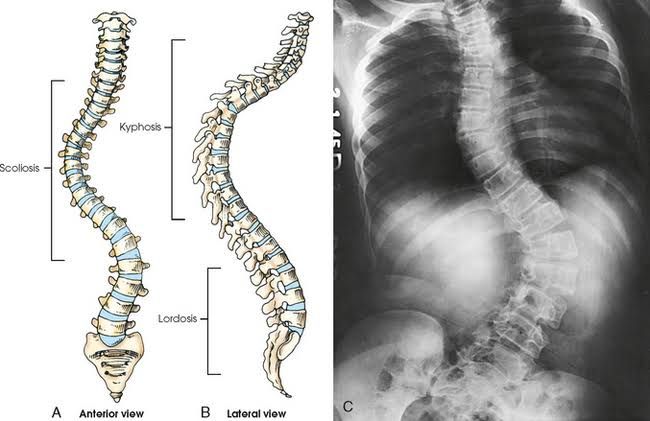
6. Radiography for Scoliosis
- Purpose: To assess the degree and progression of lateral curvature of the spine.
- Patient Positioning:
- The examination is performed with the patient standing (erect) to demonstrate the condition under the effect of gravity.
- A single long-format AP or PA projection is performed. The PA projection is preferred to reduce radiation dose to the breast and thyroid tissue.
- The patient stands with their back (for PA) or front (for AP) against the IR, with weight evenly distributed on both feet.
- The IR must be long enough to include from C7/T1 down to the iliac crests. Digital image stitching may be used.
- Central Ray (CR): Perpendicular, directed to the mid-thoracic region.
- Image Criteria: The entire thoracic and lumbar spine is included. The iliac crests are visible for assessing skeletal maturity (Risser sign). Minimal rotation is present.
- Supplementary View (Ferguson Method): A second AP view may be taken with a block placed under the foot on the convex side of the curve to evaluate curve flexibility.
7. Radiography for Kyphosis
- Purpose: To assess the degree of exaggerated posterior curvature of the thoracic spine (kyphosis).
- Patient Positioning:
- The examination is performed with the patient standing in a true lateral position.
- The patient should stand naturally without support. Arms may be held forward or above the head to clear the spine.
- The IR must include the entire thoracic and lumbar spine.
- Central Ray (CR): Perpendicular, directed to the mid-thoracic region (T7).
- Image Criteria: The entire thoracic and lumbar spine is demonstrated in a true lateral profile, allowing for the measurement of the kyphotic angle (Cobb angle).
Conclusion
Mastery of vertebral column radiography requires a blend of technical precision, anatomical knowledge, and a commitment to patient-centered care. By following these structured protocols, radiologic technologists can consistently produce high-quality diagnostic images that are essential for accurate diagnosis and effective patient management, while always prioritizing radiation safety and patient well-being.