The Three Primary Colors
In the context of light, the three primary colors are Red, Green, and Blue (RGB). These are known as additive primary colors because, when combined, they create different hues. For instance, mixing red and green light produces yellow, red and blue light produce magenta, and green and blue light produce cyan. When all three primary colors of light are combined in equal proportions, they produce white light. This additive color system is fundamental to understanding how our eyes perceive color, particularly through the lens of the Young-Helmholtz theory.
The Young-Helmholtz Trichromatic Theory of Color Vision
The Young-Helmholtz Trichromatic Theory, independently proposed by Thomas Young in 1802 and later refined by Hermann von Helmholtz in 1852, is the cornerstone of our understanding of color perception at the retinal level. This theory posits that the human eye possesses three distinct types of cone photoreceptors, each maximally sensitive to different wavelengths of light, corresponding roughly to red, green, and blue.
- Long-Wavelength (L) Cones: These cones are most sensitive to longer wavelengths of light, peaking in the yellowish-green region, often referred to as “red” cones.
- Medium-Wavelength (M) Cones: These cones are most sensitive to medium wavelengths, peaking in the green region, and are known as “green” cones.
- Short-Wavelength (S) Cones: These cones are most sensitive to shorter wavelengths, peaking in the blue region, and are referred to as “blue” cones.
It’s important to note that the sensitivity curves of these cones overlap significantly. For example, L-cones also respond to green light, and M-cones respond to red light, albeit less strongly than to their preferred wavelengths. The brain interprets a specific color by analyzing the relative levels of excitation from these three types of cones. If, for instance, a pure yellow light strikes the retina, it will strongly stimulate both the L-cones and M-cones, while only minimally stimulating the S-cones. The brain processes this specific ratio of stimulation and perceives it as yellow. This differential activation allows for the perception of millions of distinct colors from the three primary spectral sensitivities. This theory successfully explains various forms of color blindness, which often arise from the absence or malfunction of one or more types of cones.
The Color Vision Pathway
The journey of color information from the eye to the brain is a complex neural pathway:
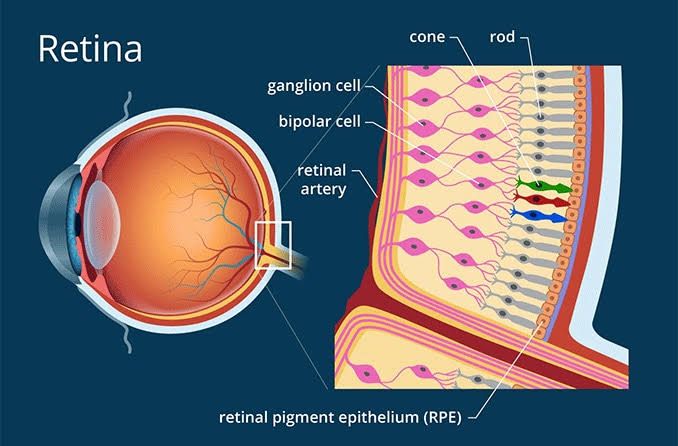
- Retina (Photoreceptors): The process begins in the retina, specifically with the cone photoreceptor cells. As discussed, L, M, and S cones absorb light of different wavelengths, converting light energy into electrical signals.
- Retina (Bipolar Cells): These electrical signals are then transmitted to bipolar cells, which act as an intermediary, relaying information from the photoreceptors to the ganglion cells.
- Retina (Ganglion Cells): From the bipolar cells, the signals reach the retinal ganglion cells. For color vision, a specialized subset of ganglion cells, known as parvocellular (P-type) ganglion cells, are particularly crucial. These cells begin to process color information in an “opponent-process” fashion, creating channels that respond to opposing color pairs (red-green, blue-yellow). For example, some P-cells are excited by red light and inhibited by green light, while others show the opposite response. This opponent processing enhances color contrast and allows for distinctions that the trichromatic theory alone cannot fully explain at this stage.
- Optic Nerve: The axons of the retinal ganglion cells converge to form the optic nerve, which exits the back of the eye.
- Optic Chiasm: The optic nerves from both eyes meet at the optic chiasm. Here, fibers from the nasal (medial) half of each retina cross over to the opposite side of the brain, while fibers from the temporal (lateral) half remain on the same side. This arrangement ensures that the visual cortex in each hemisphere receives information from the entire contralateral visual field.
- Lateral Geniculate Nucleus (LGN) of the Thalamus: After the optic chiasm, the visual information travels via the optic tracts to the LGN, a relay center in the thalamus. The LGN has distinct layers; the parvocellular layers (P-layers) specifically receive and process color-opponent information from the P-type ganglion cells. It further refines these signals before sending them to the cortex.
- Primary Visual Cortex (V1): From the LGN, projections, known as optic radiations, carry the refined visual information to the primary visual cortex (V1), located in the occipital lobe. In V1, specific cells (often organized into “blobs”) are particularly responsive to color and further process the opponent-color signals.
- Higher Visual Areas: From V1, color information is then transmitted to higher visual areas, particularly area V4 (often referred to as the “color center” of the brain), where more complex aspects of color perception, such as color constancy (perceiving an object’s color as stable despite changes in illumination), are processed. This hierarchical processing allows for the construction of a complete and stable color experience.
Color Blindness (Color Vision Deficiency) and Diagnostic Tests
Color Blindness, more accurately termed Color Vision Deficiency (CVD), is a condition where an individual has difficulty distinguishing between certain colors or perceiving the full range of colors. It is most commonly genetic and X-linked, meaning it affects a significantly higher percentage of males than females.
Types of Color Blindness:
- Red-Green Color Blindness: The most common type, resulting from anomalies in L or M cones.
- Protanomaly: Reduced sensitivity to red light (anomalous L-cones).
- Protanopia: Complete absence of functional L-cones (dichromacy, red-green confusion).
- Deuteranomaly: Reduced sensitivity to green light (anomalous M-cones).
- Deuteranopia: Complete absence of functional M-cones (dichromacy, green-red confusion).
- Blue-Yellow Color Blindness: Less common, involving abnormalities in S cones.
- Tritanomaly: Reduced sensitivity to blue light.
- Tritanopia: Complete absence of functional S-cones.
- Achromatopsia (Monochromacy): The rarest and most severe form, where an individual sees only shades of grey. This occurs due to a complete absence or malfunction of all cone photoreceptors, leading to extremely poor visual acuity and severe light sensitivity (photophobia).
Causes: While usually genetic (congenital), CVD can also be acquired due to various factors like diseases (e.g., glaucoma, diabetes), medications, chemical exposure, or retinal damage.
Tests to Detect Color Blindness:
- Ishihara Color Vision Test:
- This is the most widely used screening test. It consists of a series of “pseudoisochromatic plates” – plates with numbers or pathways composed of colored dots embedded within a field of similarly colored dots. Individuals with normal color vision can easily discern the hidden number or path, while those with certain types of CVD will have difficulty or see a different number/path. It primarily screens for red-green deficiencies.
- Farnsworth Munsell 100 Hue Test (and D-15 Test):
- This test assesses the ability to discriminate between subtle shades of color. The full 100 Hue Test involves arranging 100 caps of slightly different hues in sequential order. The D-15 (Dichotomous 15) is a shorter version, often used for screening, where 15 caps must be arranged. The pattern of errors can help identify the type and severity of CVD.
- Anomaloscope:
- Considered the most precise diagnostic test, particularly for red-green deficiencies. The individual views a bipartite field: one half contains a pure yellow light, and the other half contains a mixture of red and green light. The task is to adjust the amounts of red and green light until the two halves appear to match the target yellow. The amounts of red and green required reveal specific deficiencies (e.g., protanomaly, deuteranomaly).
- Lantern Tests (e.g., Farnsworth Lantern Test):
- These tests are used for occupational screening (e.g., pilots, sailors) where precise color identification is critical for safety. They involve identifying sequences of colored lights (red, green, white) presented at a distance, simulating real-world signaling conditions.
Mechanism of Dark Adaptation
Dark adaptation is the process by which the eyes increase their sensitivity to light in low-illuminance conditions, allowing us to see in dim environments after transitioning from bright light. This process is time-dependent and involves both photopigment regeneration and neural adjustments.
- Pupil Dilation: Immediately upon entering a dark environment, the pupil dilates (widens) to allow more light to enter the eye. This is a rapid, reflexive response.
- Photopigment Regeneration (Rods and Cones):
- Bleaching in Bright Light: In bright light, photopigments (rhodopsin in rods, photopsins in cones) are “bleached” – they break down into their constituent components (opsin protein and retinal, a derivative of Vitamin A). This bleaching makes the photoreceptors much less sensitive to light.
- Regeneration in Darkness: In darkness, these components recombine to regenerate the photopigments.
- Cone Regeneration: Cone photopsins regenerate relatively quickly, accounting for the initial rapid phase of dark adaptation (first 5-10 minutes), where there’s a modest increase in sensitivity. This is known as photopic vision.
- Rod Regeneration: Rhodopsin in rods regenerates much more slowly, taking up to 30-45 minutes for full regeneration. This slower, more significant increase in sensitivity allows for scotopic vision (night vision), which is highly sensitive to light but lacks color discrimination. The regeneration of rhodopsin is critical; a molecule of Vitamin A (retinal) is isomerized from the trans to the cis form and then recombines with the opsin protein.
- Neural Plasticity and Retinal Processing: Beyond photoreceptor changes, neural circuits in the retina and beyond also adjust. Ganglion cells and interneurons become more sensitive to weaker signals, amplifying the limited light information available. This involves changes in synaptic transmission and signal integration. The neural pathway effectively switches from primarily cone-mediated (high acuity, color) to primarily rod-mediated (high sensitivity, no color).
- Shift in Spectral Sensitivity (Purkinje Shift): As the eyes adapt to darkness, their peak sensitivity shifts from the photopic peak (around 555 nm, yellowish-green) to the scotopic peak (around 507 nm, blue-green). This is why reds appear darker and blues brighter in dim light.
Mechanism of Light Adaptation
Light adaptation is the converse process to dark adaptation, enabling the eyes to adjust to a sudden increase in illumination. This is a much faster process, occurring almost instantaneously.
- Pupil Constriction: The immediate and most rapid response is the constriction (narrowing) of the pupil. This reduces the amount of light entering the eye, protecting the photoreceptors from overstimulation and reducing glare.
- Photopigment Bleaching: In bright light, a large proportion of rhodopsin in rods and photopsins in cones rapidly break down (bleach). This reduces the availability of active photopigments, thereby decreasing the overall sensitivity of the photoreceptors. For rods, extensive bleaching leads to their saturation, making them effectively non-functional in bright light, thus shifting vision almost entirely to cones.
- Photoreceptor Desensitization: Beyond pigment breakdown, the photoreceptors themselves become less sensitive. This involves biochemical changes within the photoreceptor cells, such as a decrease in intracellular cyclic GMP (cGMP) levels, which directly affects the closure of ion channels responsible for the phototransduction cascade. High calcium levels, a consequence of light exposure, also contribute to this desensitization by modulating the enzymes involved in photopigment regeneration.
- Neural Adjustments: Higher-level neural circuits also rapidly adapt. The sensitivity of retinal neurons and subsequent visual pathway components effectively decreases to accommodate the stronger signals from the active photoreceptors, preventing saturation and allowing for a wide dynamic range of light perception.
Night Blindness (Nyctalopia) and Its Causes
Night blindness, or nyctalopia, is a condition characterized by impaired vision in low-light conditions or difficulty seeing in the dark. Individuals with night blindness struggle to adapt to dim environments, often finding it hard to navigate or perform tasks at dusk or in poorly lit rooms. This condition is almost invariably linked to a malfunction of the rod photoreceptors, which are responsible for scotopic (low-light) vision.
Causes of Night Blindness:
- Vitamin A Deficiency: This is one of the most common reversible causes globally, particularly in developing countries. Vitamin A (retinol) is a crucial precursor for retinal, which in turn forms part of the rhodopsin molecule found in rods. Without sufficient Vitamin A, rhodopsin cannot be adequately synthesized, impairing rod function and leading to night blindness.
- Retinitis Pigmentosa (RP): This is a group of inherited eye diseases that cause progressive degeneration of the retina. RP typically affects the rod photoreceptors first, leading to a gradual loss of peripheral vision and night vision, eventually progressing to central vision loss. It is a leading genetic cause of night blindness.
- Congenital Stationary Night Blindness (CSNB): This is a non-progressive, inherited disorder that affects the ability of rods to respond to light. It is present from birth and does not worsen over time. Various genetic mutations can cause CSNB, affecting different parts of the phototransduction cascade in rods.
- Cataracts: A cataract is a clouding of the eye’s natural lens. While primarily causing blurred vision, glare, and faded colors, it can also significantly reduce the amount of light reaching the retina, particularly in dim conditions, and thus impede night vision. Surgical removal of cataracts can often restore night vision.
- Glaucoma Medications: Certain medications used to treat glaucoma (e.g., pilocarpine) can cause the pupil to constrict (miosis), thereby reducing the light entering the eye and exacerbating night vision difficulties.
- Zinc Deficiency: Zinc plays a role in the transport and metabolism of Vitamin A and is essential for the enzymatic conversion of retinol to retinal. While less common, severe zinc deficiency can indirectly contribute to night blindness.
In conclusion, the intricate processes of color perception, mediated by the trichromatic theory and complex neural pathways, work in concert with the remarkable adaptability of our visual system to varying light conditions. Understanding the mechanisms of dark and light adaptation, as well as the causes of conditions like night blindness, provides profound insight into the sophisticated biological engineering behind one of our most vital senses.