The human heart, a marvel of biological engineering, is a tirelessly working muscular pump essential for sustaining life. Its intricate structure and precise function ensure the continuous circulation of oxygenated blood throughout the body and deoxygenated blood to the lungs. When this complex system falters, particularly its delicate valves, serious health conditions can arise.
The Heart: Anatomy and Physiology
The heart is a fist-sized, cone-shaped organ situated in the mediastinum, slightly to the left of the sternum. Its primary function is to pump blood, delivering oxygen and nutrients to tissues while removing carbon dioxide and waste products.
1. Heart Anatomy
The heart is composed of four chambers, four valves, and a complex network of blood vessels:
- Chambers:
- Atria (Upper Chambers): The Right Atrium receives deoxygenated blood from the body via the superior and inferior vena cava. The Left Atrium receives oxygenated blood from the lungs via the pulmonary veins.
- Ventricles (Lower Chambers): The Right Ventricle pumps deoxygenated blood to the lungs via the pulmonary artery. The Left Ventricle, the strongest chamber, pumps oxygenated blood to the rest of the body via the aorta.
- Valves: These fibrous structures ensure unidirectional blood flow, preventing backflow.
- Atrioventricular (AV) Valves:
- Tricuspid Valve: Located between the right atrium and right ventricle.
- Mitral (Bicuspid) Valve: Located between the left atrium and left ventricle.
- Semilunar Valves:
- Pulmonic (Pulmonary) Valve: Located between the right ventricle and pulmonary artery.
- Aortic Valve: Located between the left ventricle and aorta.
- Atrioventricular (AV) Valves:
- Major Blood Vessels:
- Vena Cava (Superior & Inferior): Return deoxygenated blood from the body to the right atrium.
- Pulmonary Artery: Carries deoxygenated blood from the right ventricle to the lungs.
- Pulmonary Veins: Carry oxygenated blood from the lungs to the left atrium.
- Aorta: The body’s largest artery, carrying oxygenated blood from the left ventricle to the systemic circulation.
- Myocardium: The muscular wall of the heart. The interventricular septum divides the two ventricles.
2. Heart Physiology
The heart’s function is best understood by following the path of blood circulation and the cardiac cycle:
- Blood Circulation:
- Deoxygenated blood enters the right atrium from the vena cava.
- It passes through the tricuspid valve into the right ventricle.
- The right ventricle contracts, pushing blood through the pulmonic valve into the pulmonary artery, which carries it to the lungs for oxygenation.
- Oxygenated blood returns from the lungs via the pulmonary veins to the left atrium.
- It then passes through the mitral valve into the left ventricle.
- The powerful left ventricle contracts, forcing blood through the aortic valve into the aorta, from where it is distributed to the entire body.
- Cardiac Cycle: Consists of two main phases:
- Diastole (Relaxation/Filling): The heart chambers relax and fill with blood.
- Systole (Contraction/Ejection): The heart chambers contract to eject blood.
- Electrical Conduction System: The heart has its own electrical system that initiates and regulates its rhythmic contractions. The Sinoatrial (SA) node acts as the natural pacemaker, generating electrical impulses that spread through the atria, causing them to contract. The impulse then travels to the Atrioventricular (AV) node, which briefly delays it before conducting it to the ventricles via the Bundle of His and Purkinje fibers, causing ventricular contraction.
Valvular Heart Diseases (VHDs)
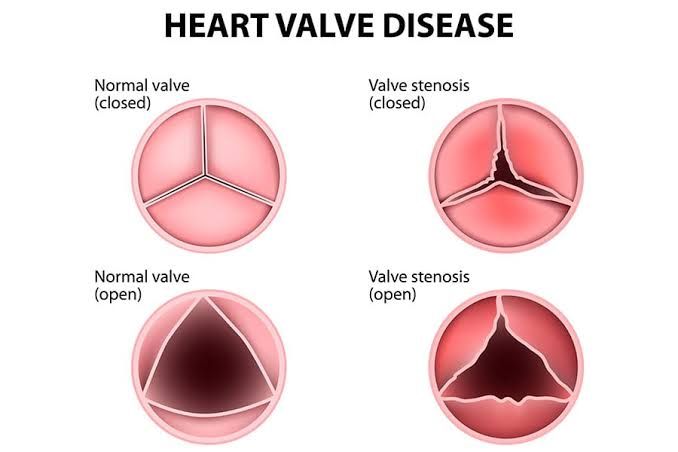
Valvular heart diseases occur when one or more of the heart’s valves are damaged or diseased, leading to impaired blood flow. This impairment typically manifests as either stenosis (narrowing of the valve opening, impeding forward blood flow) or regurgitation (incompetence, or leakage, of the valve, allowing backflow of blood).
1. Aortic Stenosis (AS)
- Pathophysiology: Aortic stenosis is the narrowing of the aortic valve opening, obstructing blood flow from the left ventricle to the aorta. This increases pressure in the left ventricle, causing it to work harder and leading to left ventricular hypertrophy (thickening of the muscle). Over time, this can lead to heart failure. Common causes include age-related calcification, congenital bicuspid aortic valve, and rheumatic heart disease.
- Signs: Systolic ejection murmur (crescendo-decrescendo, heard loudest at the right upper sternal border, radiating to the carotids), diminished S2 heart sound, carotid shudder.
- Symptoms: Classic triad: angina (chest pain), syncope (fainting), and dyspnea (shortness of breath). Other symptoms include fatigue, palpitations, and heart failure symptoms.
- Diagnosis: Clinical examination (murmur), Electrocardiogram (ECG) showing left ventricular hypertrophy, Chest X-ray (cardiomegaly, calcified valve).
- Investigations: Echocardiography (Transthoracic and Transesophageal) is the definitive diagnostic tool, assessing valve structure, gradients, and ventricular function. Cardiac catheterization may be used to measure pressure gradients and assess coronary artery disease before surgery.
- Indications for Surgical Intervention:
- Symptomatic severe AS (even with preserved LV function).
- Asymptomatic severe AS with left ventricular dysfunction (ejection fraction < 50%).
- Asymptomatic severe AS with symptoms on exercise testing.
- Severe AS in patients undergoing other cardiac surgery (e.g., CABG).
2. Aortic Regurgitation (AR)
- Pathophysiology: Aortic regurgitation (also known as aortic insufficiency) occurs when the aortic valve fails to close completely during diastole, causing blood to leak back from the aorta into the left ventricle. This volume overload increases the workload on the left ventricle, leading to its dilation and hypertrophy. Chronic untreated AR can lead to progressive LV dysfunction and heart failure. Causes include aortic root dilation, valvular degeneration, endocarditis, and rheumatic fever.
- Signs: Diastolic decrescendo murmur (heard best at the left sternal border), wide pulse pressure (high systolic, low diastolic), water-hammer pulse (Corrigan’s pulse), Duroziez’s sign (femoral artery murmur).
- Symptoms: Often asymptomatic for years. Symptoms include dyspnea on exertion, orthopnea, paroxysmal nocturnal dyspnea (PND), angina, palpitations, and fatigue.
- Diagnosis: Clinical examination (murmurs, peripheral signs), ECG (LV hypertrophy), Chest X-ray (cardiomegaly, dilated aorta).
- Investigations: Echocardiography (TTE/TEE) is crucial for assessing severity, LV size/function, and etiology. Cardiac MRI can provide detailed volumetric assessment. Cardiac catheterization may be used prior to surgery.
- Indications for Surgical Intervention:
- Symptomatic severe AR.
- Asymptomatic severe AR with Left Ventricular Ejection Fraction (LVEF) < 50%.
- Asymptomatic severe AR with severe LV dilation (LV end-systolic dimension > 50 mm or end-diastolic dimension > 65 mm).
- Severe AR in patients undergoing other cardiac surgery.
3. Mitral Stenosis (MS)
- Pathophysiology: Mitral stenosis is the narrowing of the mitral valve opening, obstructing blood flow from the left atrium to the left ventricle. This causes pressure buildup in the left atrium, leading to left atrial enlargement and increased pulmonary venous pressure. Long-standing MS can lead to pulmonary hypertension and right heart failure. The most common cause is rheumatic fever.
- Signs: Diastolic rumble murmur with an opening snap, loud S1, signs of pulmonary hypertension (e.g., elevated JVP).
- Symptoms: Dyspnea (especially with exertion), fatigue, orthopnea, PND, hemoptysis (coughing blood), palpitations (due to atrial fibrillation), and signs of right heart failure (edema).
- Diagnosis: Clinical examination (murmur), ECG (left atrial enlargement, atrial fibrillation), Chest X-ray (left atrial enlargement, pulmonary congestion).
- Investigations: Echocardiography (TTE/TEE) is definitive for assessing valve anatomy, area, gradients, and pulmonary pressures. Cardiac catheterization is rarely needed for diagnosis but may be indicated before intervention to assess pulmonary pressures or coronary arteries.
- Indications for Surgical Intervention:
- Symptomatic severe MS.
- Moderate to severe MS with recurrent embolic events despite anticoagulation.
- Severe MS with pulmonary hypertension.
- MS in patients undergoing other cardiac surgery.
- Percutaneous balloon mitral valvuloplasty (PBMV) is often the preferred initial intervention for severe, symptomatic, non-calcified MS without significant regurgitation.
4. Mitral Regurgitation (MR)
- Pathophysiology: Mitral regurgitation occurs when the mitral valve fails to close completely during left ventricular systole, causing blood to leak back into the left atrium from the left ventricle. This volume overload leads to left atrial and left ventricular dilation. Over time, it can result in left ventricular dysfunction, pulmonary hypertension, and heart failure. Causes include mitral valve prolapse, ischemic heart disease (papillary muscle dysfunction), endocarditis, and rheumatic heart disease.
- Signs: Holosystolic murmur (heard loudest at the apex, radiating to the axilla).
- Symptoms: Often asymptomatic for a long time. Symptoms include dyspnea on exertion, fatigue, palpitations (due to atrial fibrillation), and symptoms of heart failure (edema, orthopnea).
- Diagnosis: Clinical examination (murmur, signs of heart failure), ECG (left atrial/ventricular enlargement, atrial fibrillation), Chest X-ray (cardiomegaly, pulmonary vascular congestion).
- Investigations: Echocardiography (TTE/TEE) is critical for assessing severity, etiology, ventricular size/function, and pulmonary pressures. Cardiac MRI may be used in selected cases.
- Indications for Surgical Intervention:
- Symptomatic severe MR.
- Asymptomatic severe MR with LVEF < 60% or LV end-systolic dimension > 40 mm.
- Severe MR with new-onset atrial fibrillation or pulmonary hypertension.
- Severe MR in patients undergoing other cardiac surgery.
- Mitral valve repair is often preferred over replacement when feasible.
Valve Replacement Conduits: Advantages and Disadvantages
When valvular heart disease progresses to a severe stage, surgical intervention, often involving valve replacement, becomes necessary. The choice of prosthetic valve is a crucial decision, weighing the patient’s age, lifestyle, co-morbidities, and preferences. The main types are mechanical and bioprosthetic valves.
1. Mechanical Heart Valves
- Description: Manufactured from durable synthetic materials like pyrolytic carbon and metal alloys. They are designed for longevity.
- Advantages:
- Exceptional Durability: Highly durable, offering a near-permanent solution, especially beneficial for younger patients.
- Less Prone to Degeneration: Do not degenerate or calcify like tissue valves.
- Disadvantages:
- Lifelong Anticoagulation: Require lifelong anticoagulation therapy with warfarin to prevent blood clot formation on the valve, which can lead to stroke or valve thrombosis. This carries a risk of bleeding complications.
- Audible Click: Patients may hear a “click” as the valve opens and closes, which can be bothersome for some.
- Risk of Thromboembolism: Despite anticoagulation, there remains a small but persistent risk of clot formation and subsequent embolism.
2. Bioprosthetic Heart Valves (Tissue Valves)
- Description: Derived from animal tissue (porcine – pig, bovine – cow pericardium) or, less commonly, human cadaveric tissue (allografts/homografts). These valves are treated to reduce antigenicity and increase durability.
- Advantages:
- No Lifelong Anticoagulation: Typically do not require lifelong anticoagulation, as the risk of thrombosis is much lower than with mechanical valves (though a short course of anticoagulation or antiplatelet therapy may be prescribed initially). This makes them suitable for patients unable to take anticoagulants or those desiring pregnancy.
- No Audible Click: Quieter than mechanical valves, providing a more natural feel.
- Disadvantages:
- Limited Durability: Prone to structural degeneration, calcification, and tearing over time, leading to eventual failure. Their lifespan varies but is generally 10-15 years, often necessitating re-operation. Durability is inversely related to age (they fail faster in younger patients due to higher metabolic activity and calcium turnover).
- Re-operation Risk: The need for repeat surgery (re-intervention) is a significant long-term disadvantage.
- Higher Risk of Early Failure in Younger Patients: Biological valves tend to degenerate more rapidly in younger individuals.
Percutaneous Balloon Valvuloplasty (PBV)
Percutaneous balloon valvuloplasty (also known as balloon valvotomy) is a minimally invasive catheter-based procedure designed to treat stenotic (narrowed) heart valves, primarily the mitral and pulmonic valves, and sometimes the aortic valve in select pediatric or young adult cases.
- Procedure Explanation:
- A catheter with a deflated balloon at its tip is inserted into a blood vessel (typically in the groin or arm).
- Guided by fluoroscopy (X-ray imaging) and echocardiography, the catheter is advanced to the narrowed heart valve.
- Once positioned across the stenotic valve, the balloon is inflated for a short period, widening the valve opening by fracturing calcifications or separating fused leaflets.
- The balloon is then deflated and withdrawn. This procedure avoids open-heart surgery, reducing recovery time and potential complications.
- Indications:
- Symptomatic, Severe Mitral Stenosis: This is the most common and successful application of PBV, especially in patients with non-calcified or minimally calcified valves, no significant mitral regurgitation, and favorable valve anatomy (e.g., pliable leaflets without extensive subvalvular fusion). It is often preferred over surgery in suitable candidates.
- Congenital Pulmonary Stenosis: Highly effective in treating isolated pulmonary valve stenosis, particularly in children and young adults.
- Congenital Aortic Stenosis: Can be used in selected cases of congenital aortic stenosis in children or young adults to delay the need for surgical replacement, though results are generally less durable than for mitral or pulmonary stenosis.
- Severe Aortic Stenosis in High-Risk Surgical Patients (as a Bridge or Palliative Measure): In elderly or very high-risk patients unsuitable for surgical aortic valve replacement (SAVR) or transcatheter aortic valve implantation (TAVI), PBV might be considered a palliative measure to improve symptoms temporarily or as a bridge to other definitive therapies.
Conclusion
The heart’s intricate design, from its chambers and valves to its electrical system, orchestrates the relentless flow of life-sustaining blood. Valvular heart diseases, whether stenosis or regurgitation, present significant challenges to this vital function, often leading to progressive heart failure if left untreated. Advances in diagnostic imaging, particularly echocardiography, allow for precise identification and quantification of these conditions. Therapeutic interventions range from lifestyle modifications and medications to advanced surgical valve replacement and minimally invasive procedures like percutaneous balloon valvuloplasty. The choice of valve replacement conduit, be it mechanical or bioprosthetic, involves a careful consideration of the patient’s individual circumstances, highlighting the personalized approach required in modern cardiovascular medicine. Understanding these complex aspects is paramount for healthcare professionals and patients alike in navigating the journey toward optimal heart health.