X-ray tubes are the fundamental components responsible for generating X-rays, which are indispensable in medical imaging, industrial inspection, and scientific research. Understanding their intricate design, operational principles, and inherent characteristics is crucial for safe and effective application.
Core Components of a Generic X-Ray Tube
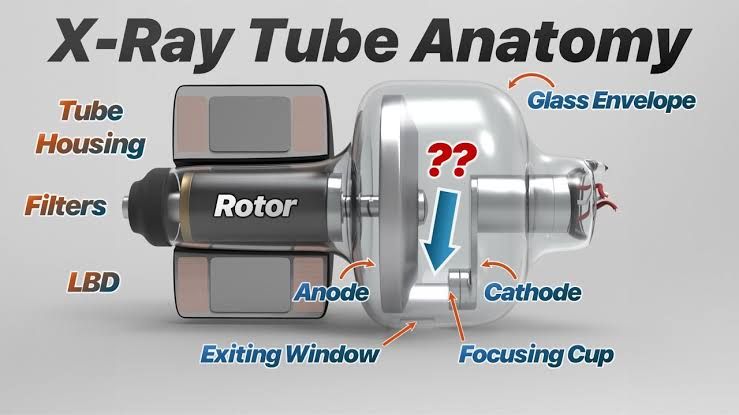
At its core, an X-ray tube is a specialized vacuum tube designed to accelerate electrons to high speeds and then rapidly decelerate them, thereby producing X-ray photons. While variations exist, all X-ray tubes share several fundamental components:
- Cathode: This is the negative electrode, serving as the source of electrons. It typically consists of:
- Filament: A small coil of wire, usually made of thoriated tungsten, which, when heated by an electric current (thermionic emission), emits electrons.
- Focusing Cup: A negatively charged, concave metal cup (e.g., nickel or molybdenum) that surrounds the filament. Its electrostatic repulsion focuses the emitted electron cloud into a tight beam directed towards the anode.
- Anode: This is the positive electrode, which serves as the target for the electron beam and the site of X-ray production. It must be able to withstand extremely high temperatures.
- Target Track/Spot: The specific area on the anode where the electron beam strikes. This is typically made of tungsten or a tungsten-rhenium alloy due to their high atomic number (efficient X-ray production) and high melting point.
- Stem/Base: A conductive pathway for heat dissipation and electrical connection, often made of copper due to its excellent thermal conductivity.
- Glass Envelope: A vacuum-sealed enclosure, typically made of Pyrex glass (borosilicate glass) or metal, which houses the cathode and anode. Maintaining a high vacuum within the envelope is critical to prevent collisions between electrons and gas molecules, which would reduce efficiency, generate undesirable heat, and damage the filament.
- Window: A thin, typically beryllium or Pyrex glass, segment of the glass envelope through which the X-ray photons exit the tube. Beryllium is often preferred for low-energy applications due to its minimal absorption of X-rays.
- Protective Housing: A lead-lined, oil-filled metal casing that surrounds the glass envelope. Its primary functions include:
- Radiation Protection: The lead lining absorbs undesirable off-axis X-rays (leakage radiation), protecting personnel and patients.
- Electrical Insulation: The oil provides electrical insulation for the high voltage applied across the tube.
- Heat Dissipation: The oil absorbs heat from the glass envelope and facilitates its transfer to the housing’s external cooling fins, allowing for efficient heat dissipation to the ambient air.
Fixed Anode X-Ray Tube and Its Components
The fixed (or stationary) anode X-ray tube represents an earlier and simpler design, primarily used in applications where high power and rapid heat dissipation are not paramount.
Description: In a fixed anode tube, the anode assembly remains stationary. The electron beam from the cathode consistently strikes the same small target area on the anode. This design is robust and relatively inexpensive.
Components Specific to Fixed Anode Tubes:
- Stationary Anode Block: This is a large block of copper, chosen for its excellent thermal conductivity. Embedded within the copper block, at the site of electron impact, is the target material. This target is almost universally made of tungsten (W) due to its high atomic number (Z=74), which ensures efficient production of X-rays, and its high melting point (3422°C), allowing it to withstand the intense heat generated. Sometimes, a thin layer of rhenium is added to the tungsten for increased strength and prevention of pitting at high temperatures.
- Heat Dissipation: Because the target area is fixed, heat concentrates rapidly. To manage this, the copper anode block is often quite massive, serving as a heat sink. It relies on conduction to transfer heat away from the target spot into the rest of the copper body, which then dissipates heat into the oil within the protective housing via convection. External cooling fins on the protective housing further aid in dissipating heat to the ambient air.
Applications: Fixed anode tubes are typically found in dental X-ray units, some portable X-ray machines, and older fluoroscopic systems where exposure times are short and power requirements are moderate.
Limitations: The primary limitation of fixed anode tubes is their limited heat capacity. Concentrating a large amount of energy onto a single, small, stationary target area quickly leads to high temperatures, restricting the maximum power output, exposure time, and frequency of exposures. Overheating can damage or pit the target, leading to reduced X-ray output and image degradation.
Rotating Anode X-Ray Tube and Its Components
The rotating anode X-ray tube is the dominant design in modern diagnostic imaging due to its superior heat dissipation capabilities, enabling higher power outputs and longer exposure times.
Description: In a rotating anode tube, the anode disc continuously spins at high speed while the electron beam strikes its beveled edge. This distributes the heat generated by electron bombardment over a much larger surface area, significantly increasing the tube’s heat capacity.
Components Specific to Rotating Anode Tubes:
- Rotating Anode Disc: This is the core component. It is a beveled disc, typically 7-13 cm in diameter, constructed from materials optimized for heat capacity and X-ray production.
- Target Material: The outer rim of the disc, where the electron beam strikes, is coated with tungsten-rhenium alloy. Rhenium adds mechanical strength and elasticity, helping the tungsten withstand the stresses of rapid heating and cooling and preventing cracking or pitting.
- Base Material: The main body of the disc is often made of molybdenum (Mo) or a graphite substrate underneath the tungsten-rhenium. Molybdenum has a relatively high melting point (2623°C) and is a good conductor of heat. Graphite is increasingly used as a backing for the tungsten-rhenium alloy due to its superior heat storage capacity and lower density.
- Anode Stem: Connects the rotating anode disk to the rotor. Usually made of molybdenum, which is a poor thermal conductor to reduce heat transfer from the anode disc to the rotor bearings.
- Rotor: A cylindrical component attached to the anode stem, comprising a copper cylinder with an iron core. It is situated within the vacuum of the glass envelope.
- Stator: A series of electromagnets arranged around the neck of the anode-end of the glass envelope, but outside the vacuum. When the stator coils are energized, they create a rotating magnetic field that induces eddy currents in the rotor, causing it to spin via electromagnetic induction.
- Ball Bearings: High-temperature-resistant bearings (often silver-plated for lubrication in vacuum) support the rotating anode stem, allowing for smooth, high-speed rotation (typically 3,000-10,000 RPM or even higher for specialized tubes).
Advantages: The primary advantage of rotating anode tubes is their significantly enhanced heat dissipation. By spreading the heat over a larger constantly moving target area, they can handle much higher tube currents and longer exposure times, leading to more intense X-ray beams and greater diagnostic capabilities.
Applications: Rotating anode tubes are used in virtually all modern diagnostic imaging equipment, including general radiography, computed tomography (CT), fluoroscopy, angiography, and mammography.
Anode Angle and Its Significance
The anode angle (also known as target angle or target inclination) refers to the angle of the target surface with respect to the central ray of the X-ray beam or, more precisely, the incident electron beam. It is typically a small angle, ranging from approximately 6 to 20 degrees in diagnostic tubes.
Significance:
The anode angle plays a critical role in balancing two crucial parameters:
- Effective Focal Spot Size: A smaller anode angle results in a smaller effective focal spot for a given actual focal spot size (as explained by the line focus principle below). A smaller effective focal spot leads to sharper, more detailed images by reducing geometric unsharpness.
- Field Size Coverage: A smaller anode angle, while creating a sharper image, limits the maximum field of view that can be uniformly irradiated by the X-ray beam without severe anode heel effect (see Step 6). A larger anode angle allows for a wider field of view.
Compromise: The selection of the anode angle is a compromise between achieving high spatial resolution (smaller effective focal spot) and covering a sufficiently large anatomical area. Radiography systems often use angles between 12-15 degrees, while mammography tubes, requiring very high resolution over a small area, might use angles as low as 6-8 degrees. Conversely, tubes designed for large field-of-view applications might use larger angles, accepting slightly less sharpness.
Line Focus Principle
The line focus principle is a fundamental concept in X-ray tube design that allows for the simultaneous achievement of high heat capacity and high spatial resolution.
Explanation: This principle dictates that by angling the anode target, a larger actual focal spot (the area on the anode where electrons actually strike) can be used to distribute heat, while projecting a smaller effective focal spot (the apparent size of the X-ray source as viewed from the image receptor).
- Actual Focal Spot (A): The rectangular area on the anode target that is bombarded by the electron beam. For heat dissipation, a larger actual focal spot is desirable as it spreads the heat over a greater area.
- Effective Focal Spot (E): The projected size of the focal spot onto the image receptor plane. This is the size that determines the spatial resolution of the image. A smaller effective focal spot is desirable for sharper images.
Relationship: The mathematical relationship is: Effective Focal Spot = Actual Focal Spot × sin (Anode Angle)
Since the sine of a small angle is a small number (e.g., sin(10°) ≈ 0.17), a relatively large actual focal spot can be made to appear as a much smaller effective focal spot by using a small anode angle.
Benefits: The line focus principle is a brilliant engineering solution because it allows:
- Increased Heat Capacity: A larger actual focal spot distributes heat over a wider area on the anode, enabling higher tube currents and longer exposure times without damaging the target.
- Improved Spatial Resolution: A smaller effective focal spot minimizes geometric blur, resulting in sharper and more detailed radiographic images.
This principle is what makes high-output diagnostic X-ray tubes viable.
Anode Heel Effect
The anode heel effect describes the phenomenon where the intensity of the X-ray beam is not uniform across its field, but rather decreases towards the anode end of the tube and increases towards the cathode end.
Cause: This effect arises due to two primary factors:
- X-ray Absorption in Anode Material: As X-rays are produced at various depths within the target material, those traveling towards the anode end of the tube must traverse a greater thickness of the target material compared to those traveling towards the cathode end. This increased path length leads to greater self-absorption of X-ray photons within the anode itself.
- Target Angle: The oblique angle of the anode target further exacerbates this differential absorption. Photons emitted at larger angles (towards the cathode) have a shorter path through the target, while those emitted at smaller angles (towards the anode) have a longer, more absorbing path.
Impact on Image Quality: The anode heel effect results in a noticeable intensity gradient across the radiographic image. The image will appear darker (more exposure) on the cathode side and lighter (less exposure) on the anode side. The magnitude of this effect is influenced by:
- Anode Angle: Smaller anode angles increase the heel effect.
- Source-to-Image Distance (SID): Shorter SIDs increase the heel effect because the angular divergence of the beam is more pronounced over a shorter distance.
- Image Receptor Size: Larger image receptors, covering a wider field, will demonstrate a more prominent heel effect.
Clinical Considerations: Understanding the anode heel effect is crucial for optimizing image quality in radiography:
- Patient Positioning: When imaging body parts with varying thicknesses, the thicker part of the anatomy (e.g., the thoracic spine in a lateral chest X-ray, or the abdomen in an abdominal X-ray) should be positioned towards the cathode end of the X-ray tube. This aligns the thicker part with the more intense portion of the X-ray beam, ensuring more uniform exposure and improved diagnostic quality.
- Tube Orientation: Radiographers often orient the X-ray tube to consciously utilize the anode heel effect to their advantage, ensuring proper exposure across the entire region of interest. For example, in a foot X-ray, the heel (thicker part) would be placed under the cathode end.
By carefully considering the components, operating principles, and inherent effects like the line focus principle and anode heel effect, medical professionals and technicians can leverage X-ray technology to its fullest potential, ensuring optimal diagnostic image quality and patient safety.