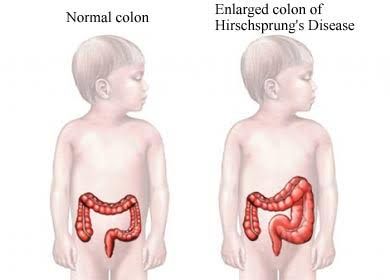
Hirschsprung’s disease (HD), also known as congenital aganglionic megacolon, is a birth defect characterized by the absence of ganglion cells in a segment of the colon, leading to chronic constipation and potential complications.
Definition and Epidemiology
Hirschsprung’s disease is defined by the absence of ganglion cells in the myenteric and submucosal plexuses of the colon. These ganglion cells are crucial for coordinated peristalsis, the rhythmic contractions that propel stool through the digestive tract. The absence of these cells results in a functional obstruction, preventing the passage of stool and leading to the characteristic symptoms of HD.
Epidemiology:
- Incidence: HD affects approximately 1 in 5,000 live births, making it a relatively rare condition.
- Gender Predilection: Males are affected more frequently than females, with a male-to-female ratio of approximately 4:1.
- Geographic Variation: The incidence of HD is relatively consistent across different geographic regions and ethnic groups.
- Associated Anomalies: HD can occur as an isolated anomaly or in association with other congenital conditions, such as Down syndrome (trisomy 21).
Pathogenesis and Etiology
The pathogenesis of HD involves a complex interplay of genetic and environmental factors that disrupt the normal development of the enteric nervous system (ENS). The ENS is responsible for controlling gastrointestinal motility, secretion, and blood flow.
Pathogenesis:
- Neural Crest Cell Migration: The ENS originates from neural crest cells, which migrate caudally from the neural crest along the developing gut during embryogenesis. In HD, this migration is disrupted, leading to the absence of ganglion cells in the affected segment of the colon.
- Proliferation and Differentiation: Even if neural crest cells reach the gut, defects in their proliferation, survival, or differentiation into ganglion cells can also result in aganglionosis.
- Apoptosis: Increased apoptosis (programmed cell death) of ganglion cells may contribute to the pathogenesis of HD.
Etiology:
- Genetic Factors: HD has a strong genetic component, with mutations in several genes implicated in its development. The most commonly identified gene is the RET proto-oncogene, which plays a critical role in the development of the ENS.
- Mutations in RET account for approximately 50% of familial cases and 15-20% of sporadic cases of HD.
- Other genes associated with HD include EDNRB, EDN3, GDNF, NRTN, SOX10, and SIP1.
- The inheritance pattern of HD can be complex, with both autosomal dominant and recessive modes of inheritance reported.
- Environmental Factors: While genetic factors play a primary role, environmental factors may also contribute to the development of HD, potentially influencing the expression of genes involved in ENS development. However, the specific environmental factors involved remain largely unknown.
Clinical Presentation and Patient History
The clinical presentation of HD varies depending on the length of the aganglionic segment and the age of the patient.
Common Symptoms:
- Neonates:
- Delayed passage of meconium: Failure to pass meconium within the first 24-48 hours of life is a hallmark sign of HD.
- Abdominal distension: The inability to pass stool leads to abdominal distension.
- Bilious vomiting: Obstruction can cause vomiting, often with bile.
- Refusal to feed: Infants with HD may exhibit poor feeding due to abdominal discomfort.
- Older Infants and Children:
- Chronic constipation: Difficulty passing stool, often requiring enemas or laxatives.
- Abdominal distension: Persistent abdominal swelling.
- Failure to thrive: Poor weight gain and growth due to malabsorption and decreased appetite.
- Enterocolitis: A potentially life-threatening complication characterized by inflammation of the colon, leading to fever, diarrhea, and abdominal pain.
Patient History:
A thorough patient history is crucial for diagnosing HD. Important aspects of the history include:
- Age of onset of symptoms: Note the age at which constipation or other symptoms began.
- Meconium passage: Inquire about the timing of meconium passage after birth.
- Bowel habits: Detail the frequency, consistency, and difficulty of bowel movements.
- Use of laxatives or enemas: Determine if the child requires medication or enemas to pass stool.
- Family history: Ask about any family history of HD or other gastrointestinal disorders.
- Associated anomalies: Inquire about any other congenital conditions or developmental delays.
Differentiation Between Hirschsprung’s Disease and Habitual Constipation
Differentiating HD from habitual constipation is crucial to ensure appropriate management. Habitual constipation, also known as functional constipation, is a common condition in children characterized by infrequent or difficult bowel movements without any underlying anatomical or physiological abnormalities.
Key Differentiating Factors:
| Feature | Hirschsprung’s Disease | Habitual Constipation |
|---|---|---|
| Onset | Typically in the neonatal period or early infancy | Usually later in childhood, often associated with toilet training |
| Meconium Passage | Delayed or absent | Normal |
| Abdominal Distension | Often present, can be significant | May be present, but usually less severe |
| Soiling | Less common | Common, especially with encopresis |
| Response to Laxatives | Limited or no response | Usually responsive to laxatives and dietary changes |
| Rectal Examination | Empty rectum with possible forceful expulsion of stool upon withdrawal | Rectum often filled with stool |
| Barium Enema | Transition zone between narrowed aganglionic segment and dilated proximal colon | Normal or diffuse colonic dilatation |
| Rectal Biopsy | Absence of ganglion cells | Presence of ganglion cells |
Investigation and Diagnosis
The diagnosis of HD typically involves a combination of clinical evaluation, imaging studies, and histological examination.
Diagnostic Tests:
- Rectal Examination: A rectal examination can reveal an empty rectum with a possible forceful expulsion of stool upon withdrawal of the examining finger, suggesting a functional obstruction.
- Barium Enema: A barium enema is an X-ray examination of the colon using barium contrast. In HD, a barium enema may show a “transition zone” between the narrowed aganglionic segment and the dilated, normally innervated colon.
- Anorectal Manometry: This test measures the pressure in the rectum and anal canal and can assess the function of the internal anal sphincter. In HD, the rectoanal inhibitory reflex is typically absent.
- Rectal Biopsy: The definitive diagnosis of HD is made by rectal biopsy, which involves obtaining a small sample of rectal tissue for histological examination. The absence of ganglion cells in the submucosal plexus confirms the diagnosis.
- Suction Biopsy: A suction biopsy can be performed at the bedside without anesthesia and is often the initial diagnostic test.
- Full-Thickness Biopsy: A full-thickness biopsy, which involves obtaining a larger tissue sample, may be necessary if the suction biopsy is inconclusive.
Surgical Treatment and Indications
The primary treatment for HD is surgical resection of the aganglionic segment of the colon, followed by anastomosis of the normally innervated colon to the anus.
Surgical Procedures:
- Pull-Through Procedures: These procedures involve resecting the aganglionic segment and pulling the normally innervated colon down to the anus. Common pull-through procedures include:
- Soave Procedure: The aganglionic colon is resected, and the normally innervated colon is pulled through the muscular cuff of the rectum.
- Duhamel Procedure: The normally innervated colon is brought down behind the rectum and anastomosed to the anus, creating a common channel.
- Swenson Procedure: The aganglionic colon is resected, and the normally innervated colon is directly anastomosed to the anus.
- Laparoscopic Surgery: Laparoscopic techniques are increasingly used for HD surgery, offering the benefits of smaller incisions, reduced pain, and faster recovery.
Indications for Surgery:
- Confirmed Diagnosis of HD: Surgery is indicated for all patients with a confirmed diagnosis of HD.
- Failure of Conservative Management: If non-surgical measures, such as enemas and stool softeners, fail to relieve symptoms, surgery is necessary.
- Complications: Complications such as enterocolitis or bowel obstruction require prompt surgical intervention.
Postoperative Care:
After surgery, patients require close monitoring for complications such as anastomotic leaks, strictures, and enterocolitis. Long-term follow-up is essential to monitor bowel function and address any ongoing issues.
Conclusion
Hirschsprung’s disease is a congenital disorder characterized by the absence of ganglion cells in the colon, leading to functional obstruction and constipation. Early diagnosis and surgical intervention are critical for improving outcomes and preventing complications. This comprehensive guide provides a thorough understanding of HD, from its definition and pathogenesis to its clinical presentation, diagnosis, and treatment, enabling healthcare professionals to effectively manage this challenging condition.