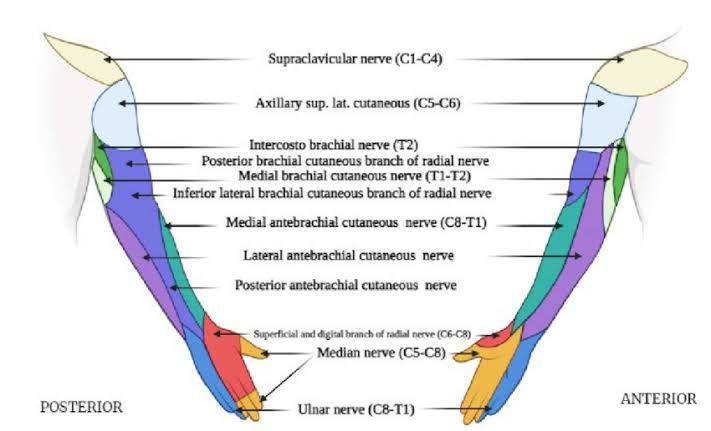
Understanding the intricate sensory pathways of the upper limb is fundamental for accurate neurological diagnosis. Two key concepts, dermatomes and cutaneous innervation, provide distinct yet interrelated frameworks for mapping sensation on the skin. While often discussed together, it is crucial to differentiate between them to precisely localize neurological lesions, whether at the spinal nerve root level or along peripheral nerves.
Dermatomes of the Upper Limb
Definition: A dermatome represents an area of skin supplied by the sensory fibers of a single spinal nerve root. These roots emerge from the spinal cord, and their somatosensory projections onto the skin follow a predictable pattern.
Formation: Dermatomes arise from the embryonic development where somites differentiate into specific tissue types, including the dermis, which retains its connection to its original spinal nerve segment. While there is a general, accepted map, individual variations and significant overlap between adjacent dermatomes exist due to the branching and intermingling of nerve fibers. This overlap means that complete sensory loss in a single dermatome often requires injury to more than one nerve root.
Clinical Significance: Assessing dermatomal sensation is vital for localizing lesions within the spinal cord or at the spinal nerve root level (e.g., disc herniation, spinal cord compression, or radiculopathy).
Mapping the Dermatomes of the Upper Limb:
The primary dermatomes contributing to the sensory supply of the arm and forearm are C5, C6, C7, C8, and T1. Their typical distributions are as follows:
- C5 Dermatome:
- Location: Extends over the lateral aspect of the shoulder, including the superior lateral arm, often described as the “regimental badge” area.
- Clinical Test: Sensation over the deltoid region.
- C6 Dermatome:
- Location: Covers the lateral forearm, radial side of the hand, thumb, and index finger.
- Clinical Test: Sensation over the radial aspect of the forearm and the thumb.
- C7 Dermatome:
- Location: Encompasses the middle of the posterior arm, posterior forearm, and the middle finger.
- Clinical Test: Sensation over the middle finger.
- C8 Dermatome:
- Location: Spans the medial forearm, ulnar side of the hand, ring finger, and little finger.
- Clinical Test: Sensation over the ulnar aspect of the hand and the little finger.
- T1 Dermatome:
- Location: Includes the medial aspect of the arm, extending into the axilla.
- Clinical Test: Sensation over the medial epicondyle region of the humerus.
Cutaneous Innervation of Specific Nerves in the Arm and Forearm
Definition: Cutaneous innervation refers to the specific areas of skin supplied by the sensory branches of a particular peripheral nerve. These nerves are formed by the intricate plexus (e.g., the brachial plexus) where fibers from multiple spinal nerve roots combine and then redistribute into distinct peripheral nerves.
Formation: Unlike dermatomes, which follow a segmental pattern, peripheral nerves typically contain fibers from several spinal roots but then innervate a more discrete, often elongated, territory of skin. This makes them susceptible to injury along their specific anatomical course.
Clinical Significance: Assessing cutaneous innervation is crucial for diagnosing and localizing lesions affecting specific peripheral nerves (e.g., nerve entrapment, transection, or neuropathy).
Mapping the Cutaneous Innervation of the Upper Limb Nerves:
The major peripheral nerves originating from the brachial plexus and supplying sensation to the arm and forearm are the axillary, musculocutaneous, radial, median, ulnar, and medial cutaneous nerves.
- Axillary Nerve (C5, C6):
- Cutaneous Branch: Superior lateral cutaneous nerve of the arm.
- Area of Innervation: Skin over the inferior part of the deltoid muscle, often termed the “regimental badge” area.
- Musculocutaneous Nerve (C5, C6, C7):
- Cutaneous Branch: Lateral cutaneous nerve of the forearm (also known as the lateral antebrachial cutaneous nerve).
- Area of Innervation: Lateral aspect of the forearm, extending from the elbow to the wrist.
- Radial Nerve (C5, C6, C7, C8, T1): The radial nerve has extensive cutaneous distribution through several branches:
- Posterior Cutaneous Nerve of the Arm: Skin along the posterior aspect of the arm.
- Inferior Lateral Cutaneous Nerve of the Arm: Skin on the inferolateral aspect of the arm.
- Posterior Cutaneous Nerve of the Forearm: Skin along the posterior aspect of the forearm.
- Superficial Radial Nerve (Superficial Branch of Radial Nerve):
- Area of Innervation: Dorsal aspect of the hand over the radial two-thirds (including the thumb, index finger, middle finger, and the radial half of the ring finger), extending only to the proximal phalanges; the dorsal tips of these fingers are usually supplied by the median nerve.
- Median Nerve (C5, C6, C7, C8, T1):
- Palmar Cutaneous Branch:
- Area of Innervation: Supplies the skin over the thenar eminence (base of the thumb on the palm). Notably, this branch typically arises proximal to the carpal tunnel and thus sensation in this area is usually spared in Carpal Tunnel Syndrome.
- Digital Cutaneous Branches:
- Area of Innervation: Palmar surface of the thumb, index finger, middle finger, and the radial half of the ring finger. These branches also supply the dorsal tips (distal to the DIP joints) of the same fingers.
- Palmar Cutaneous Branch:
- Ulnar Nerve (C8, T1):
- Dorsal Cutaneous Branch:
- Area of Innervation: Medial third of the dorsum of the hand, the entire little finger, and the ulnar half of the ring finger (extending somewhat proximally over the phalanges). This branch arises proximal to the wrist and thus supplies sensation to the ulnar dorsal hand even if the lesion is at the wrist.
- Palmar Cutaneous Branch:
- Area of Innervation: Ulnar side of the palm.
- Digital Cutaneous Branches:
- Area of Innervation: Palmar surface of the little finger and the ulnar half of the ring finger.
- Dorsal Cutaneous Branch:
- Medial Cutaneous Nerves:
- Medial Cutaneous Nerve of the Arm (C8, T1):
- Area of Innervation: Medial aspect of the arm.
- Medial Cutaneous Nerve of the Forearm (C8, T1):
- Area of Innervation: Medial aspect of the forearm.
- Medial Cutaneous Nerve of the Arm (C8, T1):
Correlating Dermatomes and Cutaneous Innervation
The primary distinction between dermatomes and cutaneous innervation lies in their anatomical basis: dermatomes relate to spinal cord segments (spinal nerve roots), while cutaneous innervation relates to specific peripheral nerves. While distinct, these two maps are not entirely independent, as peripheral nerves are formed by the amalgamation of fibers from multiple spinal roots.
Key Points of Correlation and Differentiation:
- Overlap of Origins: A single peripheral nerve typically carries sensory fibers from several spinal nerve roots. For example, the median nerve receives contributions from C5-T1, while the ulnar nerve primarily from C8, T1. Conversely, a single spinal nerve root contributes to multiple peripheral nerves.
- Distinct Patterns:
- Dermatomes: Present as relatively broad, circumferential bands or longitudinal strips reflecting their segmental embryonic origin. There is often significant overlap between adjacent dermatomes, meaning a single root lesion may not cause complete anesthesia.
- Cutaneous Innervation: Follows the specific, often more discrete and linear, anatomical distribution of a peripheral nerve. The sensory loss pattern is usually clearly demarcated and distinct for each nerve.
- Clinical Utility:
- If a patient presents with sensory loss over the C6 dermatome, it suggests a lesion affecting the C6 spinal nerve root (e.g., cervical radiculopathy).
- If the sensory loss is confined to the distribution of the superficial radial nerve, it points to a lesion of that specific peripheral nerve (e.g., compression near the wrist).
- Areas of Close Correspondence:
- The C5 dermatome and the axillary nerve’s cutaneous distribution (regimental badge area) show good correspondence.
- The C6 dermatome aligns somewhat with the musculocutaneous nerve’s supply to the lateral forearm and contributes heavily to the radial nerve’s distribution.
- The C8 dermatome corresponds well with the sensation provided by the ulnar nerve on the medial hand and little finger.
- The T1 dermatome largely mirrors the distribution of the medial cutaneous nerve of the arm.
In essence, dermatomes reflect the “source” of the sensory fibers from the spinal cord, while cutaneous innervation reflects the “delivery pathway” (the peripheral nerve) to the skin. Understanding both is paramount for pinpointing the exact level and nature of a neurological lesion.
Identifying Sensory Loss in Case of Injury to Different Nerves
When a peripheral nerve is injured, the resulting sensory deficit will typically follow the pattern of its cutaneous innervation, not necessarily its dermatomal contribution. This is a critical distinction for clinical diagnosis.
Here are examples of sensory loss patterns for injuries to specific nerves of the upper limb:
- Axillary Nerve Injury:
- Sensory Loss: Affects the skin over the inferolateral aspect of the deltoid muscle (the “regimental badge” area). Often accompanied by weakness in shoulder abduction and external rotation.
- Musculocutaneous Nerve Injury:
- Sensory Loss: Numbness or paresthesia along the lateral aspect of the forearm. Motor deficits include weakness in elbow flexion and forearm supination.
- Radial Nerve Injury:
- Sensory Loss (Superficial Branch): Loss of sensation over the dorsum of the hand, specifically over the radial two-thirds (including the thumb, index, middle, and radial half of the ring finger), extending only to the proximal parts of the digits. The dorsal tips of these fingers are typically spared.
- Overall Radial Nerve Injury: If the injury is higher, motor deficits (wrist drop, inability to extend fingers and thumb) will accompany these sensory losses, and the posterior arm and forearm cutaneous areas may also be affected.
- Median Nerve Injury:
- High Median Nerve Lesion (e.g., at elbow):
- Sensory Loss: Numbness, tingling, or anesthesia over the palmar aspect of the thumb, index finger, middle finger, and the radial half of the ring finger. Also affects the dorsal tips of these same digits. The palmar cutaneous branch may also be affected, leading to sensory loss over the thenar eminence.
- Low Median Nerve Lesion (e.g., Carpal Tunnel Syndrome):
- Sensory Loss: Numbness, tingling, or anesthesia over the palmar aspect of the thumb, index finger, middle finger, and the radial half of the ring finger. This typically includes the dorsal tips of these fingers. Crucially, sensation over the thenar eminence is usually spared because the palmar cutaneous branch of the median nerve arises proximal to the carpal tunnel and supplies this area.
- High Median Nerve Lesion (e.g., at elbow):
- Ulnar Nerve Injury:
- Sensory Loss: Numbness, tingling, or anesthesia affecting the entire little finger and the ulnar half of the ring finger (both palmar and dorsal aspects). Sensory loss also extends to the ulnar side of the hand, including the medial third of the dorsum of the hand.
- Motor deficits (e.g., weakness of intrinsic hand muscles, leading to “claw hand” in severe cases) are often concomitant.
- Medial Cutaneous Nerve of Arm/Forearm Injury:
- Sensory Loss: Specific to the medial aspect of the arm or medial aspect of the forearm, depending on which nerve is affected. These are purely sensory nerves.
Conclusion
The precise mapping of sensory innervation in the upper limb, through both dermatomal and cutaneous nerve distributions, forms a cornerstone of neurological assessment. While dermatomes provide insight into spinal nerve root integrity and potential spinal cord lesions, the cutaneous innervation maps guide the diagnosis and localization of peripheral nerve injuries. A thorough understanding of their distinct patterns, as well as their intricate correlations, enables clinicians to accurately pinpoint the level of neurological damage, leading to more effective diagnostic strategies and treatment plans. This nuanced approach to sensory topography is indispensable for all professionals involved in musculoskeletal and neurological health.