Red blood cells are the most abundant cellular components in blood, primarily responsible for oxygen transport from the lungs to the body’s tissues and carbon dioxide transport back to the lungs. An accurate determination of RBC count is crucial for diagnosing and monitoring various hematological conditions, including anemia (low RBC count), polycythemia (high RBC count), and other associated disorders. While automated cell counters are prevalent in modern laboratories, the manual method remains an essential skill for its foundational understanding, quality control, and utility in resource-limited settings or when automated systems are unavailable.
Principle of the Method
The principle behind manual RBC counting involves diluting a precisely measured volume of blood with a specific isotonic diluting fluid. This fluid serves several purposes: it prevents the aggregation of red blood cells, maintains their morphology, and acts as an anti-coagulant. Hayem’s fluid is commonly used as it is sufficiently isotonic to prevent hemolysis or crenation of RBCs, is non-toxic to cells, and inhibits bacterial growth.
Once diluted, a small, representative sample of the suspension is introduced into a specialized counting chamber of known volume, typically a Neubauer’s chamber. The cells within defined areas of this chamber are then counted under a microscope. Knowing the dilution factor and the volume of the counted area, the number of red blood cells per unit volume of the original blood sample can be calculated.
The dilution factor when using an RBC pipette to the 101 mark is typically 1:200. This means that for every 1 part of blood, there are 199 parts of diluting fluid, resulting in a total of 200 parts.
Materials and Reagents Required
To perform an accurate manual RBC count, the following materials and reagents are essential:
- RBC Pipette (Thoma pipette): A specialized glass pipette with a bulb containing a red bead for identification and mixing, marked at 0.5, 1.0, and 101.
- Neubauer’s Hemocytometer (Counting Chamber): A thick glass slide with a precisely ruled grid (counting area) and a known depth (0.1 mm). It typically has two counting areas separated by a groove.
- Cover Glass (Special Hemocytometer Cover Slip): A flat, optically true glass slip designed to fit over the counting area of the hemocytometer, ensuring a uniform chamber depth.
- Microscope: A high-quality compound microscope with 10x (low power) and 40x (high power) objectives.
- Hayem’s Fluid: The commonly used isotonic diluting fluid. Its composition typically includes:
- Mercuric chloride: 0.5 g
- Sodium chloride: 1.0 g
- Sodium sulfate: 5.0 g
- Distilled water: 200 mL
- Note: Other isotonic solutions like Gower’s fluid or physiological saline can also be used, but Hayem’s is preferred for its preservation properties.
- Sterile Lancet or Blood Collection System: For obtaining a capillary blood sample (finger prick) or venipuncture blood (e.g., EDTA anticoagulated blood).
- Cotton Swabs and 70% Alcohol: For skin disinfection.
- Clean Lint-free Cloth or Gauze: For wiping pipettes and chambers.
- Disposal Container: For sharps and contaminated materials.
- Aspiration Device (optional but recommended): For safely drawing blood and diluting fluid into the pipette.
Step-by-Step Procedure
Adherence to precise technique at each step is crucial for accurate results.
1. Preparation of Equipment:
- Ensure the Neubauer chamber and its special cover slip are scrupulously clean and dry. Use distilled water and a lint-free cloth or lens paper for cleaning. Avoid scratching the ruled surface.
- Similarly, ensure the RBC pipette is clean and dry. If it has been used, rinse thoroughly with water, then alcohol, and finally acetone, followed by drawing air through to dry. Avoid using detergents that may leave residue.
2. Obtaining the Blood Sample:
- For capillary blood: Cleanse the fingertip (or heel for infants) with 70% alcohol and allow it to air dry completely. Puncture with a sterile lancet to obtain a free-flowing drop of blood. Wipe away the first drop of blood with a clean gauze as it may contain tissue fluid.
- For venous blood: Use a well-mixed EDTA anticoagulated blood sample.
3. Drawing Blood into the RBC Pipette (Dilution Step 1):
- Immediately after obtaining a good second drop of blood, quickly draw blood into the RBC pipette exactly up to the 0.5 mark. This requires a steady hand and careful aspiration to avoid air bubbles.
- If you over-aspirate, carefully touch the tip to a clean gauze to draw off excess blood until the 0.5 mark is accurately reached. If you under-aspirate, it’s better to discard the sample and start over to ensure accuracy.
4. Drawing Hayem’s Fluid (Dilution Step 2):
- Wipe any excess blood from the outside of the pipette tip.
- Immediately immerse the tip of the pipette into the Hayem’s fluid.
- Carefully draw the Hayem’s fluid into the pipette until the level reaches the 101 mark. This will dilute the blood 1:200. Ensure no air bubbles are introduced during this step.
- The liquid levels at 0.5 and 101 marks should be read at the lower meniscus.
5. Mixing the Contents:
- Remove the rubber tubing or aspiration device from the pipette.
- Hold the pipette horizontally and firmly seal both ends with your thumb and forefinger.
- Mix the contents thoroughly for at least 2-3 minutes using a figure-of-eight motion or by placing it on a pipette shaker. This ensures homogeneous distribution of the red blood cells within the diluent. The red bead in the bulb aids in mixing. Improper mixing is a common source of error.
6. Discarding the First Few Drops:
- After mixing, discard the first 3-4 drops of the diluted fluid from the pipette. This ensures that the fluid in the stem (which was not properly diluted) is expelled and only the well-mixed fluid from the bulb is used for charging the chamber.
7. Charging the Neubauer’s Chamber:
- Place the special cover slip over the counting area of the Neubauer chamber. Ensure it is firmly seated, creating Newton’s rings (areas of rainbow colors) indicating proper contact.
- Hold the pipette at a 45-degree angle with the tip touching the edge of the cover slip and the counting platform.
- Allow a small drop of the well-mixed diluted sample to flow out gently by capillary action into the space between the cover slip and the counting area.
- The chamber should be filled smoothly without overflowing the grooves or introducing air bubbles. Overfilling or underfilling will lead to inaccurate depth and thus inaccurate counts.
8. Allowing Cells to Settle:
- Place the charged Neubauer chamber on a flat surface (e.g., the microscope stage) and allow the cells to settle for at least 5-10 minutes. This ensures all cells lie on the same focal plane for accurate counting. Avoid any vibrations during this settling time.
9. Microscopic Observation and Counting:
- Place the charged chamber on the microscope stage.
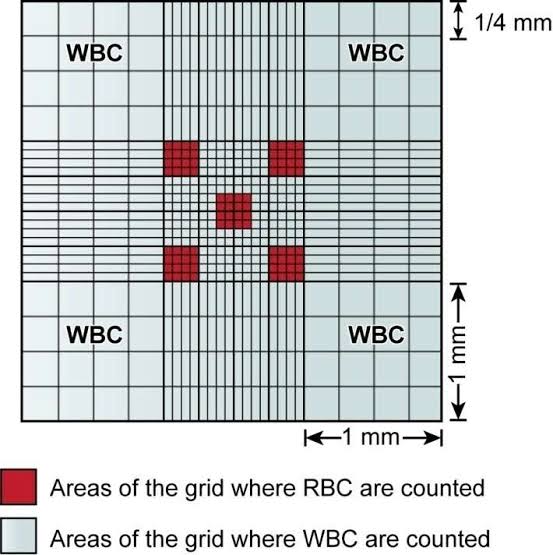
- First, use the 10x objective to locate the central large square of the Neubauer chamber. This central square is typically subdivided into 25 medium-sized squares, and each of these 25 squares is further subdivided into 16 smaller squares.
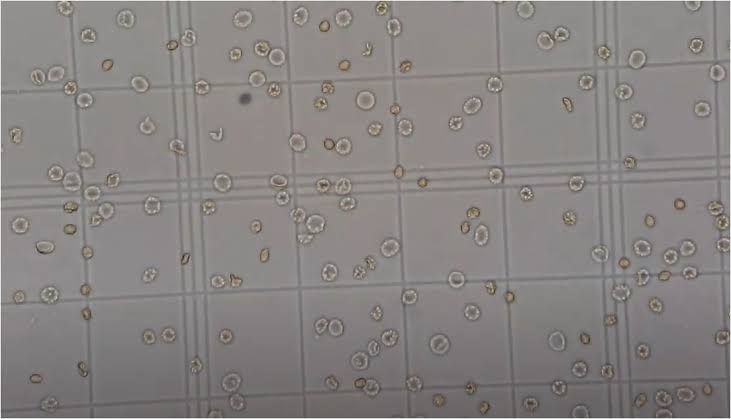
- Switch to the 40x objective to clearly visualize the red blood cells within these smaller squares. The RBCs will appear as biconcave discs, sometimes slightly refractile.
- Counting Area for RBCs: For RBC counting, typically five of the medium-sized squares within the central large square are counted: the four corner squares and the central square. Each of these five medium squares is divided into 16 small squares, making a total of 80 small squares counted (5 squares x 16 small squares/square = 80 total small squares).
- Applying Thomas’s Rule: To avoid double counting and ensure consistency, apply Thomas’s rule (or the “L-shaped rule”): Count cells that lie within the boundaries of the square and those that touch the lines on the top and left sides. Do not count cells that touch the lines on the bottom and right sides. This systematic approach prevents over- or under-counting.
- Count the cells systematically in each of the selected 5 medium squares. Count all cells in the first small square, then move to the next in an organized pattern (e.g., zigzag or serpentine) until all 16 small squares within that medium square are counted. Repeat for all 5 selected medium squares.
- Record the total number of cells counted (N) from all 80 small squares.
Calculations
To calculate the Red Blood Cell count, the following formula is applied:
RBC Count (cells/µL) = (Total cells counted (N) × Dilution Factor) / (Area Counted × Depth of Chamber)
Let’s break down each variable:
- N (Total Cells Counted): This is the sum of red blood cells counted in the 5 medium-sized squares (which encompass 80 tiny squares) of the central grid.
- Dilution Factor: When using an RBC pipette with blood drawn to the 0.5 mark and Hayem’s fluid to the 101 mark, the dilution is 1:200. So, the Dilution Factor is 200.
- Area Counted: The central large square of the Neubauer chamber is 1 mm² (1mm x 1mm). It is divided into 25 medium squares, each measuring 0.2 mm x 0.2 mm = 0.04 mm². Since we count 5 of these medium squares (the four corners and the center), the total area counted is: 5 squares × 0.04 mm²/square = 0.2 mm²
- Depth of Chamber: The depth of the Neubauer chamber is a standard 0.1 mm.
Now, substitute these values into the formula:
RBC Count (cells/µL) = (N × 200) / (0.2 mm² × 0.1 mm) RBC Count (cells/µL) = (N × 200) / (0.02 mm³)
To simplify the constant (200 / 0.02): 200 / 0.02 = 200 / (2/100) = 200 × (100/2) = 100 × 100 = 10,000
Therefore, the simplified formula is:
RBC Count (cells/µL) = N × 10,000
Example Calculation: If you count a total of 550 cells (N = 550) in the 5 designated medium squares:
RBC Count = 550 × 10,000 RBC Count = 5,500,000 cells/µL (or 5.5 × 10^6 cells/µL)
This value is often reported as millions of cells per microliter (µL) or per cubic millimeter (mm³), as 1 µL = 1 mm³.
Normal Reference Ranges
The normal reference ranges for RBC count can vary slightly based on age, sex, and geographical location. Approximate normal values for adults are:
- Adult Males: 4.5 – 5.9 million cells/µL (or 4.5 – 5.9 x 10^12 cells/L)
- Adult Females: 3.9 – 5.2 million cells/µL (or 3.9 – 5.2 x 10^12 cells/L)
- Newborns: Higher, typically 4.8 – 7.1 million cells/µL
It is important to refer to the specific reference ranges established by the laboratory conducting the test.
Clinical Significance
Deviations from the normal RBC count range can indicate various underlying health conditions:
- Low RBC Count (Anemia): This indicates a reduced oxygen-carrying capacity of the blood. Anemia can be caused by:
- Blood loss (e.g., hemorrhage, chronic gastrointestinal bleeding)
- Decreased RBC production (e.g., bone marrow disorders, nutritional deficiencies like iron, B12, or folate deficiency, chronic kidney disease)
- Increased RBC destruction (e.g., hemolytic anemia)
- Signs and symptoms include fatigue, pallor, shortness of breath, and weakness.
- High RBC Count (Polycythemia/Erythrocytosis): An elevated RBC count can lead to increased blood viscosity, raising the risk of blood clots, stroke, and heart attack. Causes include:
- Primary Polycythemia (Polycythemia Vera): A bone marrow disorder.
- Secondary Polycythemia: Often a physiological response to chronic hypoxia (e.g., living at high altitudes, chronic lung disease, sleep apnea, certain kidney diseases producing excess erythropoietin).
- Dehydration can also cause a relative polycythemia due to reduced plasma volume.
Therefore, an accurate RBC count is a critical component of a complete blood count (CBC) and provides valuable diagnostic information.
Sources of Error and Precautions
Manual RBC counting is prone to several errors if proper technique and precautions are not observed.
- Improper Blood Collection:
- First drop of capillary blood not discarded (contains tissue fluid).
- Hesitant pricking or squeezing the finger (causes hemolysis and dilution with tissue fluid).
- Using partially clotted blood or inadequately mixed anticoagulated blood.
- Inaccurate Pipetting:
- Blood or diluent drawn above or below the marks.
- Air bubbles in the pipette stem or bulb.
- Failure to wipe outside of the pipette tip after drawing blood before drawing diluent.
- Delay in drawing diluent after blood, leading to clotting.
- Inadequate Mixing:
- Insufficient mixing time (less than 2-3 minutes) or improper mixing technique results in non-uniform cell distribution. This is a very common and significant error.
- Improper Chamber Charging:
- Failure to discard the first few drops (contains undiluted blood from the stem).
- Overfilling or underfilling the chamber (alters the effective depth).
- Presence of air bubbles under the cover slip.
- Delay in charging the chamber after mixing (cells settle in the pipette).
- Counting Errors:
- Failure to allow cells to settle completely.
- Counting cells in the wrong squares (e.g., WBC squares instead of RBC squares).
- Inconsistent application of Thomas’s rule, leading to double-counting or missing cells on boundary lines.
- Counting artifacts, debris, or yeast cells instead of RBCs.
- Dirty microscope optics or chamber leading to blurred vision.
- Dirty Equipment:
- Residues on the pipette or chamber can lead to inaccurate volume measurements or obstruct counting.
- Contamination with dust, fibers, or microorganisms.
Precautions to Ensure Accuracy:
- Thoroughly clean and dry all glassware before use.
- Work systematically and without rushing.
- Always ensure proper mixing of the diluted sample.
- Use a known volume of sample and diluent.
- Follow Thomas’s rule meticulously during counting.
- Count a sufficient number of squares to ensure a statistically representative sample.
- Perform counts in duplicate if possible, and ensure they are within an acceptable range of agreement (e.g., within 10% of each other).
- Perform regular quality control checks on diluents and equipment.
Conclusion
The manual estimation of red blood cell count using a Neubauer chamber and Hayem’s fluid is a foundational skill in hematology. Despite the advent of automated analyzers, understanding and being proficient in this manual technique is invaluable for comprehending basic hematological principles, troubleshooting automated results, and functioning in various clinical settings. Meticulous adherence to each step of the procedure, coupled with a thorough understanding of the underlying principles and potential sources of error, is paramount to ensuring accurate and clinically meaningful results.