Blood Flow to Capillaries and the Role of Pre-Capillary Sphincters
1. Overview of Blood Flow to Capillaries
Blood flow through the circulatory system is a highly regulated process that ensures tissues receive adequate oxygen and nutrients while removing waste products. The journey of blood begins in the heart, where it is pumped into large arteries. These arteries branch into smaller arterioles, which further divide into even smaller vessels called capillaries.
Capillaries are the smallest blood vessels in the body, with walls that are only one cell thick. This structure allows for efficient exchange of gases (oxygen and carbon dioxide), nutrients, and waste products between blood and surrounding tissues. The flow of blood into capillaries is primarily driven by the pressure generated during heart contractions, known as systolic pressure.
2. Mechanism of Blood Flow Regulation
As blood travels from arterioles to capillaries, its flow is influenced by several factors including vessel diameter, blood viscosity, and overall vascular resistance. The regulation of blood flow is crucial for maintaining homeostasis within tissues. When tissues require more oxygen or nutrients—such as during physical activity—local signals trigger vasodilation (widening) of arterioles and capillaries to increase blood flow.
3. Role of Pre-Capillary Sphincters
Pre-capillary sphincters are specialized smooth muscle cells located at the junction between arterioles and capillaries. These sphincters play a critical role in regulating blood flow into capillary beds. They can constrict or relax based on local metabolic demands or systemic signals.
When pre-capillary sphincters constrict, they reduce the diameter of the entrance to the capillary bed, thereby decreasing blood flow into that area. This mechanism helps prioritize blood distribution according to tissue needs; for example, during intense exercise, sphincters may close in less active areas while remaining open in muscles requiring increased perfusion.
Conversely, when these sphincters relax, they allow more blood to enter the capillary network, facilitating greater nutrient delivery and waste removal from active tissues. This dynamic control helps protect delicate brain tissue from fluctuations in arterial pressure while ensuring adequate perfusion throughout various regions.
4. Conclusion
In summary, the flow of blood to capillaries is a finely tuned process influenced by heart activity and vascular resistance, with pre-capillary sphincters serving as critical regulators that modulate this flow based on local tissue demands.
Exchange of Substances Between Blood and Interstitial Fluid
The exchange of substances between blood and interstitial fluid occurs primarily at the level of capillaries, which are the smallest blood vessels in the body. This exchange is crucial for maintaining homeostasis, delivering nutrients to cells, and removing waste products. The mechanisms involved in this exchange include diffusion, facilitated diffusion, osmosis, and bulk flow.
1. Mechanisms of Exchange
- Diffusion: Small molecules such as oxygen (O2) and carbon dioxide (CO2) can diffuse directly through the endothelial cell membranes of capillaries due to their small size and lipid-soluble nature. This process is driven by concentration gradients; substances move from areas of higher concentration to areas of lower concentration.
- Facilitated Diffusion: Larger molecules like glucose and certain ions (e.g., sodium, potassium) require specific transport proteins to cross the capillary wall. These transporters facilitate the movement of these substances down their concentration gradients without expending energy.
- Bulk Flow: This mechanism involves the movement of fluids across capillary walls driven by pressure differences. It consists of two processes: filtration and reabsorption.
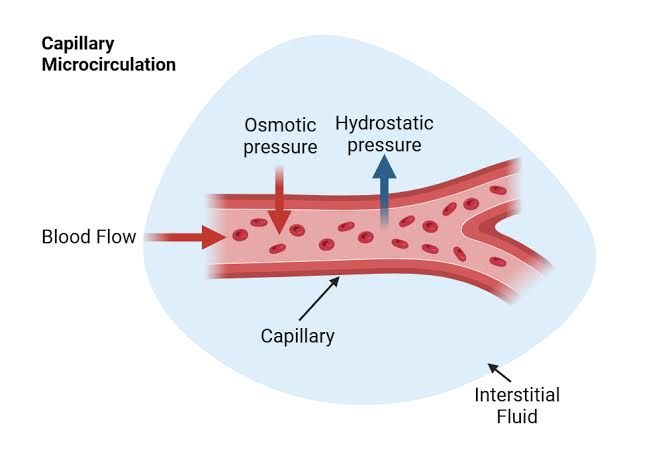
- Filtration occurs when hydrostatic pressure within the capillaries exceeds osmotic pressure, pushing fluid out into the interstitial space.
- Reabsorption happens when osmotic pressure draws fluid back into the capillaries from the interstitial fluid.
2. Factors Affecting Exchange
Several factors influence the efficiency and directionality of substance exchange between blood and interstitial fluid:
- Hydrostatic Pressure: Capillary hydrostatic pressure (CHP) is a key factor driving filtration. At the arterial end of a capillary, CHP is higher (approximately 35 mm Hg), promoting fluid movement out into tissues. As blood moves through the capillary bed towards the venous end, CHP decreases (to about 18 mm Hg), facilitating reabsorption.
- Osmotic Pressure: Blood colloidal osmotic pressure (BCOP), primarily determined by plasma proteins that cannot cross the capillary membrane, plays a significant role in drawing water back into the bloodstream. BCOP remains relatively constant at around 25 mm Hg throughout most of the capillary length.
- Net Filtration Pressure (NFP): The NFP is calculated as CHP minus BCOP. A positive NFP indicates net filtration (fluid moving out), while a negative NFP indicates net reabsorption (fluid moving in). For example:
- At arterial end: NFP = CHP (35 mm Hg) – BCOP (25 mm Hg) = +10 mm Hg
- At venous end: NFP = CHP (18 mm Hg) – BCOP (25 mm Hg) = -7 mm Hg
- Capillary Permeability: The structure of different types of capillaries affects how easily substances can pass through them. Continuous capillaries have tight junctions limiting permeability, while fenestrated capillaries have pores allowing larger molecules to pass more freely.
- Lymphatic System Role: Not all filtered fluid returns to circulation; approximately 24 liters are filtered daily while only about 20.4 liters are reabsorbed. The excess fluid is collected by lymphatic vessels which help maintain fluid balance in tissues.
In summary, various substances exchange between blood and interstitial fluid through mechanisms like diffusion and bulk flow influenced by hydrostatic and osmotic pressures along with other factors such as permeability and lymphatic drainage.
Primary Forces that Control Fluid Movement Through Capillary Membrane
Fluid movement through capillary membranes is primarily controlled by two opposing forces: hydrostatic pressure and osmotic pressure. These forces work together to regulate the exchange of fluids between the blood in capillaries and the surrounding interstitial fluid.
1. Hydrostatic Pressure
Hydrostatic pressure is the force exerted by a fluid due to its weight or pressure within a confined space. In the context of capillary exchange, there are two important types of hydrostatic pressure:
- Capillary Hydrostatic Pressure (CHP): This is the pressure exerted by blood against the walls of the capillaries. It is highest at the arterial end of the capillary bed, typically around 35 mm Hg, and decreases to approximately 18 mm Hg at the venous end. The CHP drives fluid out of the capillaries into the interstitial space, promoting filtration.
- Interstitial Fluid Hydrostatic Pressure (IFHP): This is the pressure exerted by fluid in the interstitial spaces outside of the capillaries. Generally, IFHP is lower than CHP due to continuous absorption of excess fluid by lymphatic vessels. The difference between these pressures facilitates fluid movement from areas of higher hydrostatic pressure (inside capillaries) to areas of lower hydrostatic pressure (interstitial fluid).
2. Osmotic Pressure
Osmotic pressure refers to the tendency of water to move across a semipermeable membrane from an area of lower solute concentration to an area of higher solute concentration. In terms of capillary exchange, osmotic pressure can be broken down into:
- Blood Colloidal Osmotic Pressure (BCOP): This is generated by plasma proteins that remain in the blood and cannot cross the capillary membrane. BCOP typically remains constant at about 25 mm Hg along most parts of a capillary. It draws water back into the capillaries from interstitial fluid due to its higher protein concentration compared to tissue fluid.
- Interstitial Fluid Colloidal Osmotic Pressure (IFCOP): This represents osmotic pressure exerted by proteins present in interstitial fluid, which is usually very low compared to BCOP. As a result, it has minimal impact on reabsorption compared to BCOP.
3. Net Filtration Pressure (NFP)
The interaction between hydrostatic and osmotic pressures determines net filtration pressure (NFP), which dictates whether filtration or reabsorption occurs at any given point along a capillary:
NFP = (CHP − IFHP) − (BCOP − IFCOP)
When NFP is positive, filtration occurs as more fluid exits into tissues; when NFP is negative, reabsorption occurs as fluid returns into capillaries.
In summary, the primary forces controlling fluid movement through capillary membranes are hydrostatic pressure (specifically Capillary Hydrostatic Pressure) and osmotic pressure (specifically Blood Colloidal Osmotic Pressure).
Formation of Lymph and Lymph Flow
The lymphatic system plays a crucial role in maintaining fluid balance within the body, as well as supporting immune function. Understanding how lymph is formed and how it flows through the lymphatic system involves several key processes.
1. Formation of Lymph
Lymph is formed from interstitial fluid, which is the fluid that surrounds cells in tissues. This process begins with blood circulation:
- Capillary Exchange: Every day, approximately 20 liters of plasma (the liquid component of blood) leak out of capillaries into surrounding tissues through tiny pores in their walls. This plasma delivers essential nutrients and oxygen to cells while also collecting waste products.
- Interstitial Fluid: As plasma seeps out, it becomes interstitial fluid after delivering its nutrients and oxygen to the cells. The remaining fluid contains waste products that need to be removed from the tissue.
- Lymph Formation: Not all interstitial fluid returns directly to the bloodstream; about 3 liters remain in the tissues each day. This excess fluid is collected by tiny lymphatic capillaries, which are specialized vessels designed to absorb this fluid. Once absorbed, this interstitial fluid is referred to as lymph.
2. Structure of Lymphatic Vessels
Once formed, lymph travels through a network of lymphatic vessels:
- Lymph Capillaries: These are small, thin-walled vessels located throughout most tissues in the body. They have openings that allow interstitial fluid to enter easily but prevent backflow.
- Larger Lymphatic Vessels: The lymphatic capillaries converge into larger vessels known as lymphatic vessels. These vessels contain valves that help maintain unidirectional flow toward the larger ducts.
3. Lymph Flow
The flow of lymph follows a specific pathway:
- Movement Through Vessels: Lymph flows from smaller capillaries into larger lymphatic vessels and eventually into two major ducts: the right lymphatic duct and thoracic duct.
- Ducts to Bloodstream: The right lymphatic duct drains lymph from the right upper quadrant of the body (including the right arm and right side of the head), while the thoracic duct collects lymph from all other parts of the body. Both ducts empty their contents into subclavian veins located near the heart.
- Reentry into Circulation: Once emptied into these veins, lymph reenters the bloodstream, where it can circulate throughout the body again.
4. Factors Influencing Lymph Flow
Several factors influence how effectively lymph flows through this system:
- Muscle Contraction: Physical activity helps propel lymph through vessels due to muscle contractions compressing nearby lymphatics.
- Respiratory Movements: Breathing creates pressure changes in the thoracic cavity that assist in moving lymph toward larger ducts.
- Valves in Lymph Vessels: The presence of valves prevents backflow and ensures that lymph moves steadily toward its destination.
In summary, lymph is formed from excess interstitial fluid collected by specialized capillaries, which then transport it through a network of vessels towards major ducts for reentry into circulation. This process is vital for maintaining fluid balance and supporting immune responses within the body.
Factors Regulating Lymph Flow and Development of Edema
1. Lymphatic System Structure and Function
The lymphatic system is a network of vessels, nodes, and organs that plays a crucial role in maintaining fluid balance in the body. It collects excess interstitial fluid from tissues and returns it to the bloodstream. The flow of lymph is primarily driven by several factors:
- Muscle Contraction: Skeletal muscle contractions during movement compress lymphatic vessels, propelling lymph forward. This is often referred to as the “muscle pump” mechanism.
- Respiratory Movements: Breathing creates pressure changes in the thoracic cavity, which aids in drawing lymph into the central circulation.
- Valves in Lymphatic Vessels: One-way valves prevent backflow of lymph, ensuring unidirectional flow toward the thoracic duct and eventually into the bloodstream.
2. Hydrostatic and Oncotic Pressure
The balance between hydrostatic pressure (the pressure exerted by fluids) and oncotic pressure (the pressure exerted by proteins) is critical for regulating fluid movement between blood vessels and surrounding tissues:
- Hydrostatic Pressure: High hydrostatic pressure within capillaries can lead to fluid leakage into interstitial spaces, contributing to edema if not adequately drained by the lymphatic system.
- Oncotic Pressure: Proteins such as albumin maintain oncotic pressure within blood vessels. A decrease in plasma protein levels can reduce oncotic pressure, leading to increased fluid accumulation in tissues.
3. Inflammation and Tissue Injury
Inflammation can significantly impact lymph flow and contribute to edema development:
- Vasodilation: During inflammation, blood vessels dilate, increasing permeability and allowing more fluid to escape into surrounding tissues.
- Lymphatic Damage: Inflammatory processes can damage lymphatic vessels or nodes, impairing their ability to transport lymph effectively.
4. Obstruction of Lymphatic Pathways
Any obstruction within the lymphatic system can lead to localized edema:
- Surgical Removal or Radiation Therapy: Procedures that involve removal of lymph nodes (e.g., cancer surgeries) or radiation therapy can disrupt normal lymph drainage pathways.
- Infections: Conditions like cellulitis can scar or obstruct lymphatic vessels, leading to impaired drainage.
5. Venous Insufficiency
Conditions affecting venous return can also influence lymph flow:
- Chronic Venous Insufficiency (CVI): Poor venous return increases hydrostatic pressure in veins, causing excess fluid to leak into interstitial spaces, which may overwhelm the capacity of the lymphatic system.
6. Genetic Factors
Certain genetic conditions affect the development and function of the lymphatic system itself:
- Primary Lymphedema: Genetic mutations can lead to congenital malformations or dysfunctions within the lymphatic system that predispose individuals to lymphedema.
In summary, various factors regulate lymph flow including structural components of the lymphatic system, pressures within blood vessels, inflammatory responses, obstructions due to surgical interventions or infections, venous health status, and genetic predispositions. When these systems are disrupted or overwhelmed, edema may develop as a result.