Definition of Face and Brow Presentation
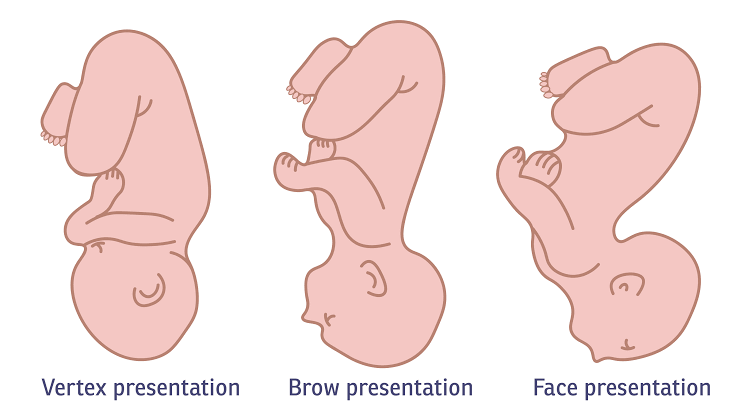
Face and brow presentations are specific types of fetal presentations that occur during childbirth. In a normal delivery, the fetus typically presents head-first, with the vertex (top of the head) leading the way through the birth canal. However, in face presentation, the fetus’s face is positioned to come out first, while in brow presentation, the forehead is presented.
- Face Presentation: In this scenario, the fetal chin is directed towards the mother’s pubic symphysis. The neck is hyperextended, allowing the face to be the presenting part. This position can lead to complications during labor due to potential obstruction or difficulty in navigating through the pelvis.
- Brow Presentation: In brow presentation, the fetal head is partially extended so that the forehead presents first. The chin is not fully tucked into the chest but rather positioned slightly above it. This type of presentation can also complicate labor as it may lead to a longer duration of labor and increased risk for cesarean delivery if not managed appropriately.
Causes of Face and Brow Presentation
The causes of face and brow presentations can be multifactorial and may include anatomical, physiological, and environmental factors:
- Fetal Positioning: Abnormal fetal positioning during pregnancy can lead to face or brow presentations. If a fetus remains in an unusual position for an extended period, such as breech or transverse lie, it may result in these atypical presentations.
- Maternal Pelvic Shape: The shape and size of a mother’s pelvis can influence how a fetus positions itself during late pregnancy. A narrow or irregularly shaped pelvis may restrict optimal positioning for vertex presentation.
- Uterine Abnormalities: Conditions such as uterine fibroids or congenital uterine anomalies can affect space within the uterus and alter fetal positioning.
- Multiple Gestations: In cases of twins or higher-order multiples, limited space within the uterus can lead to abnormal presentations including face or brow positions.
- Oligohydramnios: Low amniotic fluid levels (oligohydramnios) can restrict fetal movement and contribute to abnormal presentations by limiting space for normal rotation into a vertex position.
- Previous Birth History: A history of previous deliveries with abnormal presentations may predispose subsequent pregnancies to similar outcomes due to changes in pelvic anatomy or muscle tone.
- Maternal Factors: Factors such as maternal obesity or excessive weight gain during pregnancy could potentially impact fetal positioning by altering intra-abdominal pressure dynamics.
- Gestational Age: As pregnancy progresses toward term, there is less room for movement; thus, if a fetus has not settled into a vertex position by late pregnancy (around 36 weeks), it may present in an alternative manner like face or brow presentation.
In summary, both face and brow presentations are significant deviations from typical vertex presentation during childbirth that arise from various anatomical and physiological factors affecting both mother and fetus.
Types and Positions of Face and Brow Presentation
1. Face Presentation
Face presentation occurs when the fetal head is hyperextended, causing the face to present as the leading part during delivery. This type of presentation is relatively rare, occurring in approximately 0.2% of live births.
- Types of Face Presentation:
- Mentum Anterior (MA): The fetal chin (mentum) is positioned towards the mother’s anterior (front) side. This is the most favorable position for vaginal delivery.
- Mentum Transverse (MT): The chin is positioned laterally, either to the left or right side of the mother’s pelvis. This position can complicate delivery.
- Mentum Posterior (MP): The chin faces towards the mother’s posterior side, which is less common and may lead to difficulties during labor.
- Diagnosis: Face presentation can be diagnosed through digital examination during labor when distinctive facial features such as the nose, mouth, and chin are palpated. Ultrasound can confirm a hyperextended neck.
2. Brow Presentation
Brow presentation is even less common than face presentation, with an incidence ranging from 1 in 500 to 1 in 1400 deliveries. In this case, the fetal head is positioned between full flexion (vertex) and hyperextension (face).
- Types of Brow Presentation:
- Frontal Presentation: The presenting part includes the forehead and frontal bones. It can also be classified based on its orientation:
- Right Frontotransverse (RFT): The forehead presents towards the right side of the mother’s pelvis.
- Left Frontotransverse (LFT): The forehead presents towards the left side.
- Mentum Anterior Position: Similar to face presentation but with a brow leading; however, it typically transitions to vertex as labor progresses.
- Frontal Presentation: The presenting part includes the forehead and frontal bones. It can also be classified based on its orientation:
- Diagnosis: Like face presentation, brow presentation is usually diagnosed late in labor through cervical examination where features such as the forehead and anterior fontanelle are palpated while excluding facial features like mouth and chin.
Conclusion
Understanding these presentations is crucial for managing labor effectively. While vertex presentation remains ideal for vaginal delivery due to lower risks associated with abnormal presentations like face or brow, recognizing these types allows healthcare providers to prepare for potential complications that may arise during childbirth.
Mechanism of Labor of Face and Brow Presentation
The mechanism of labor refers to the series of movements that the fetus undergoes during the process of delivery. In cases of face and brow presentations, these mechanisms differ from the typical vertex presentation due to the positioning and orientation of the fetal head.
Face Presentation Mechanism
- Engagement: In face presentation, the fetal head is hyperextended, with the mentum (chin) presenting as the leading part. The engagement occurs when the chin enters the pelvic inlet, typically in a mentum anterior position (facing down towards the maternal pelvis). This position allows for optimal alignment with the pelvic canal.
- Descent: As labor progresses, descent occurs through uterine contractions pushing down on the fetus. The chin continues to lead, moving through the pelvic inlet while maintaining its position relative to the maternal pelvis.
- Flexion and Internal Rotation: Unlike vertex presentations where flexion occurs naturally, in face presentations, there is limited flexion due to hyperextension. However, some degree of internal rotation may still occur as contractions help maneuver the fetal head through different positions within the pelvis.
- Extension: As descent continues, extension occurs at the occipito-frontal plane. The fetal neck remains extended, allowing for further movement through the birth canal. The facial features become more prominent as they pass under the pubic symphysis.
- Restitution: After passing through the pelvic outlet, restitution occurs where the fetal head rotates back to align with its original position relative to its body (the mentum facing anteriorly).
- Expulsion: Finally, as contractions continue and with maternal effort during pushing, expulsion occurs where the face emerges first from beneath the pubic symphysis followed by other parts of the body.
Brow Presentation Mechanism
- Engagement: In brow presentation, engagement happens when part of the forehead (the frontal bone) presents at the pelvic inlet rather than a fully flexed vertex or an extended face. This can occur in various positions such as right frontotransverse or left frontotransverse depending on how it aligns with maternal anatomy.
- Descent: Similar to face presentation, descent involves uterine contractions pushing down on a partially extended fetal neck which allows for movement through labor.
- Flexion and Internal Rotation: Brow presentation often transitions into a vertex presentation if sufficient flexion occurs during labor; however, if it persists as brow presentation, internal rotation may be limited due to resistance from maternal structures.
- Extension: As labor progresses and if brow presentation persists without transitioning into a vertex position, extension will occur at both occipito-frontal and frontal-mentum planes leading to potential complications during delivery since this position is less favorable for passage through narrow pelvic dimensions.
- Restitution: If brow presentation resolves into a more favorable position (like vertex), restitution will occur similarly as described in face presentations; otherwise, it may remain challenging due to continued extension.
- Expulsion: Expulsion in brow presentations can be complicated because if not resolved into a vertex position prior to delivery attempts, it may require intervention such as cesarean section due to increased risk for obstructed labor or injury during vaginal delivery.
In summary, both face and brow presentations involve unique mechanisms that challenge normal labor dynamics primarily due to hyperextension of fetal neck positioning which complicates descent and expulsion processes compared to typical vertex presentations.
Complications Associated with Face and Brow Presentation
Maternal Complications
- Prolonged Labor: Both face and brow presentations can lead to prolonged labor due to ineffective contractions or malpositioning of the fetus. This can increase maternal fatigue and stress.
- Increased Risk of Cesarean Section: If labor does not progress adequately or if there are signs of fetal distress, a cesarean section may be necessary. The likelihood of requiring surgical intervention increases significantly with these presentations.
- Perineal Trauma: The unusual positioning of the fetal head can result in increased pressure on the perineum during delivery, leading to higher rates of perineal tears or episiotomies.
- Uterine Atony: Following delivery, there may be an increased risk of uterine atony (failure of the uterus to contract effectively), which can lead to postpartum hemorrhage.
- Infection Risk: Prolonged labor associated with abnormal presentations may increase the risk of infection for both mother and baby due to extended rupture of membranes or invasive monitoring techniques.
Fetal Complications
- Fetal Distress: Abnormal presentations can lead to umbilical cord compression, resulting in decreased oxygen supply to the fetus (fetal distress). Continuous fetal monitoring is often required during labor.
- Facial Injuries: In cases where face presentation occurs, there is a risk of facial injuries such as bruising or fractures due to pressure against maternal pelvic structures during delivery.
- Neck Injury (Brachial Plexus Injury): The abnormal positioning may also increase the risk of brachial plexus injury due to excessive lateral traction on the neck during delivery attempts.
- Asphyxia: Severe cases where there is significant cord compression or prolonged labor without adequate oxygenation can lead to asphyxia in newborns.
- Intracranial Hemorrhage: There is a potential risk for intracranial hemorrhage due to abnormal forces exerted on a vulnerable fetal head during delivery.
- Malformations Due to Pressure Effects: Prolonged pressure from maternal pelvic structures may potentially cause transient malformations or deformities in facial structure post-delivery.
- Increased Neonatal Intensive Care Unit (NICU) Admission Rates: Infants born via face or brow presentation may have higher rates of NICU admissions due to complications arising from their presentation at birth.
Conclusion
Face and brow presentations pose several risks that necessitate careful monitoring and management during labor and delivery. Understanding these complications helps healthcare providers prepare for potential interventions that may be required for both maternal and neonatal health outcomes.
Diagnosis of Face and Brow Presentation
Face Presentation Diagnosis:
- Timing of Diagnosis: Face presentation is typically diagnosed late in the first or second stage of labor.
- Digital Examination: During a vaginal examination, distinctive facial features can be palpated through a dilated cervix. The key anatomical structures to identify include:
- The nose
- The mouth
- The chin (mentum)
- Malar bones and orbital ridges
- Differentiation from Breech Presentation: Care must be taken to differentiate face presentation from breech presentation, as the mouth may be confused with the anus. The triangular configuration formed by the mouth and orbital ridges helps in distinguishing it from breech presentations.
- Ultrasound Evaluation: Confirmation of face presentation can be achieved through ultrasound, which will show a hyperextended fetal neck.
Brow Presentation Diagnosis:
- Timing of Diagnosis: Brow presentation may be encountered early in labor but is often a transitional state that converts to vertex presentation.
- Vaginal Examination: Diagnosis is made through digital examination after the membranes have ruptured and the head has begun to engage:
- Palpation reveals the brow, orbits, anterior fontanelle, and occasionally the eyes and bridge of the nose.
- Notably, it is impossible to palpate the chin or posterior fontanelle during this examination.
- Abdominal Palpation: In some cases, abdominal palpation using Leopold maneuvers can help identify brow presentation by noting a high head position.
In summary, both face and brow presentations are diagnosed primarily through careful vaginal examinations during labor, with ultrasound serving as an additional confirmatory tool for face presentations.
Management of Face and Brow Presentation
The management of face and brow presentations during labor requires careful consideration due to the unique challenges these presentations pose. Here are the different ways to manage each type:
1. Face Presentation Management
In face presentations, where the fetal chin (mentum) is the presenting part, management strategies depend on the orientation of the mentum:
- Mentum Anterior Position: If the mentum is in an anterior position (facing down towards the maternal pelvis), there is a reasonable chance for vaginal delivery. Continuous monitoring of fetal heart rate and labor progress is essential. The usual principles of labor management apply, including allowing for adequate time for descent and ensuring that maternal positioning supports optimal fetal positioning.
- Mentum Posterior Position: In cases where the mentum is posterior (facing upwards), vaginal delivery becomes significantly more complicated due to the inability of the fetus to flex its neck adequately. This position typically necessitates a cesarean delivery because it increases the risk of obstructed labor and potential fetal distress.
- Continuous Monitoring: Regardless of mentum position, continuous fetal heart rate monitoring is crucial to detect any signs of fetal distress early. Clinical assessments should be repeated frequently to evaluate progress.
- Avoidance of Certain Interventions: Internal monitoring devices such as scalp electrodes are discouraged due to risks of trauma or injury to the presenting parts. Manual manipulations or midforceps deliveries are also not recommended as they can increase maternal and neonatal morbidity.
2. Brow Presentation Management
Brow presentations involve less extension than face presentations, with the leading part being between the anterior fontanelle and orbital ridges. Management strategies include:
- Expectant Management: Approximately 30-40% of brow presentations may convert to a face presentation during labor, while about 20% may convert to a vertex presentation. Therefore, expectant management with close observation is often appropriate.
- Vaginal Delivery Possibility: If brow presentation occurs in an anterior position, there may be potential for vaginal delivery under careful monitoring. The same principles apply as with face presentation; however, if there are signs that progression is not occurring or if complications arise, intervention may be necessary.
- Cesarean Delivery Indication: If brow presentation remains in a mentum posterior position or if there are complications such as failure to progress in labor or signs of fetal distress, cesarean delivery may be indicated.
- Monitoring and Assessment: Similar to face presentations, continuous fetal heart rate monitoring and regular clinical assessments are critical throughout labor for brow presentations.
In summary, both face and brow presentations require individualized management based on specific circumstances such as fetal positioning and maternal health status. Continuous monitoring and assessment play vital roles in determining whether vaginal delivery can be achieved safely or if surgical intervention is necessary.