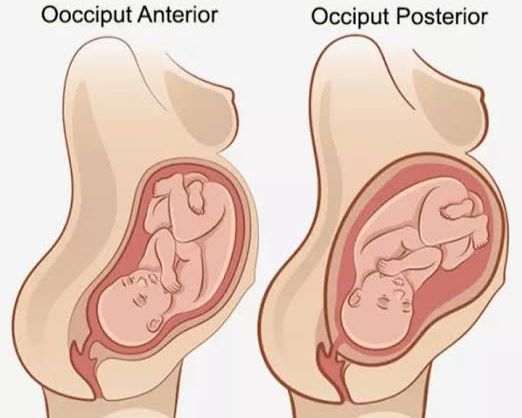
The occipito-posterior (OP) position refers to a fetal presentation during labor where the back of the baby’s head (the occiput) is positioned towards the mother’s back, specifically facing upwards. In this position, the fetus is oriented such that its face is directed towards the mother’s abdomen, which can complicate labor and delivery. The OP position is one of several possible fetal positions; others include occipito-anterior (OA), where the baby’s face is directed toward the mother’s back, and transverse or breech positions.
Causes of Occipito-Posterior Position
- Maternal Pelvic Shape and Size: The shape and size of a mother’s pelvis can influence fetal positioning. A narrow or irregularly shaped pelvis may limit space for optimal fetal rotation, leading to a higher likelihood of the baby settling into an OP position.
- Uterine Tone and Muscle Tone: The tone of the uterine muscles can affect how well the fetus can move into an ideal position. Increased uterine tone may restrict movement, while decreased tone might allow for more freedom but could also lead to less control over positioning.
- Fetal Factors: Certain characteristics of the fetus itself, such as size and activity level, can contribute to its positioning. Larger fetuses may have difficulty rotating into an OA position due to limited space in the uterus, while very active fetuses might shift positions frequently.
- Multiple Pregnancies: In cases of multiple gestations (twins or more), there is often less space available for each fetus to maneuver into an optimal position. This crowded environment increases the chances that at least one fetus will be in an OP position.
- Previous Birth Experiences: Women who have previously given birth may have a higher likelihood of having their subsequent babies in an OP position if they experienced it before. This could be due to anatomical changes from previous pregnancies or habitual positioning by the fetus based on prior experiences.
- Posture and Activity Levels During Pregnancy: Maternal posture during pregnancy can influence fetal positioning. For instance, spending prolonged periods sitting or leaning back may encourage babies to adopt an OP position rather than rotating forward into an OA position.
- Gestational Age: As pregnancy progresses, especially beyond 37 weeks, there is less room for movement within the uterus. If a baby has not settled into a favorable anterior position by this time, it may remain in an OP orientation until labor begins.
- Amniotic Fluid Levels: Abnormal levels of amniotic fluid—either too much (polyhydramnios) or too little (oligohydramnios)—can impact fetal movement and positioning within the uterus, potentially leading to an OP presentation.
- Maternal Body Mass Index (BMI): Higher maternal BMI has been associated with increased risk for various complications during pregnancy and labor, including abnormal fetal positioning like OP due to potential effects on pelvic dimensions and uterine space.
- Labor Progression Factors: During labor itself, factors such as contractions’ strength and frequency can influence how well a baby rotates into a favorable position; ineffective contractions might fail to encourage rotation from OP to OA.
In summary, various anatomical, physiological, behavioral, and environmental factors contribute to a fetus adopting an occipito-posterior position during pregnancy and labor.
Causes of Failure of Spontaneous Anterior Rotation
1. Fetal Factors
- Macrosomia: A larger-than-average fetus can lead to difficulties during labor, as the increased size may hinder the ability to rotate spontaneously. The weight and dimensions of a macrosomic infant can create mechanical challenges in navigating the birth canal.
- Abnormal Presentation: If the fetus is not in the optimal position (e.g., breech or transverse lie), it may struggle to achieve anterior rotation. The ideal presentation for delivery is vertex (head down), and deviations from this can complicate labor.
- Fetal Malformations: Congenital anomalies affecting the fetal structure, such as skeletal dysplasias, can impede normal movement and positioning during labor.
2. Maternal Pelvic Factors
- Contracted Pelvis: A pelvis that is smaller than average (contracted) can restrict the space available for fetal movement. This includes conditions like inlet contraction, midpelvic contraction, or outlet contraction, which can significantly increase the risk of dystocia.
- Pelvic Shape Abnormalities: Variations in pelvic shape—such as android or platypelloid shapes—can affect how well the fetus can navigate through the birth canal. For instance, an android pelvis may have a narrower outlet that complicates rotation.
3. Soft Tissue Factors
- Uterine Abnormalities: Conditions such as uterine fibroids or malformations (e.g., septate uterus) can obstruct the passage and prevent effective rotation of the fetus.
- Excess Adipose Tissue: Increased body fat in the maternal abdomen may also contribute to difficulties in fetal positioning and movement during labor.
4. Labor Dynamics
- Ineffective Uterine Contractions: Poorly coordinated or weak contractions may fail to provide sufficient force for fetal rotation. Effective contractions are crucial for facilitating movement through the birth canal.
- Prolonged Labor: Extended periods of labor can lead to fatigue in both mother and fetus, potentially resulting in failure to rotate due to exhaustion or decreased energy levels.
5. Psychological Factors
- Maternal Anxiety or Stress: High levels of anxiety or stress during labor may influence uterine tone and contractions, potentially impacting fetal positioning and spontaneous rotation.
In summary, failure of spontaneous anterior rotation during labor can be attributed to a combination of factors related to both fetal characteristics and maternal anatomy, along with dynamics of labor itself.
Mechanism of Labor in Occipito-Posterior Position
The mechanism of labor refers to the series of movements that the fetus undergoes during the process of delivery. In the occipito-posterior (OP) position, where the baby’s head is down but facing the mother’s abdomen instead of her back, the mechanism of labor can be more complex and may lead to a longer labor. The following steps outline this mechanism:
1. Engagement
In the OP position, engagement occurs when the widest part of the fetal head enters the pelvic inlet. This is typically achieved with the biparietal diameter (the distance between the two parietal bones) aligned with the pelvic brim. However, in OP presentations, this alignment can be less favorable due to the orientation of the fetal head.
2. Descent
As contractions occur, they help push the fetus down through the birth canal. In OP position, descent may be slower compared to an occipito-anterior (OA) position because of increased resistance from maternal pelvic structures and potential misalignment.
3. Flexion
During flexion, ideally, the fetal chin moves toward its chest, allowing for a smaller presenting diameter as it navigates through the pelvis. In OP position, flexion may not occur optimally if there is significant resistance from maternal tissues or if contractions are ineffective.
4. Internal Rotation
In a typical labor scenario with OA presentation, internal rotation would see the fetal head rotate from a transverse or oblique position to face downward towards the mother’s back. In OP presentations, however, internal rotation can be challenging; often, it requires additional effort from uterine contractions and maternal positioning changes (e.g., walking or using specific labor positions) to facilitate this movement.
5. Extension
Once internal rotation is successful and aligns with either OA or another favorable position for delivery, extension occurs as the fetal head emerges from under the pubic symphysis. This step involves tilting backward as it passes through the vaginal opening.
6. External Rotation (Shoulder Rotation)
After delivery of the head, external rotation occurs where one shoulder rotates anteriorly and then delivers followed by subsequent delivery of the other shoulder.
7. Expulsion
Finally, after both shoulders have been delivered, expulsion occurs as the rest of the body follows through.
Throughout these stages in an OP presentation, there may be increased risks for complications such as prolonged labor or a higher likelihood of requiring interventions like forceps assistance or cesarean delivery due to difficulties encountered during descent and rotation phases.
Overview of Complications Associated with Occipito-Posterior Position
This positioning can lead to various complications during labor and delivery.
1. Prolonged Labor
One of the primary complications associated with the OP position is prolonged labor. The baby’s head may not engage properly in the pelvis, leading to a slower progression through the stages of labor. This can result in increased maternal fatigue and stress, as well as higher risks for both mother and baby.
2. Increased Pain During Labor
Women in OP positions often experience more intense back pain during contractions, commonly referred to as “back labor.” This occurs because the pressure from the baby’s head on the mother’s spine can cause significant discomfort.
3. Higher Risk of Cesarean Delivery
Due to difficulties in progressing through labor, there is an increased likelihood that a cesarean section may be necessary if the baby does not rotate into a more favorable position. Studies indicate that babies in OP positions are more likely to require surgical intervention compared to those in OA positions.
4. Fetal Distress
The OP position can sometimes lead to fetal distress due to prolonged labor or inadequate oxygenation if there are issues with umbilical cord compression. Continuous fetal monitoring is often required to assess any signs of distress.
5. Instrumental Delivery Complications
If an instrumental delivery (using forceps or vacuum extraction) becomes necessary due to failure to progress, there are additional risks involved. These can include trauma to both mother and baby, such as lacerations or cephalohematoma (bleeding between the skull and its outer covering).
6. Maternal Trauma or Injury
Increased pressure on pelvic structures during an OP delivery can lead to perineal tears or episiotomies, which may complicate recovery postpartum. Additionally, there may be a higher incidence of pelvic floor dysfunction following such deliveries.
7. Postpartum Hemorrhage
There is some evidence suggesting that women who deliver in an OP position may have a slightly elevated risk of postpartum hemorrhage due to uterine atony or retained placental fragments resulting from prolonged labor.
Conclusion
In summary, while many women successfully deliver babies in the occipito-posterior position without severe complications, it is associated with several potential risks that healthcare providers must monitor closely throughout labor and delivery.
Diagnosis of Occipito-Posterior Position
Diagnosing the occipito-posterior (OP) position, where the fetal head is down but facing the mother’s abdomen, involves several methods that can be employed during labor. The accuracy of these methods is crucial for effective management and intervention.
1. Clinical Examination: Vaginal Examination
A vaginal examination is a common method used to assess fetal position during labor. However, it has limitations in accurately diagnosing OP position due to factors such as:
- Caput Succedaneum: This swelling on the baby’s head can obscure the identification of sutures and fontanels.
- Scalp Hair: The presence of hair can also complicate the assessment.
Despite these challenges, trained healthcare providers may attempt to identify the fetal head’s orientation by palpating the sutures and fontanels through a vaginal exam. However, studies indicate that this method has a high rate of inaccuracy when diagnosing OP positions.
2. Ultrasound Imaging
Ultrasound has emerged as a superior diagnostic tool compared to digital vaginal examinations. There are several types of ultrasound approaches that can be utilized:
- Transabdominal Ultrasound: This method allows visualization of the fetus from outside the abdomen and can help determine its position relative to maternal pelvic landmarks.
- Transperineal Ultrasound: Conducted through the perineum, this technique provides a view of the fetal head’s orientation as it descends into the birth canal.
- Transvaginal Ultrasound: This approach offers detailed imaging and is particularly useful in cases where other methods may not provide clear information.
Research indicates that ultrasound significantly improves diagnostic accuracy for identifying malpositions like OP, especially in both first and second stages of labor.
3. Assessment During Labor Progression
Monitoring labor progression is essential for diagnosing OP position. If labor is prolonged or if there are signs indicating difficulty with descent (such as increased maternal pain or ineffective contractions), further evaluation using ultrasound may be warranted to confirm fetal position.
4. Maternal Posturing Techniques
While not a diagnostic method per se, certain maternal postures can influence fetal rotation from OP to occipito-anterior (OA) position. Encouraging mothers to adopt positions such as hands-and-knees or leaning forward may facilitate rotation during labor, which should be monitored closely by healthcare providers.
In summary, while vaginal examinations have traditionally been used for diagnosing fetal positions, they are often inaccurate for detecting occipito-posterior positioning. In contrast, ultrasound techniques provide more reliable results and should be prioritized in clinical practice for accurate diagnosis and management.
Managing Occipito-Posterior Position
The management of the occipito-posterior (OP) position during labor involves various strategies aimed at facilitating the baby’s rotation to a more favorable position for delivery. Here are the different ways to manage this situation:
1. Early Recognition
Recognizing the OP position early in labor is crucial. This can be achieved through regular prenatal check-ups, particularly during the third trimester when the baby’s position can be assessed. If an OP position is suspected, it is important to discuss potential implications and management strategies with a healthcare provider.
2. Maternal Positioning Techniques
Changing maternal positions can significantly influence fetal positioning. Some effective techniques include:
- Hands and Knees Position: This position helps widen the pelvis and encourages the baby to rotate. Spending 10-15 minutes in this position multiple times a day may be beneficial.
- Leaning Forward: Leaning over a birthing ball or the back of a chair can help tilt the pelvis, which may encourage rotation of the baby into a more favorable position.
- Side-Lying: Lying on the left side can relax pelvic muscles and potentially facilitate rotation.
3. Optimal Fetal Positioning Techniques
Several specific exercises and techniques can promote optimal fetal positioning:
- Pelvic Tilts: Gentle pelvic tilts can help align the baby within the pelvis, encouraging it to rotate into an anterior position.
- Spinning Babies® Techniques: This approach includes various exercises designed to promote optimal fetal positioning, such as inversions, rebozos, and forward-leaning inversions. Consulting with a certified Spinning Babies® practitioner can provide guidance on these techniques.
4. Hydrotherapy
Using water during labor can provide relaxation and pain relief, which may help facilitate fetal rotation. Immersion in a warm bath or shower allows pelvic muscles to relax, giving more room for the baby to move.
5. Labor Support
Having a knowledgeable birth team is essential for managing an OP position effectively. Skilled healthcare providers, doulas, and childbirth educators can offer support by guiding mothers through techniques that may assist in rotation and managing pain during labor.
6. Patience and Trust in Process
Sometimes despite all efforts, babies may not rotate during labor. It is important for mothers to remain patient and trust their bodies’ processes since many women successfully deliver babies in the OP position without complications.
7. Discussing Options with Healthcare Provider
If concerns arise about progress during labor due to persistent OP positioning, it’s vital for mothers to discuss options with their healthcare provider. These options might include assisted delivery methods such as forceps or vacuum extraction or considering cesarean section if necessary.
By employing these management strategies, many mothers can navigate challenges associated with an occipito-posterior presentation effectively.