Understanding Hemoglobin Affinity and P50 Values
Hemoglobin is a protein in red blood cells responsible for transporting oxygen from the lungs to tissues and returning carbon dioxide from tissues to the lungs. The affinity of hemoglobin for oxygen can be quantified using the P50 value, which is defined as the partial pressure of oxygen (pO2) at which hemoglobin is 50% saturated with oxygen. This value provides insight into how readily hemoglobin binds to oxygen.
Step 1: Define P50 Value
The P50 value is a critical parameter in understanding hemoglobin’s affinity for oxygen. A lower P50 indicates higher affinity, meaning that hemoglobin binds oxygen more tightly. Conversely, a higher P50 suggests lower affinity, indicating that hemoglobin requires a higher concentration of oxygen to achieve the same level of saturation.
Step 2: Calculate Affinity Using P50
The relationship between the affinity of hemoglobin for oxygen and its P50 value can be expressed mathematically through the Hill equation or by using the following formula:
K = 1 ÷ P50
Where:
- K is the association constant (a measure of affinity).
- P50 is the partial pressure of oxygen at which hemoglobin is 50% saturated.
This equation implies that as P50 increases, K decreases, indicating lower affinity.
Step 3: Example Calculation
To illustrate this calculation, let’s assume we have a typical P50 value for adult human hemoglobin under normal physiological conditions, which is approximately 26 mmHg.
Using our formula:
K = 1 ÷ P50 = 1 ÷ 26mmHg ≈ 0.0385mmHg−1
This result indicates that at a pO2 of 26 mmHg, the binding affinity of hemoglobin for oxygen can be quantified as approximately 0.0385 mmHg^{-1}.
Step 4: Interpretation
A K value of approximately 0.0385 mmHg^{-1} signifies that under standard conditions, hemoglobin has a moderate affinity for oxygen. Changes in physiological conditions (like pH or temperature) can affect this affinity and thus alter the P50 value accordingly.
For example:
- Increased levels of carbon dioxide (hypercapnia) or decreased pH (acidosis) will typically increase the P50 value (lowering affinity), facilitating oxygen release where it is needed most.
- Conversely, decreased carbon dioxide levels or increased pH (alkalosis) will decrease the P50 value (increasing affinity), enhancing oxygen uptake in the lungs.
Conclusion
In summary, by utilizing the P50 value, we can effectively calculate and interpret the affinities of hemoglobin for oxygen. The calculated association constant based on a typical adult human hemoglobin’s P50 value illustrates how changes in environmental factors can influence this crucial biological process.
Understanding the Oxygen-Hemoglobin Dissociation Curve in Anemia and Carbon Monoxide Poisoning
The oxygen-hemoglobin dissociation curve is a critical tool for understanding how hemoglobin (Hb) binds and releases oxygen (O2) under various physiological conditions. The shape of this curve can be significantly altered in conditions such as anemia and carbon monoxide poisoning, affecting the body’s ability to transport and utilize oxygen effectively.
1. The Shape of the Curve in Anemia
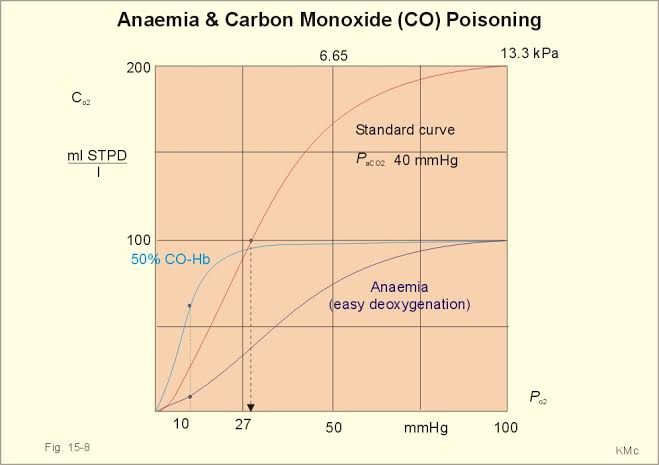
Anemia is characterized by a reduced concentration of hemoglobin in the blood, which can occur due to various factors such as nutritional deficiencies, chronic diseases, or bone marrow disorders. In anemia, although the shape of the oxygen-hemoglobin dissociation curve remains sigmoidal, its position on the graph is affected.
- Reduced Hemoglobin Concentration: Since hemoglobin is responsible for carrying oxygen, a lower concentration means that even if the partial pressure of oxygen (PO2) is normal, there will be less total oxygen bound to hemoglobin. This results in a lower overall oxygen saturation (SO2) at any given PO2 compared to healthy individuals.
- Curve Characteristics: The curve itself does not shift left or right; rather, it becomes flatter at lower saturations because there are fewer hemoglobin molecules available to bind oxygen. This means that while hemoglobin’s affinity for oxygen may remain unchanged, the total amount of oxygen transported to tissues is diminished due to the lack of sufficient hemoglobin.
- Physiological Response: In response to anemia, the body may increase cardiac output and enhance respiratory rate to compensate for reduced oxygen delivery. However, despite these compensatory mechanisms, tissue hypoxia can still occur if anemia is severe.
2. The Shape of the Curve in Carbon Monoxide Poisoning
Carbon monoxide (CO) poisoning presents a different challenge regarding the oxygen-hemoglobin dissociation curve. CO has a much higher affinity for hemoglobin than O2—approximately 240 times greater—which leads to significant alterations in how hemoglobin interacts with both CO and O2.
- Leftward Shift of the Curve: When CO binds to hemoglobin, it forms carboxyhemoglobin (CO bound to Hb), which not only reduces the amount of available hemoglobin for O2 binding but also alters the structure of remaining unbound hemoglobin. This structural change increases its affinity for O2, causing a leftward shift in the dissociation curve.
- Implications of Leftward Shift: A leftward shift indicates that at any given PO2, hemoglobin holds onto O2 more tightly and releases it less readily into tissues. As a result, even though arterial PO2 might be normal or elevated due to supplemental O2 therapy or environmental conditions, tissues may still experience hypoxia because less O2 is being released from hemoglobin where it is needed most.
- Clinical Consequences: Patients with CO poisoning may present with symptoms such as headache, dizziness, confusion, and ultimately loss of consciousness due to inadequate tissue perfusion with O2 despite potentially normal blood gas readings. Treatment typically involves removing exposure to CO and administering high-flow supplemental oxygen to displace CO from hemoglobin.
In summary:
- In anemia, while total oxygen transport capacity decreases due to reduced hemoglobin levels without shifting the curve significantly left or right.
- In carbon monoxide poisoning, there is a leftward shift in the dissociation curve due to increased affinity for O2 after CO binding; this results in impaired release of O2 into tissues despite potentially normal arterial blood gases.
Methods of Calculating Oxygen Consumption in Normal, Anemic, and Carbon Monoxide Poisoning Individuals
Oxygen consumption (VO2) is a critical parameter in assessing respiratory and metabolic function. It can be measured using various methods depending on the physiological state of the individual, such as normal physiology, anemia, or carbon monoxide poisoning. Below are detailed descriptions of the methods used to calculate oxygen consumption in these different conditions.
1. Normal Individuals
In healthy individuals, oxygen consumption can be calculated using several methods:
- Indirect Calorimetry: This is the most common method for measuring VO2. It involves measuring the volume of oxygen inhaled and the volume of carbon dioxide exhaled over a specific period. The difference between these volumes allows for the calculation of VO2 using the formula: VO2 = (VI × FIO2) − (VE × FEO2), Where:
- VI = Volume of inspired air
- VE = Volume of expired air
- FIO2 = Fractional concentration of inspired oxygen
- FEO2 = Fractional concentration of expired oxygen
- Metabolic Cart Systems: These systems provide real-time measurements during exercise or rest by analyzing respiratory gases. They typically use a mask or mouthpiece connected to a gas analyzer.
- Heart Rate Monitoring: In some cases, VO2 can be estimated based on heart rate responses during exercise using established correlations between heart rate and oxygen consumption.
2. Anemic Individuals
Anemia affects oxygen transport but not necessarily oxygen consumption directly. However, it is essential to consider hemoglobin levels when calculating VO2:
- Calculation Adjustments: In anemic patients, while indirect calorimetry can still be used to measure VO2, adjustments must be made for reduced hemoglobin levels. The formula for calculating total oxygen content in blood (CaO2) becomes crucial: CaO2 = (Hb × 1.34 × SaO2)+(0.0031 × PaO2), Where:
- Hb = Hemoglobin concentration (g/dL)
- SaO2 = Arterial saturation with oxygen (%)
- PaO2 = Partial pressure of arterial oxygen (mmHg)
- Impact on VO2 Calculation: Since anemic individuals have lower hemoglobin levels, their capacity to transport oxygen is diminished; thus, even if their VO2 remains unchanged during physical activity, they may experience fatigue sooner due to less available oxygen for muscle metabolism.
3. Carbon Monoxide Poisoning
Carbon monoxide (CO) binds with hemoglobin more effectively than oxygen does, leading to reduced availability of O2 for tissues despite potentially normal arterial O2 saturation readings:
- Measurement Techniques: In cases of CO poisoning, traditional methods like pulse oximetry may give falsely normal readings because they cannot differentiate between oxyhemoglobin and carboxyhemoglobin (CO bound to hemoglobin).
- Carboxyhemoglobin Levels: To accurately assess the impact on VO2 in CO poisoning cases, blood tests are necessary to determine carboxyhemoglobin levels:
- Calculating Effective Oxygen Delivery: The effective delivery of oxygen must account for both reduced hemoglobin function and altered blood flow dynamics due to hypoxia caused by CO binding.
- VO2 Calculation Adjustments: Similar adjustments as with anemia need to be made when calculating VO2 in CO poisoning cases since total available O2 is significantly compromised.
In summary, while indirect calorimetry remains a standard method across all conditions for measuring VO2, specific adjustments and considerations must be made based on the individual’s physiological state—normal physiology versus conditions like anemia or carbon monoxide poisoning.