DNA Transcription in Prokaryotes
DNA transcription is the process by which genetic information encoded in DNA is copied into messenger RNA (mRNA). In prokaryotes, this process occurs in the cytoplasm and involves several key proteins and enzymes. Below is a detailed step-by-step explanation of this process.
1. Initiation of Transcription
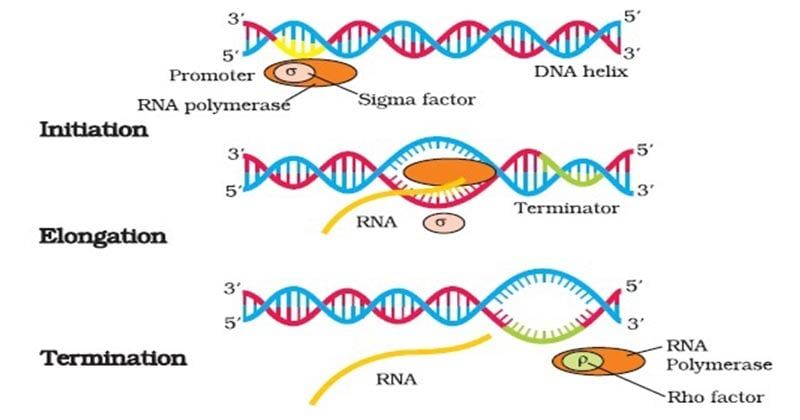
The initiation phase begins when RNA polymerase, the enzyme responsible for synthesizing RNA, binds to a specific region on the DNA called the promoter. The promoter contains specific sequences that signal where transcription should start. In prokaryotes, the core RNA polymerase consists of five subunits: two alpha (α) subunits, one beta (β) subunit, one beta prime (β’) subunit, and one omega (ω) subunit.
- Role of Sigma Factor: To initiate transcription, RNA polymerase requires a sigma factor (σ), which is a protein that helps the core enzyme recognize and bind to the promoter region. Different sigma factors can direct RNA polymerase to different sets of genes depending on environmental conditions or cellular needs.
2. Formation of the Transcription Bubble
Once RNA polymerase is bound to the promoter with the help of the sigma factor, it unwinds a small section of the DNA double helix, creating what is known as a transcription bubble. This bubble exposes the template strand of DNA that will be used for mRNA synthesis.
3. Elongation Phase
During elongation, RNA polymerase moves along the DNA template strand in a 3’ to 5’ direction while synthesizing mRNA in a 5’ to 3’ direction. The enzyme catalyzes the addition of ribonucleotides complementary to the DNA template strand:
- Nucleotide Addition: As RNA polymerase moves along the DNA, it incorporates ribonucleoside triphosphates (NTPs) into the growing mRNA chain based on complementary base pairing rules: adenine (A) pairs with uracil (U) in RNA (instead of thymine in DNA), and cytosine (C) pairs with guanine (G).
- Role of RNA Polymerase: The enzyme has intrinsic proofreading capabilities that allow it to correct errors during transcription by backtracking and excising incorrectly incorporated nucleotides.
4. Termination of Transcription
Transcription continues until RNA polymerase encounters a termination signal in the DNA sequence. There are two main types of termination mechanisms in prokaryotes:
- Rho-dependent Termination: This mechanism involves a protein called Rho factor that binds to the nascent mRNA and moves toward RNA polymerase. When it catches up with RNA polymerase at a pause site on the DNA template, it causes dissociation of both RNA polymerase and mRNA from DNA.
- Rho-independent Termination: This mechanism relies on specific sequences within the mRNA itself that form a hairpin loop followed by a series of uracils. The formation of this structure destabilizes the interaction between mRNA and RNA polymerase, leading to termination.
5. Post-transcriptional Modifications
In prokaryotes, mRNA undergoes minimal post-transcriptional modifications compared to eukaryotes; however, certain processes such as ribosome binding can begin immediately after transcription due to coupling between transcription and translation.
Key Proteins and Enzymes Involved:
- RNA Polymerase: The main enzyme responsible for synthesizing mRNA from DNA.
- Sigma Factor: A protein that assists in recognizing promoters.
- Rho Factor: A protein involved in Rho-dependent termination.
Overall, transcription in prokaryotes is efficient due to its coupling with translation and relatively simple regulatory mechanisms compared to eukaryotic systems.
Understanding RNA Synthesis from a DNA Template
To derive the sequence of an RNA molecule from a DNA template, we need to understand the process of transcription. During transcription, the enzyme RNA polymerase synthesizes RNA by reading the DNA template strand and creating a complementary RNA strand.
Step 1: Identify the DNA Template Strand
Let’s assume we have a hypothetical DNA template strand. For example, consider the following DNA sequence:
5’ – ATGCGTACGTTAGC – 3’
In this sequence, the important aspect is that we will be transcribing from one of the two strands of DNA. The strand that is used as a template for RNA synthesis is known as the antisense or template strand.
Step 2: Determine the Complementary Base Pairing Rules
During transcription, RNA polymerase pairs nucleotides according to specific base pairing rules:
- Adenine (A) in DNA pairs with Uracil (U) in RNA.
- Thymine (T) in DNA pairs with Adenine (A) in RNA.
- Cytosine (C) in DNA pairs with Guanine (G) in RNA.
- Guanine (G) in DNA pairs with Cytosine (C) in RNA.
Step 3: Transcribe the Sequence
Using our example DNA template strand:
5’ – ATGCGTACGTTAGC – 3’
The complementary base pairing will yield:
- A → U
- T → A
- G → C
- C → G
- G → C
- T → A
- A → U
- C → G
- G → C
- T → A
- T → A
- A → U
- G → C
- C → G
Thus, when we transcribe this sequence into RNA, we read it from 3’ to 5’ on the template strand but write it from 5’ to 3’ for the newly synthesized RNA strand.
The resulting mRNA sequence will be:
5’ – AUGCGUACGUUAGC – 3’