DNA Transcription in Eukaryotes
Transcription is the process by which genetic information encoded in DNA is copied into messenger RNA (mRNA). In eukaryotes, this process occurs in the nucleus and involves several key proteins and enzymes that facilitate the accurate synthesis of RNA. Below is a detailed step-by-step discussion of the transcription process, highlighting the roles of various components involved.
1. Initiation of Transcription
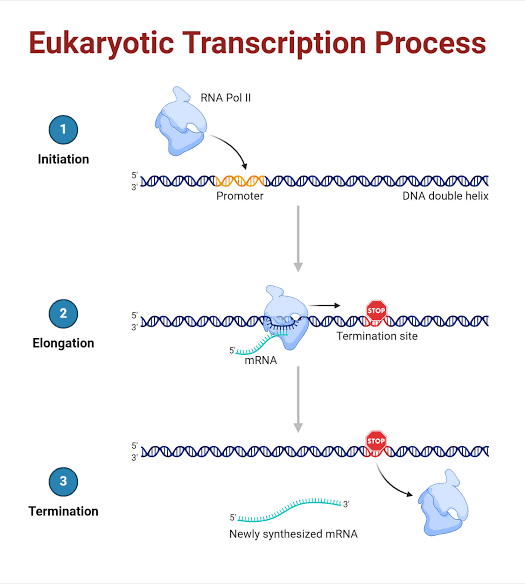
The transcription process begins with the binding of transcription factors to specific regions of the DNA known as promoters. The promoter region contains essential sequences that signal where transcription should start.
- Transcription Factors: These proteins are crucial for recognizing and binding to promoter sequences. They help recruit RNA polymerase II, the enzyme responsible for synthesizing mRNA.
- TATA Box: A common element found in many eukaryotic promoters is the TATA box, located approximately 25-30 base pairs upstream of the transcription start site. The TATA-binding protein (TBP), a component of the transcription factor IID (TFIID), binds to this region, causing a local unwinding of DNA.
2. Formation of the Pre-Initiation Complex (PIC)
Once TBP has bound to the TATA box, additional transcription factors assemble at the promoter to form a pre-initiation complex.
- General Transcription Factors (GTFs): Several GTFs are recruited to form this complex, including TFIIA, TFIIB, TFIIE, TFIIF, and TFIIH. Each factor plays a role in stabilizing RNA polymerase II at the promoter and facilitating its activation.
- RNA Polymerase II: This enzyme is then recruited to form a stable complex with GTFs at the promoter. It has an intrinsic ability to synthesize RNA from a DNA template but requires these additional factors for proper initiation.
3. Promoter Clearance and Elongation
After forming a stable pre-initiation complex, RNA polymerase II undergoes phosphorylation of its C-terminal domain (CTD), which is critical for transitioning from initiation to elongation.
- CTD Phosphorylation: The phosphorylation occurs primarily through the action of TFIIH, which possesses kinase activity. This modification allows RNA polymerase II to release from some GTFs and begin synthesizing mRNA.
- Elongation Factors: As RNA polymerase II moves along the DNA template strand, it synthesizes mRNA by adding ribonucleotides complementary to the DNA template strand (A pairs with U; C pairs with G). Various elongation factors assist in this process by enhancing RNA polymerase’s efficiency and stability during elongation.
4. Termination of Transcription
Termination occurs when RNA polymerase encounters specific sequences that signal it to stop transcribing.
- Polyadenylation Signal: In eukaryotes, termination often involves recognition of a polyadenylation signal (AAUAAA) located downstream of the coding sequence. This signal triggers cleavage of the newly synthesized pre-mRNA.
- Cleavage and Polyadenylation Factors: After cleavage at this site, polyadenylation factors add a poly(A) tail to the 3’ end of mRNA, which is important for mRNA stability and export from the nucleus.
5. Post-Transcriptional Modifications
Before mRNA can be translated into protein, it undergoes several modifications:
- Capping: A 7-methylguanylate cap is added to the 5’ end shortly after transcription begins. This cap protects mRNA from degradation and assists in ribosome binding during translation.
- Splicing: Introns (non-coding regions) are removed from pre-mRNA through splicing facilitated by spliceosomes—complexes made up of small nuclear RNAs (snRNAs) and proteins. Exons (coding regions) are joined together to form mature mRNA.
6. Exporting Mature mRNA
Finally, mature mRNA must be transported out of the nucleus into the cytoplasm where translation occurs:
- Nuclear Export Proteins: These proteins recognize processed mRNA molecules and facilitate their transport through nuclear pores into the cytoplasm.
In summary, DNA transcription in eukaryotes involves multiple steps characterized by intricate interactions among various proteins and enzymes that ensure accurate gene expression regulation.
Comparison of DNA Transcription in Prokaryotes vs. Eukaryotes
1. Overview of Transcription Process
Transcription is the process by which genetic information encoded in DNA is copied into messenger RNA (mRNA). This process is essential for gene expression and occurs in both prokaryotic and eukaryotic cells, but there are significant differences in how it occurs in these two domains of life.
2. Location of Transcription
In prokaryotes, transcription occurs in the cytoplasm because they lack a defined nucleus. The absence of compartmentalization allows transcription and translation to occur simultaneously, enabling a rapid response to environmental changes.
In eukaryotes, transcription takes place within the nucleus. After transcription, the mRNA must undergo several processing steps before it can be translated into protein. This separation of transcription and translation allows for more complex regulation of gene expression.
3. Structure of RNA Polymerase
Prokaryotic cells typically have a single type of RNA polymerase that synthesizes all types of RNA (mRNA, tRNA, rRNA). This enzyme consists of a core enzyme made up of multiple subunits and requires a sigma factor to initiate transcription at specific promoters.
Eukaryotic cells possess three different types of RNA polymerases:
- RNA Polymerase I synthesizes rRNA (except 5S rRNA),
- RNA Polymerase II synthesizes mRNA and some snRNA,
- RNA Polymerase III synthesizes tRNA and 5S rRNA. Each polymerase has distinct functions and recognizes different promoter elements.
4. Promoter Recognition
In prokaryotes, promoters are recognized by the sigma factor associated with RNA polymerase. The typical prokaryotic promoter contains specific sequences such as the -10 region (Pribnow box) and -35 region that are crucial for binding.
In eukaryotes, promoter recognition is more complex due to additional regulatory elements. Eukaryotic promoters often contain a TATA box located about 25-30 base pairs upstream from the transcription start site, along with other enhancers and silencers that can be located far away from the promoter itself. These elements interact with various transcription factors that help recruit RNA polymerase II to initiate transcription.
5. Initiation Phase
In prokaryotes, once the RNA polymerase-sigma complex binds to the promoter, it unwinds a short segment of DNA to form an open complex, allowing for the synthesis of mRNA to begin almost immediately after binding.
In eukaryotes, initiation is more intricate; it involves multiple steps including:
- Binding of general transcription factors (GTFs) to the promoter,
- Formation of a pre-initiation complex,
- Phosphorylation of the C-terminal domain (CTD) of RNA polymerase II before elongation can commence.
6. Post-transcriptional Modifications
Prokaryotic mRNA undergoes minimal processing; once synthesized, it can be translated directly into protein without further modification.
In contrast, eukaryotic mRNA undergoes extensive post-transcriptional modifications:
- Capping: A 7-methylguanylate cap is added to the 5’ end.
- Polyadenylation: A poly-A tail is added to the 3’ end.
- Splicing: Introns are removed from pre-mRNA through splicing mechanisms involving spliceosomes or self-splicing introns.
These modifications are crucial for mRNA stability, export from the nucleus, and efficient translation.
7. Termination Mechanisms
Prokaryotic termination can occur through two primary mechanisms:
- Rho-dependent termination involves a protein called Rho that binds to RNA and moves toward RNA polymerase.
- Rho-independent termination relies on specific sequences that cause the formation of a hairpin loop followed by a series of uracils which destabilize the interaction between RNA polymerase and DNA.
Eukaryotic termination is more complex as well; for example:
- In eukaryotes transcribing with RNA Polymerase II, termination often involves cleavage at specific sites followed by polyadenylation rather than direct dissociation from DNA.
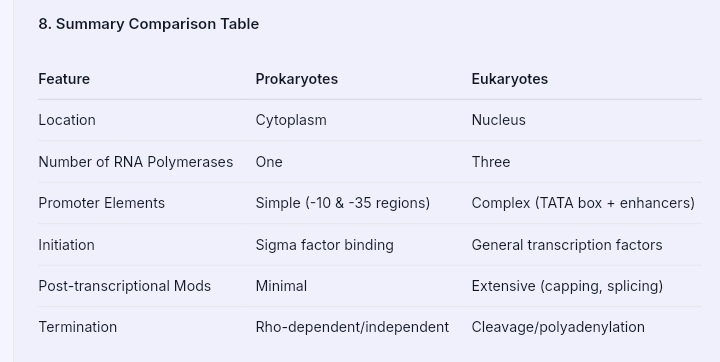
In conclusion, while both prokaryotic and eukaryotic cells utilize similar fundamental processes for transcription, they differ significantly in their complexity, regulation mechanisms, location within the cell, and post-transcriptional modifications required for functional mRNA production.