Changes in the Endometrium of the Mother with Formation of Deciduas and Decidual Reaction
The endometrium undergoes significant changes during pregnancy, particularly with the formation of the decidua and the decidual reaction. These changes are crucial for successful implantation of the embryo and subsequent fetal development.
1. Overview of the Endometrium and Its Role in Pregnancy
The endometrium is the inner lining of the uterus, which prepares each month for potential implantation of a fertilized egg. In a non-pregnant state, it undergoes cyclical changes driven by hormonal fluctuations, primarily estrogen and progesterone. During pregnancy, these hormonal influences lead to profound modifications that facilitate implantation and support embryonic development.
2. Formation of Decidua
Upon implantation of a fertilized ovum (blastocyst), the endometrial tissue transforms into what is known as decidua. This process begins shortly after conception:
- Decidualization: The endometrial stromal cells undergo decidualization, which is characterized by hypertrophy (increase in cell size) and increased secretion of specific proteins such as prolactin and insulin-like growth factor (IGF). This transformation is primarily driven by progesterone produced by the corpus luteum initially, followed by placental hormones once implantation occurs.
- Types of Decidua: The decidua can be categorized into three regions:
- Decidua basalis: The portion directly beneath the implanted embryo; it forms part of the placenta.
- Decidua capsularis: The layer covering the embryo.
- Decidua parietalis: The remaining endometrial lining not involved in placentation.
These regions play distinct roles in supporting pregnancy and facilitating nutrient exchange between mother and fetus.
3. Decidual Reaction
The decidual reaction refers to a series of physiological changes that occur in response to implantation:
- Vascular Changes: There is an increase in blood flow to the decidual tissue due to angiogenesis (formation of new blood vessels). This ensures adequate nutrient supply to both maternal tissues and developing fetal tissues.
- Immune Modulation: The decidual tissue also plays a critical role in modulating maternal immune responses to prevent rejection of the semi-allogeneic fetus. Specialized immune cells such as decidual natural killer (NK) cells are recruited to promote tolerance while still allowing for defense against pathogens.
- Secretion of Cytokines and Growth Factors: The decidua secretes various cytokines (e.g., interleukins) and growth factors that promote trophoblast invasion, enhance placental development, and maintain uterine quiescence during early pregnancy.
- Structural Changes: The architecture of the endometrium becomes more glandular with increased secretory activity, providing essential nutrients through uterine secretions until placental circulation is established.
4. Importance of Decidual Changes
The changes occurring within the endometrium are vital for several reasons:
- They create a suitable environment for embryo implantation.
- They ensure proper placentation, which is critical for fetal growth.
- They help maintain pregnancy by preventing maternal immune rejection.
In summary, these processes collectively ensure that both maternal tissues adapt effectively to support embryonic development throughout gestation.
Types of Chorionic Villi
Chorionic villi are small, finger-like projections that emerge from the chorion, an essential part of the placenta that plays a crucial role in fetal-maternal exchange. They are classified into types based on their structure, development, and function. Here are the main types:
- Primary Chorionic Villi
- Time of Development: Form during the early stages, around days 13-15 of pregnancy.
- Structure: Simple outgrowths that contain only cytotrophoblast cells covered by a layer of syncytiotrophoblast.
- Function: Provide initial contact between the maternal blood and the developing placenta.
- Secondary Chorionic Villi
- Time of Development: Around day 16.
- Structure: The mesoderm (middle embryonic layer) starts to penetrate the primary villi, forming a core of mesenchyme surrounded by cytotrophoblast and syncytiotrophoblast layers.
- Function: Act as a scaffold for further development and begin early blood vessel formation.
- Tertiary Chorionic Villi
- Time of Development: Around days 17-21.
- Structure: Blood vessels develop within the mesodermal core, forming a vascular network that eventually connects to the fetal circulatory system.
- Function: Facilitate active transport of nutrients, oxygen, and waste between mother and fetus. The formation of blood vessels in these villi marks the start of efficient fetal-maternal exchange.
- Anchoring (Stem) Villi
- Structure: Larger villi that connect the chorionic plate (fetal side of the placenta) to the decidua (maternal side), providing structural support.
- Function: Stabilize the connection between fetal and maternal tissues, allowing other villi to branch out for efficient exchange.
- Floating (Terminal) Villi
- Structure: Smaller branches that “float” in the maternal blood within the intervillous space.
- Function: Primarily responsible for gas, nutrient, and waste exchange. They have a rich network of capillaries that facilitate direct interaction with maternal blood.
These types of chorionic villi evolve to ensure a progressively more efficient maternal-fetal exchange system, crucial for fetal development.
Development of the Placenta: Fetal and Maternal Parts
The placenta is a vital organ that develops during pregnancy, facilitating nutrient and gas exchange between the mother and the developing fetus. It consists of both fetal and maternal components, each playing crucial roles in its structure and function. The development of the placenta can be understood through several key stages.
1. Formation of the Fetal Part of the Placenta
The fetal part of the placenta originates from the trophoblast, which is the outer layer of cells formed after fertilization. This process begins with:
- Fertilization and Blastocyst Formation: After sperm fertilizes an egg, a zygote forms and undergoes several divisions to become a blastocyst by around day 5 post-fertilization. The blastocyst consists of an inner cell mass (which will develop into the embryo) and an outer layer called the trophoblast.
- Trophoblast Differentiation: Upon implantation into the uterine wall (around days 6-7), the trophoblast differentiates into two layers:
- The cytotrophoblast (inner layer)
- The syncytiotrophoblast (outer layer).
The syncytiotrophoblast invades the maternal tissue, allowing for implantation and establishing contact with maternal blood vessels.
- Chorionic Villi Formation: As development continues, finger-like projections called chorionic villi form from the trophoblastic tissue. These villi extend into the maternal blood supply, increasing surface area for exchange. They are essential for nutrient uptake and waste elimination.
- Vascularization: Within these chorionic villi, fetal blood vessels develop from mesodermal cells derived from the inner cell mass. This vascular network connects to the developing fetus via umbilical arteries and veins, facilitating transport between maternal blood and fetal circulation.
2. Development of the Maternal Part of the Placenta
The maternal component of the placenta arises from modifications in uterine tissue:
- Decidual Reaction: Following implantation, changes occur in the endometrium (the lining of the uterus). The endometrial cells undergo decidualization, transforming into decidual cells that provide a supportive environment for implantation.
- Formation of Decidua: The decidua can be categorized into three regions:
- Decidua basalis (beneath where implantation occurs)
- Decidua capsularis (overlying the implanted embryo)
- Decidua parietalis (the remaining uterine lining).
The decidua basalis interacts closely with chorionic villi to form functional units known as placental cotyledons.
- Maternal Blood Supply Establishment: As trophoblastic cells invade deeper into uterine tissues, they remodel maternal spiral arteries to increase blood flow to support fetal growth. This remodeling involves replacing smooth muscle with trophoblastic cells to create low-resistance pathways for blood flow.
3. Functional Maturation
As pregnancy progresses:
- Placental Barrier Formation: By about week 10 of gestation, a functional barrier forms between maternal blood and fetal blood within chorionic villi. This barrier allows selective transfer of nutrients like glucose and amino acids while preventing large molecules such as antibodies from crossing over.
- Hormonal Production: The placenta also becomes an endocrine organ by producing hormones such as human chorionic gonadotropin (hCG), progesterone, estrogen, and placental lactogen that are crucial for maintaining pregnancy and supporting fetal development.
In summary, both parts of the placenta—the fetal part derived from trophoblastic tissue and maternal part originating from modified endometrial tissue—develop intricately to ensure successful pregnancy outcomes through effective nutrient exchange, waste removal, hormonal regulation, and immune protection.
Functions Of The Placenta
The placenta is a vital organ that plays several crucial roles during pregnancy. Below are the primary functions of the placenta, organized into distinct categories.
1. Respiration
The placenta serves as the only source of oxygen for the developing fetus. It facilitates the exchange of gases between maternal and fetal bloodstreams. Fetal hemoglobin has a higher affinity for oxygen than adult hemoglobin, which means it can draw oxygen from maternal blood more effectively. This process allows oxygen to pass from the mother’s bloodstream through the placental membrane to the fetus while simultaneously enabling carbon dioxide and other waste products to be transferred back to the mother for excretion.
2. Nutrition
All nutritional needs of the fetus are met through the placenta, primarily in the form of glucose, which is essential for energy and growth. The placenta also transfers vitamins and minerals necessary for fetal development. However, it is important to note that potentially harmful substances such as medications, alcohol, caffeine, and nicotine can also cross the placental barrier, which may affect fetal health.
3. Excretion
The placenta functions similarly to kidneys by filtering waste products from fetal circulation. Waste materials such as urea and creatinine produced by the fetus are transported across the placenta into maternal blood for elimination.
4. Endocrine Functions
The placenta has significant endocrine functions, producing several hormones essential for maintaining pregnancy:
- Human Chorionic Gonadotropin (hCG): This hormone is produced by the syncytiotrophoblast cells of the placenta shortly after implantation. hCG helps maintain the corpus luteum during early pregnancy until the placenta can take over hormone production.
- Estrogen: The placenta produces estrogen, which plays a critical role in preparing the body for childbirth by softening tissues and expanding muscles and ligaments in preparation for labor.
- Progesterone: By around five weeks gestation, progesterone production shifts predominantly to the placenta. Progesterone is crucial for maintaining pregnancy; it relaxes uterine muscles to prevent contractions and supports endometrial health.
5. Immunity
The placenta also contributes to fetal immunity by transferring maternal antibodies across its barrier during pregnancy. This transfer helps provide passive immunity to newborns during their first months of life.
Placental Circulation
The placental circulation is a critical component of fetal development, facilitating the exchange of nutrients, gases, and waste products between the mother and the fetus. This system operates through a complex network of blood vessels that connect the maternal and fetal circulatory systems via the placenta.
1. Structure of the Placenta
The placenta is an organ that develops in the uterus during pregnancy. It consists of both maternal and fetal tissues. The maternal side contains decidual tissue, while the fetal side has chorionic villi, which are finger-like projections that extend into the maternal blood supply. These villi are surrounded by maternal blood in spaces called intervillous spaces, allowing for efficient nutrient and gas exchange.
2. Blood Flow to the Placenta
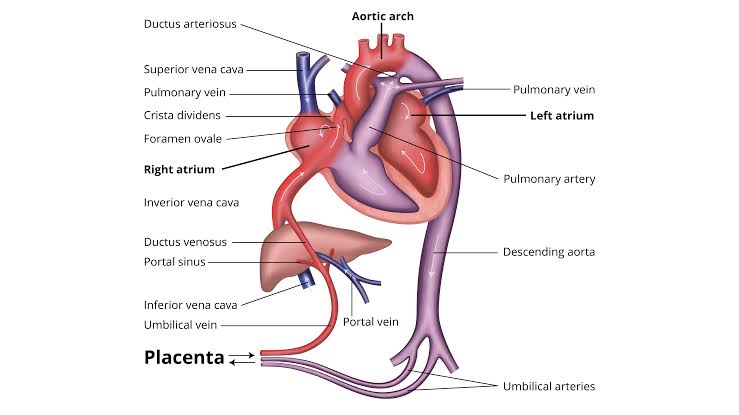
Oxygen-poor blood from the fetus is carried away from its heart through two umbilical arteries. These arteries branch off from the internal iliac arteries of the fetus and travel within the umbilical cord to reach the placenta. Upon reaching the placenta, these arteries divide into smaller branches that penetrate into the placental tissue.
3. Maternal Blood Supply
Maternal blood flows into the placenta through spiral arteries that arise from uterine arteries. These spiral arteries deliver oxygen-rich blood into the intervillous spaces surrounding chorionic villi. The pressure in these arteries allows for a continuous flow of maternal blood, which bathes the chorionic villi.
4. Exchange Mechanism
The exchange of gases (oxygen and carbon dioxide), nutrients (such as glucose and amino acids), and waste products occurs across a thin barrier formed by trophoblast cells lining the chorionic villi. Oxygen diffuses from maternal blood into fetal blood, while carbon dioxide moves in the opposite direction to be expelled by maternal circulation.
5. Return Pathway for Fetal Blood
After gas exchange occurs, oxygenated blood returns to the fetus through a single umbilical vein located within the umbilical cord. This vein carries nutrient-rich blood back to the fetus, entering through its liver via a structure known as ductus venosus before merging with other venous return pathways leading to the right atrium of the fetal heart.
6. Waste Removal
Simultaneously, metabolic waste products produced by fetal tissues are transported back to the placenta via umbilical arteries. In this process, waste products such as urea and creatinine diffuse from fetal blood into maternal circulation for elimination by maternal kidneys.
7. Importance of Placental Circulation
The efficiency of placental circulation is vital for maintaining fetal health throughout pregnancy. It ensures that adequate oxygen and nutrients are delivered while removing waste products effectively, thereby supporting normal growth and development until birth when independent respiration begins.
In summary, placental circulation involves a dual system where maternal blood supplies oxygen and nutrients to fetal blood through specialized structures in the placenta while simultaneously allowing for waste removal from fetal circulation back to maternal systems.