Cell junctions are specialized structures that facilitate the adhesion and communication between adjacent cells in tissues. They play a critical role in maintaining the structural integrity of tissues, allowing for the transmission of signals and molecules between cells, and regulating various physiological processes. Cell junctions can be classified into several types based on their structure and function.
Junctions Along the Lateral and Basal Surfaces of Cells
(a) Junctions Along Lateral Surfaces
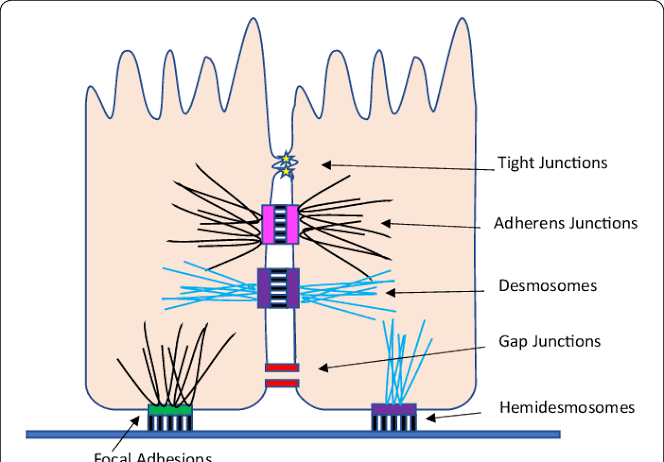
- Tight Junctions (Zonula Occludens): These junctions create a barrier that prevents the passage of molecules and ions through the space between epithelial cells. They are composed of proteins such as claudins and occludins that seal adjacent cells together.
- Adherens Junctions (Zonula Adherens): These junctions provide mechanical attachment between adjacent cells through cadherin proteins, which connect to the actin cytoskeleton. They help maintain tissue structure and integrity.
- Desmosomes: These are strong adhesive junctions that anchor intermediate filaments in one cell to those in another, providing structural stability to tissues subjected to mechanical stress. Desmosomal cadherins, such as desmogleins and desmocollins, play a crucial role in this process.
- Gap Junctions: These junctions allow for direct communication between adjacent cells through connexin proteins that form channels permitting the transfer of ions and small molecules, facilitating metabolic cooperation.
(b) Junctions Along Basal Surfaces
- Hemidesmosomes: These structures anchor epithelial cells to the underlying basement membrane by connecting intermediate filaments within the cell to extracellular matrix components like laminin.
- Basal Lamina: While not a junction per se, the basal lamina is a thin layer of extracellular matrix that provides support and anchorage for epithelial tissues, influencing cell behavior and function.
- Focal Adhesions: These are dynamic structures that connect the cytoskeleton of a cell to the extracellular matrix via integrins, playing a role in signal transduction and cellular responses to the environment.
Structure and Functions of the Five Main Types of Cell Junctions
- Tight Junctions (Zonula Occludens):
- Structure: Composed of transmembrane proteins such as claudins and occludins that form a seal between adjacent cells.
- Function: Prevent paracellular transport (movement between cells) and maintain polarity by separating apical from basolateral membranes.
- Adherens Junctions (Zonula Adherens):
- Structure: Formed by cadherin proteins linked to actin filaments via catenins.
- Function: Provide mechanical strength to tissues, facilitating communication between neighboring cells through signaling pathways.
- Desmosomes:
- Structure: Composed of desmogleins and desmocollins (cadherin family) linked to keratin intermediate filaments.
- Function: Provide strong adhesion between cells, particularly in tissues subject to stretching or shear forces, such as cardiac muscle.
- Hemidesmosomes:
- Structure: Comprised of integrins that connect keratin filaments inside the cell to laminin in the basement membrane.
- Function: Anchor epithelial cells firmly to the underlying extracellular matrix, contributing to tissue stability.
- Gap Junctions:
- Structure: Formed by connexins that assemble into connexons, creating channels for intercellular communication.
- Function: Allow direct transfer of ions and small molecules between adjacent cells, facilitating coordinated responses in tissues like cardiac muscle.
Sites of Distribution
- Tight junctions are predominantly found in epithelial tissues lining organs such as intestines and kidneys where barrier function is crucial.
- Adherens junctions are widespread in epithelial layers but also present in cardiac muscle tissue for structural integrity.
- Desmosomes are abundant in stratified squamous epithelium (e.g., skin) and cardiac muscle where mechanical resilience is necessary.
- Hemidesmosomes are primarily located at the basal surface of epithelial cells anchoring them to the basement membrane across various tissues.
- Gap junctions are prevalent in many tissues including cardiac muscle, smooth muscle, and some types of epithelia where rapid communication is essential.
Components of Junctional Complex
The junctional complex consists mainly of three types of intercellular junctions located at the lateral surfaces of epithelial cells:
- Tight Junctions
- Adherens Junctions
- Desmosomes
These components work synergistically to ensure proper tissue architecture:
- The tight junction forms a barrier preventing leakage between cells.
- The adherens junction provides structural support through connections with cytoskeletal elements.
- The desmosome reinforces this structure against mechanical stress.
Together, these components contribute not only to physical integrity but also facilitate communication through signaling pathways essential for maintaining homeostasis within tissues.