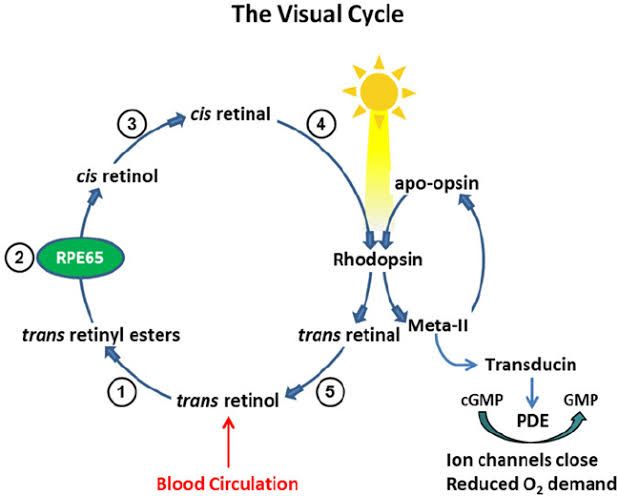
The visual cycle, also known as the retinoid cycle, is a series of biochemical reactions that occur in the retina of the eye and are essential for vision. This cycle is responsible for the regeneration of the visual pigment rhodopsin, which is located in the rod cells of the retina and plays a crucial role in low-light vision.
The visual cycle begins when light enters the eye and is absorbed by rhodopsin, causing it to change its shape and activate a signaling cascade that ultimately leads to the generation of an electrical signal sent to the brain for processing. After this activation, rhodopsin needs to be regenerated in order to continue detecting light stimuli. This regeneration process occurs through a series of enzymatic reactions that convert all-trans-retinal, the product of rhodopsin activation, back into 11-cis-retinal, which can then recombine with opsin to form new rhodopsin molecules.
The visual cycle involves several key enzymes and proteins, including retinol dehydrogenase, retinal isomerase, and ATP-binding cassette transporters. These components work together to ensure the efficient recycling of retinal molecules and the continuous function of rod cells in low-light conditions.
Overall, the visual cycle is a crucial aspect of human vision that allows us to perceive light stimuli accurately and adapt to changing lighting conditions.
Steps that contribute to the perception and interpretation of visual stimuli
The formation of visual complexes involves a series of steps that contribute to the perception and interpretation of visual stimuli. These steps include:
- Sensation: The process begins with sensation, where sensory receptors in the eyes detect light and convert it into neural signals.
- Perception: Once the sensory information is received, it is processed by the brain through perception. This step involves organizing and interpreting the sensory input to make sense of the visual stimuli.
- Recognition: After perception, recognition occurs, where the brain identifies and categorizes the visual information based on past experiences and knowledge.
- Interpretation: Interpretation involves assigning meaning to the visual stimuli, which can be influenced by cultural, social, and personal factors.
- Integration: The final step in forming visual complexes is integration, where the brain combines different elements of the visual stimuli to create a coherent and meaningful representation.
These steps work together to create a holistic understanding of visual information and play a crucial role in how individuals perceive and interact with their environment.
The role of retinaldehyde in vision
Retinaldehyde, also known as retinal or vitamin A aldehyde, plays a crucial role in the process of vision. It is a derivative of vitamin A and is essential for the functioning of the visual system. Retinaldehyde is a component of rhodopsin, which is a light-sensitive pigment found in the rods of the retina. When light enters the eye and strikes the retina, it is absorbed by rhodopsin, causing retinaldehyde to undergo a conformational change. This change triggers a cascade of biochemical reactions that ultimately lead to the generation of electrical signals sent to the brain via the optic nerve. These signals are then interpreted by the brain as visual information, allowing us to see.
Retinaldehyde is continuously regenerated in a process known as the visual cycle. After retinaldehyde undergoes its conformational change in response to light, it must be converted back to its original form in order to be available for another round of vision. This regeneration process involves several enzymatic reactions that occur in different cell types within the retina.
In summary, retinaldehyde is a critical component of the visual system, playing a key role in converting light into electrical signals that are interpreted by the brain as vision.