The Rate of ECG Tracing
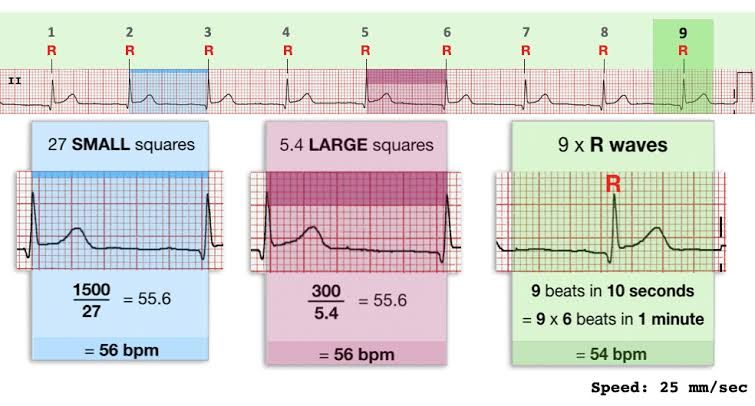
The rate of an ECG tracing can be determined by analyzing the intervals between specific waves, particularly the R waves. The standard paper speed for an ECG is 25 mm/sec, which means that:
- 1 small square (1 mm) = 0.04 seconds
- 5 small squares (5 mm) = 1 large square = 0.2 seconds
- 5 large squares = 1 second
- 1500 small squares or 300 large squares = 1 minute
How to Calculate the Rate from ECG Tracing
There are several methods to calculate the heart rate from an ECG tracing:
- Large Square Method:
- Identify two consecutive R waves.
- Count the number of large squares between them.
- Divide 300 by this number to get the heart rate in beats per minute (bpm).
- Formula: Rate = 300 / number of large squares between consecutive R waves
- Small Square Method:
- Identify two consecutive R waves.
- Count the number of small squares between them.
- Divide 1500 by this number to get the heart rate in bpm.
- Formula: Rate = 1500 / number of small squares between consecutive R waves
- R Wave Method:
- Count the number of R waves in a rhythm strip that is typically recorded over a ten-second period.
- Multiply this number by six to get the average heart rate in bpm.
- Formula: Rate = Number of R waves in a ten-second strip x 6
Interpreting Rule of 300
The Rule of 300 is a quick method for estimating heart rate from an ECG with regular rhythms:
- Count the number of large squares between two consecutive R waves.
- Divide this count into 300 to estimate the heart rate.
For example:
- If there are three large squares between two consecutive R waves, then: Heart Rate = 300 ÷ 3 = 100 bpm
This method is most accurate for regular rhythms and provides a rapid estimation.
Overview of Sinus Rhythm, Sinus Bradycardia, and Tachycardia
- Sinus Rhythm:
- Normal rhythm originating from the sinoatrial (SA) node.
- Characterized by P waves before each QRS complex and consistent intervals between beats.
- Heart rate typically ranges from 60 to 100 bpm.
- Sinus Bradycardia:
- A slower than normal sinus rhythm with a heart rate less than 60 bpm.
- Can be normal in well-trained athletes or during sleep but may indicate underlying pathology if symptomatic.
- Sinus Tachycardia:
Overdrive Suppression
Overdrive suppression is a physiological mechanism where faster pacemaker cells suppress slower pacemaker cells within the heart:
- The SA node usually sets the pace because it has the highest intrinsic firing rate among cardiac pacemaker cells.
- When another part of the heart attempts to take over pacing at a slower rate, it is suppressed by continuous impulses from the SA node.
- This ensures coordinated contraction and efficient pumping action by maintaining hierarchical control over cardiac rhythms.