
Progressive Rubella Panencephalitis (PRP) is an exceptionally rare and devastatingly fatal neurodegenerative disorder that represents a late-stage complication of a rubella virus infection. Occurring years to decades after the initial infection, PRP is characterized by a relentless and progressive decline in cognitive and motor functions, ultimately leading to death. While the widespread implementation of the measles, mumps, and rubella (MMR) vaccine has rendered PRP nearly obsolete in many parts of the world, its study remains critical for understanding persistent viral infections of the central nervous system (CNS).
Understanding Progressive Rubella Panencephalitis
Before delving into diagnosis and treatment, it is essential to understand the underlying nature of the disease. PRP is a form of chronic, inflammatory panencephalitis, meaning it involves inflammation of both the gray and white matter throughout the brain. Its etiology is directly linked to the rubella virus, but not through an acute infection. Instead, PRP develops due to the virus’s ability to persist within the CNS for a prolonged period in a latent or low-level replicative state.
The vast majority of PRP cases arise from Congenital Rubella Syndrome (CRS), which occurs when a pregnant woman contracts rubella and passes the virus to her fetus. The virus disseminates throughout the developing fetal organs, including the brain. While many neurological symptoms of CRS are apparent at birth or in early childhood, the virus can remain dormant within CNS cells for years. Much less commonly, PRP can develop following an acquired rubella infection during childhood.
The latency period between the initial infection and the onset of PRP symptoms is typically between 8 and 20 years, with most individuals presenting in their second decade of life. During this time, the persistent virus is thought to trigger a chronic, dysregulated immune response within the brain. This results in widespread inflammation, perivascular cuffing (the accumulation of inflammatory cells around blood vessels), extensive demyelination (destruction of the protective myelin sheath around nerve fibers), gliosis (scarring by glial cells), and ultimately, significant neuronal loss and cerebral atrophy. The disease’s insidious onset and inexorable progression are direct consequences of this slow-burning, destructive process.
The Diagnostic Pathway for Progressive Rubella Panencephalitis
The diagnosis of PRP is challenging due to its rarity and its clinical overlap with other neurodegenerative disorders of childhood and adolescence, most notably Subacute Sclerosing Panencephalitis (SSPE), which is caused by the measles virus. A definitive diagnosis relies on a convergence of evidence from clinical evaluation, cerebrospinal fluid analysis, serology, neuroimaging, and electrophysiological studies.
Step 1: Initial Clinical Evaluation and History
The diagnostic journey begins with a strong clinical suspicion based on the patient’s history and presenting symptoms.
- Patient History: The most crucial piece of historical information is a confirmed or suspected diagnosis of Congenital Rubella Syndrome. Hallmarks of CRS that may be present include congenital cataracts, sensorineural deafness, and cardiac defects (e.g., patent ductus arteriosus). A history of acquired rubella infection in an unimmunized child is a less common but still significant risk factor. The patient’s MMR vaccination status is a key inquiry.
- Clinical Presentation: The onset is typically insidious. Initial symptoms are often subtle and can be mistaken for psychiatric or behavioral issues. They include:
- Cognitive Decline: A noticeable deterioration in school performance, memory loss, and difficulty with concentration.
- Behavioral Changes: Irritability, emotional lability, and social withdrawal.
- Disease Progression: As the disease advances over months to years, more profound neurological deficits emerge:
- Motor Dysfunction: Ataxia (incoordination and clumsiness), spasticity (muscle stiffness), and gait disturbances.
- Seizures: Myoclonic jerks (sudden, brief muscle twitches) are common, but generalized tonic-clonic seizures can also occur.
- Visual Impairment: Optic atrophy and chorioretinitis can lead to progressive vision loss.
- Cerebellar and Brainstem Signs: Dysarthria (slurred speech) and dysphagia (difficulty swallowing) develop.
- End-Stage Disease: The patient eventually progresses to a state of profound dementia, quadriparesis, and ultimately enters a vegetative or comatose state.
Step 2: Cerebrospinal Fluid (CSF) Analysis
Analysis of the CSF, obtained via a lumbar puncture, is the cornerstone of diagnosing PRP and distinguishing it from other conditions.
- Key Findings: The CSF profile in PRP is highly characteristic and demonstrates a significant inflammatory process localized to the CNS.
- Elevated Protein: Total protein levels are moderately to markedly elevated, reflecting inflammation and breakdown of the blood-brain barrier.
- Pleocytosis: A mild increase in white blood cells (lymphocytes) may be present.
- Elevated Gamma Globulins: A high concentration of immunoglobulins (antibodies) is a hallmark finding.
- Oligoclonal Bands: The presence of oligoclonal bands in the CSF (but not in the serum) indicates that specific antibody clones are being produced exclusively within the CNS.
- Crucial Finding: Elevated Rubella-Specific IgG: The definitive diagnostic marker is an abnormally high titer of rubella-specific IgG antibodies in the CSF. To confirm that these antibodies are being produced within the CNS (intrathecal synthesis) and not just leaking from the blood, a CSF/serum rubella antibody index is calculated. A significantly elevated index provides powerful evidence for a persistent CNS rubella infection.
Step 3: Neurophysiological and Neuroimaging Studies
- Electroencephalography (EEG): The EEG is a non-invasive test that measures the brain’s electrical activity. In PRP, the findings are abnormal but often non-specific. They typically show a diffuse background slowing of brain waves, consistent with widespread cerebral dysfunction. Periodic high-amplitude slow-wave complexes may be seen, though they are less common and regular than those observed in SSPE.
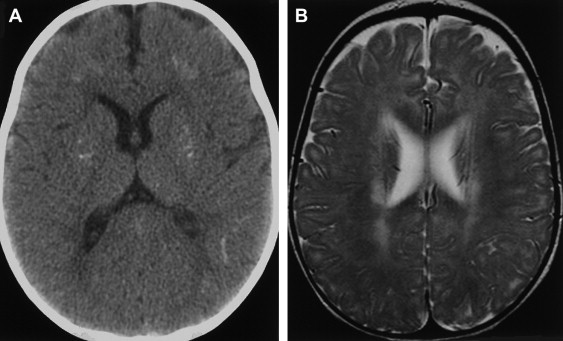
- Neuroimaging (MRI and CT): Magnetic Resonance Imaging (MRI) is the preferred imaging modality.
- Early Stages: The MRI may be normal or show subtle, non-specific changes.
- Later Stages: As the disease progresses, imaging reveals characteristic signs of widespread brain damage. These include progressive cerebral atrophy (brain shrinkage), particularly of the white matter; ventricular enlargement (hydrocephalus ex vacuo); and periventricular white matter signal abnormalities (lesions) on T2-weighted and FLAIR sequences. Cerebellar atrophy may also be prominent.
Step 4: Definitive Diagnosis (Brain Biopsy)
A brain biopsy is the gold standard for a definitive diagnosis but is rarely performed due to its invasive nature. It is typically reserved for atypical cases where other diagnostic methods are inconclusive. Histopathological examination of the brain tissue would reveal perivascular inflammatory infiltrates, widespread gliosis, demyelination, and neuronal loss. Using techniques like immunocytochemistry or electron microscopy, it is possible to identify rubella virus antigens or viral particles within the brain cells, confirming the etiology.
Treatment and Management of Progressive Rubella Panencephalitis
The prognosis for PRP is universally grim. There is no known cure, and the disease is relentlessly progressive and ultimately fatal, with death typically occurring within 2 to 10 years of symptom onset. Consequently, the focus of management is not on curing the disease but on providing comprehensive symptomatic and supportive care to maximize quality of life and ensure patient comfort.
Symptomatic Management
- Seizure Control: Anticonvulsant medications are the primary treatment for managing seizures. Medications such as valproic acid, levetiracetam, or clonazepam are often used to control myoclonic jerks and other seizure types. Dosages often need to be adjusted as the disease progresses.
- Management of Spasticity and Motor Symptoms: Muscle relaxants like baclofen or diazepam can help alleviate painful spasticity. Physical and occupational therapy are vital for maintaining mobility, preventing contractures, and assisting with activities of daily living for as long as possible.
- Nutritional Support: As dysphagia develops, ensuring adequate nutrition and hydration becomes critical. A consultation with a speech-language pathologist is necessary to assess swallowing function. In advanced stages, placement of a percutaneous endoscopic gastrostomy (PEG) tube for feeding is often required to prevent aspiration pneumonia and malnutrition.
Supportive and Palliative Care
Given the incurable nature of PRP, a multidisciplinary approach involving palliative care specialists is essential from the time of diagnosis. This team can help manage symptoms, provide psychosocial and emotional support to the patient and their family, and facilitate crucial conversations about end-of-life care and goals. The aim is to uphold the patient’s dignity and comfort throughout the course of their illness.
Investigational Therapies
Over the years, various experimental treatments have been attempted with little to no success. Antiviral agents, such as amantadine, and immunomodulatory drugs, like interferon-alpha and isoprinosine, have been tried but have failed to halt or reverse the disease’s progression. The failure of these therapies underscores the complexity of eradicating a persistent virus from the CNS once a chronic inflammatory cascade has been established.
Conclusion: The Overarching Importance of Prevention
Progressive Rubella Panencephalitis stands as a tragic and stark reminder of the devastating long-term potential of the rubella virus. While the diagnostic pathway is complex and the treatment options are purely supportive, the most powerful tool against this disease is not a treatment but a preventative measure: vaccination. The routine administration of the MMR vaccine has been profoundly successful in preventing congenital and childhood rubella, thereby virtually eliminating the substrate from which PRP arises. The continued global commitment to robust vaccination programs is the only effective strategy to ensure that this fatal neurological disease remains a relic of medical history.
References
- Wolinsky, J. S. (2018). Rubella. In Handbook of Clinical Neurology (Vol. 147, pp. 353-363). Elsevier.
- Givens, T. G., & Gilden, D. H. (2013). The role of viral infections in the etiopathogenesis of multiple sclerosis and other demyelinating diseases. Journal of Neurovirology, 19(4), 305–319.
- Townsend, J. J., Baringer, J. R., Wolinsky, J. S., Malamud, N., Mednick, J. P., Panitch, H. S., … & Oshiro, L. S. (1975). Progressive rubella panencephalitis: late onset after congenital rubella. New England Journal of Medicine, 292(19), 990-993.
- Centers for Disease Control and Prevention (CDC). (2021). Epidemiology and Prevention of Vaccine-Preventable Diseases. Chapter 19: Rubella. The Pink Book, 14th Edition.
- Best, J. M. (2007). Rubella. Seminars in Fetal and Neonatal Medicine, 12(3), 182-192.
- Weil, M. L., Itabashi, H. H., Cremer, N. E., Oshiro, L. S., Lennette, E. H., & Carnay, L. (1975). Chronic progressive panencephalitis due to rubella virus simulating subacute sclerosing panencephalitis. New England Journal of Medicine, 292(19), 994-998.