The human circulatory system is a remarkable closed-loop circuit, where the heart acts as the central pump. While immense focus is often placed on the heart’s powerful ejection of oxygenated blood into the arteries (cardiac output), the return of deoxygenated blood to the heart—a process known as venous return—is equally critical for maintaining cardiovascular homeostasis. Central to this process is a key hemodynamic parameter: Central Venous Pressure (CVP).
Defining Central Venous Pressure (CVP)
Central Venous Pressure is the hydrostatic pressure measured within the large veins of the thorax, specifically in the vena cavae, just proximal to the right atrium of the heart. For clinical and physiological purposes, CVP is considered a direct reflection of the pressure within the right atrium itself (Right Atrial Pressure or RAP). It is measured in millimeters of mercury (mmHg) or centimeters of water (cmH₂O), with a normal range typically cited as 2 to 8 mmHg.
What Does CVP Represent?
At its core, CVP provides a snapshot of the dynamic relationship between the volume of blood returning to the heart and the heart’s ability to pump that blood forward into the pulmonary circulation. It serves as a clinical estimate of two critical variables:
- Right Ventricular Preload: Preload refers to the degree of stretch on the ventricular muscle fibers at the end of diastole (the filling phase). According to the Frank-Starling mechanism, an optimal preload is necessary for a forceful contraction. Because CVP reflects the filling pressure of the right ventricle, it is often used as a surrogate measure for right ventricular end-diastolic volume, or preload.
- Systemic Fluid Status: Changes in CVP can indicate a patient’s volume status. A low CVP may suggest hypovolemia (insufficient blood volume), whereas a high CVP may point towards hypervolemia (fluid overload) or impaired cardiac function.
It is crucial to understand that CVP is not an isolated number but a dynamic value influenced by intravascular volume, venous tone, intrathoracic pressure, and, most importantly, the pumping efficacy of the right ventricle.
The Importance of CVP in Governing Venous Return
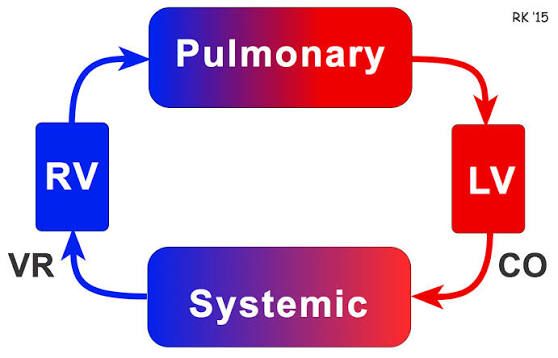
Venous return (VR) is the rate of blood flow back to the heart. For the circulatory system to function, venous return must equal cardiac output over time. The primary force driving blood from the peripheral veins back to the heart is a pressure gradient. Blood, like any fluid, flows from an area of higher pressure to an area of lower pressure.
The formula that governs this relationship is:
Venous Return (VR) = (Pmsf – CVP) / RVR
Let’s break down these components to understand CVP’s central role:
- Mean Systemic Filling Pressure (Pmsf): This is the theoretical pressure that would exist throughout the entire cardiovascular system if the heart were stopped and the blood were instantaneously redistributed to achieve equilibrium. It represents the average “fullness” or elastic recoil potential of the circulatory system, primarily determined by blood volume and the degree of venomotor tone (the contraction of smooth muscle in the veins). Pmsf is the upstream driving pressure for venous return.
- Central Venous Pressure (CVP): This is the downstream pressure. It represents the “back-pressure” that venous return must overcome to enter the right atrium.
- Resistance to Venous Return (RVR): This is the total impedance to blood flow between the peripheral vessels and the right atrium.
From this equation, the importance of CVP becomes clear. It acts as the opposing force to Pmsf. For a given Pmsf, a lower CVP creates a larger pressure gradient, which increases venous return. Conversely, a higher CVP narrows this gradient, thereby decreasing venous return. Therefore, CVP is the critical fulcrum balancing the upstream pressure from the periphery with the heart’s capacity to accept incoming blood. If the right heart fails and cannot effectively pump blood forward, CVP will rise, creating a “damming” effect that impedes venous return and causes blood to back up in the systemic venous system.
Factors that Affect and Regulate Venous Return
Venous return is not a passive process; it is actively regulated by a sophisticated interplay of factors that influence Pmsf, CVP, and RVR.
1. Blood Volume: This is the most direct determinant of Mean Systemic Filling Pressure.
- Increase in Volume (Hypervolemia): Infusing fluids or blood products increases the total volume within the circulatory system. This raises the Pmsf, widens the pressure gradient (Pmsf – CVP), and consequently increases venous return.
- Decrease in Volume (Hypovolemia): Hemorrhage, dehydration, or severe burns reduce circulating blood volume. This lowers Pmsf, narrows the pressure gradient, and significantly decreases venous return, which can lead to a drop in cardiac output and shock.
2. Sympathetic Nervous System Activity (Venomotor Tone): The veins are highly compliant vessels that act as a major blood reservoir. The sympathetic nervous system can modulate their capacity.
- Venoconstriction: When the sympathetic nervous system is activated (e.g., during exercise, stress, or in response to blood loss), it causes the smooth muscles in the walls of veins to contract. This process, known as venoconstriction, reduces the capacitance of the venous system. It effectively “squeezes” blood out of the venous reservoir and toward the heart, increasing the Pmsf without changing the total blood volume. This is a powerful mechanism for rapidly boosting venous return.
3. The Skeletal Muscle Pump: This is a crucial mechanism, especially for returning blood from the lower extremities against gravity.
- Mechanism: When leg muscles (like the gastrocnemius) contract during activities such as walking or running, they compress the deep veins embedded within them. The venous system contains a series of one-way valves that only permit blood flow toward the heart. Muscle contraction propels blood upward past these valves, while relaxation allows the veins to refill from below. The valves prevent backflow, effectively “milking” blood back to the central circulation. Prolonged standing without muscle movement eliminates this pump, leading to blood pooling in the legs.
4. The Respiratory Pump (Thoracoabdominal Pump): The act of breathing creates pressure changes in the thoracic and abdominal cavities that significantly aid venous return.
- During Inspiration: The diaphragm contracts and moves downward. This action increases pressure in the abdominal cavity, compressing the abdominal veins. Simultaneously, the expansion of the chest cavity decreases intrathoracic pressure. This creates a pressure gradient that pulls (or “sucks”) blood from the higher-pressure abdominal veins into the lower-pressure thoracic veins and right atrium, enhancing venous return.
- During Expiration: The process reverses. Intrathoracic pressure rises, and abdominal pressure falls. However, the venous valves prevent significant retrograde flow, ensuring a net forward movement of blood with each respiratory cycle.
5. Cardiac Function and CVP: The heart’s own performance directly influences the downstream pressure (CVP).
- Enhanced Contractility: A strongly contracting heart ejects a large stroke volume, effectively emptying the ventricles and lowering right atrial pressure (CVP). This low CVP maximizes the pressure gradient for venous return.
- Cardiac Failure: In right-sided heart failure, the right ventricle is weak and cannot effectively pump the returning blood into the lungs. Blood backs up in the right atrium, causing a sharp increase in CVP. This elevated CVP severely reduces the pressure gradient for venous return, leading to systemic venous congestion, peripheral edema, and jugular venous distention.
Conclusion
Central Venous Pressure is far more than a simple clinical measurement; it is a dynamic indicator representing the endpoint of venous return and the starting point of pulmonary circulation. Its value reflects the delicate balance between the volume and pressure of blood returning from the body and the heart’s ability to accommodate and propel that blood forward. Venous return itself is a complex, actively managed process, driven by the pressure gradient between the mean systemic filling pressure and the central venous pressure. It is powerfully assisted by the mechanical actions of the skeletal muscle and respiratory pumps and exquisitely regulated by blood volume and sympathetic control over venous tone. A thorough understanding of these interconnected principles is fundamental to clinical practice, enabling healthcare professionals to accurately assess cardiovascular status, guide fluid resuscitation, and manage complex hemodynamic instability.
References
- Hall, J. E., & Hall, M. E. (2021). Guyton and Hall Textbook of Medical Physiology (14th ed.). Elsevier. (Specifically, chapters on circulatory physiology, venous return, and cardiac output).
- Pinsky, M. R. (2018). Functional Hemodynamic Monitoring. Critical Care Clinics, 34(3), 335–346.
- Gelman, S. (2008). Venous Function and Central Venous Pressure: A Reevaluation. Anesthesiology, 108(4), 735–748.
- Magder, S. (2015). Understanding Venous Return. Current Anesthesia & Critical Care, 26(4), 173-180.
- Beard, D. A., & Feigl, E. O. (2011). Understanding Guyton’s venous return curves. American Journal of Physiology-Heart and Circulatory Physiology, 301(3), H629–H633.