Hydrocele and varicocele are two distinct yet common urological conditions affecting the male scrotum, often leading to patient concern due to scrotal swelling, discomfort, or implications for fertility. While both involve abnormalities within the scrotum, their underlying causes, clinical presentations, and management strategies differ significantly.
Hydrocele: An Overview
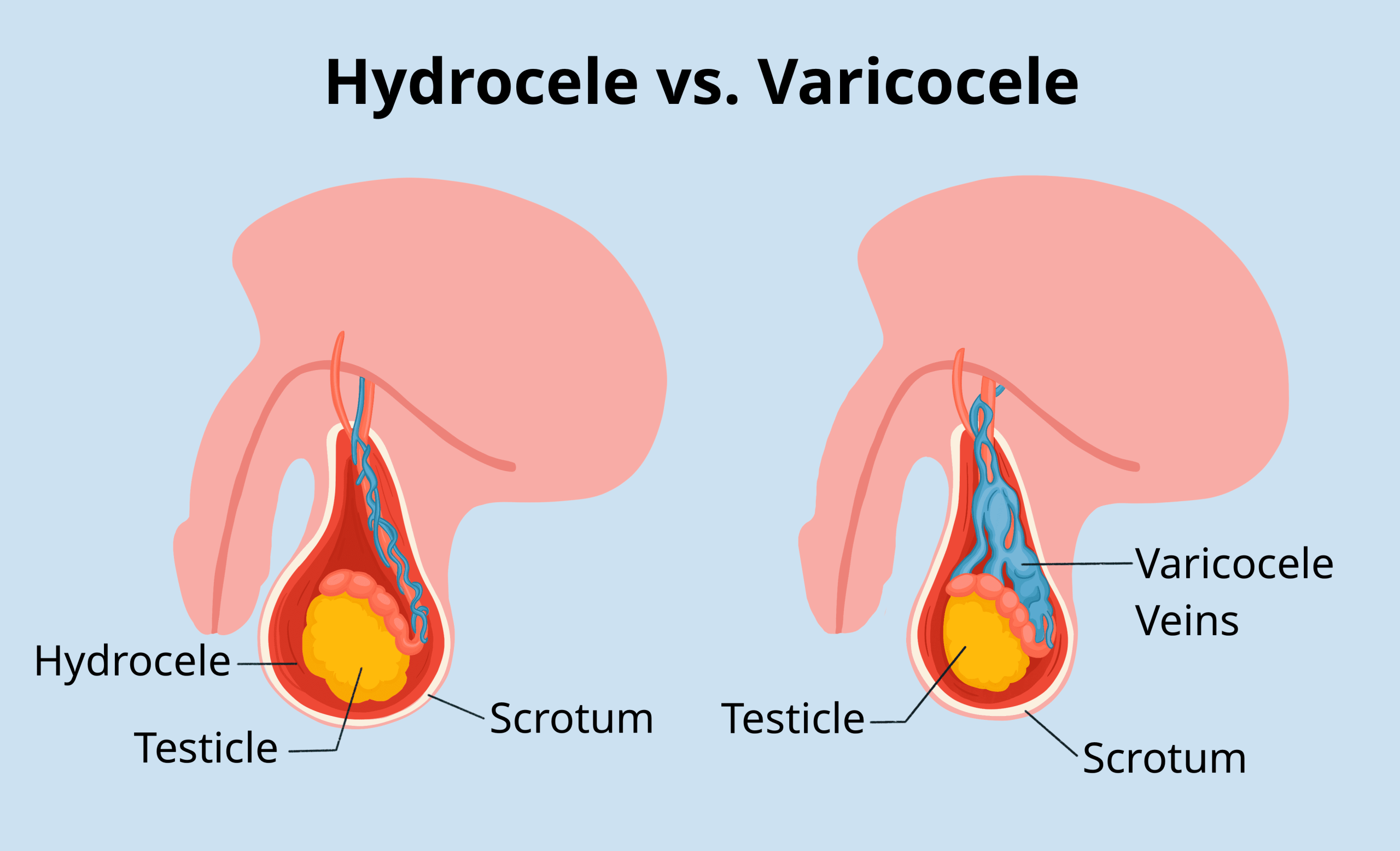
A hydrocele is a collection of serous fluid within the tunica vaginalis, the serous membrane that surrounds the testicle. This fluid accumulation leads to a non-tender, often soft, scrotal swelling that can vary in size.
1. Causes of Hydrocele
Hydroceles are broadly classified into communicating and non-communicating types, reflecting their underlying pathogenesis:
- Communicating Hydrocele: This type is primarily congenital and results from the failure of the processus vaginalis to close completely. The processus vaginalis is an embryonic outpouching of the parietal peritoneum that accompanies the testis as it descends into the scrotum. If it remains patent, peritoneal fluid can flow into the tunica vaginalis, causing a hydrocele. The size of the swelling often fluctuates, being larger at the end of the day or after activity, and may reduce overnight as fluid drains back into the abdomen. This is more common in infants and young children.
- Non-communicating Hydrocele (Acquired/Idiopathic): In this type, the processus vaginalis is completely obliterated, meaning there is no connection to the peritoneal cavity. Fluid accumulation is thought to be due to an imbalance between the production and absorption of fluid by the tunica vaginalis. This can occur without an identifiable cause (idiopathic) or be secondary to various factors:
- Trauma: Direct injury to the scrotum or testis can lead to fluid accumulation.
- Infection/Inflammation: Epididymitis, orchitis, or other scrotal infections can cause reactive fluid production.
- Surgery: Post-surgical hydroceles can occur following procedures like varicocelectomy, hernia repair, or renal transplantation, due to lymphatic disruption or inflammatory response.
- Testicular Tumors: A testicular mass can sometimes be associated with a reactive hydrocele, necessitating careful evaluation to rule out malignancy.
- Systemic Conditions: Rarely, conditions such as heart failure or generalized edema can lead to scrotal fluid collection.
2. Clinical Features of Hydrocele
Patients with hydrocele typically present with:
- Painless Scrotal Swelling: This is the hallmark symptom. The swelling can be soft, smooth, and cystic, or tense depending on the volume of fluid.
- Heaviness or Discomfort: Larger hydroceles can cause a sensation of heaviness, mild discomfort, or pressure in the scrotum, especially with prolonged standing.
- Fluctuating Size (Communicating Hydrocele): In children, the swelling may change in size throughout the day.
- Transillumination: A key diagnostic sign. When a light source is held against the scrotum in a darkened room, the fluid-filled hydrocele typically transilluminates (glows red), distinguishing it from solid masses like tumors or bowel loops in a hernia.
- Palpation: The testis can often be palpated as a distinct structure behind or within the fluid sac, though this may be difficult with very tense or large hydroceles.
Diagnosis is primarily clinical, supported by transillumination, and confirmed by scrotal ultrasound, which accurately visualizes the fluid collection and can rule out other scrotal pathologies.
3. Complications of Hydrocele
While generally benign, hydroceles can lead to:
- Discomfort and Cosmetic Concerns: Large hydroceles can be aesthetically unpleasing and cause physical discomfort or interfere with daily activities or intercourse.
- Infection: Though rare, a hydrocele can become infected, leading to pain, redness, and fever.
- Rupture: Traumatic rupture of a large, tense hydrocele can occur, causing acute pain and ecchymosis.
- Testicular Atrophy: Very large and chronic hydroceles can theoretically exert pressure on the testicle, potentially compromising its blood supply and leading to atrophy, though this is uncommon.
- Misdiagnosis of Underlying Pathology: If a hydrocele obscures a testicular tumor or other condition, it can delay diagnosis and treatment of a more serious issue.
4. Surgical Management of Hydrocele
Surgical intervention, known as hydrocelectomy, is typically indicated for symptomatic hydroceles, those causing significant discomfort or cosmetic concern, diagnostic uncertainty (to rule out a mass), or for all communicating hydroceles in children. Aspiration alone is generally not recommended for definitive treatment due to high recurrence rates and the risk of infection.
- Pre-operative Assessment: Includes a thorough history, physical examination, and often scrotal ultrasound to confirm the diagnosis and rule out other pathologies.
- Surgical Procedures:
- Incision: The approach can be scrotal or inguinal, depending on the size of the hydrocele and whether a communicating component is suspected (e.g., in children).
- Hydrocelectomy (Excision and Eversion of the Tunica Vaginalis): This is the most common adult procedure. The sac containing the fluid is identified, incised, and the fluid drained. The tunica vaginalis is then either partially excised and everted (Jaboulay’s procedure) or plicated behind the testis (Lord’s procedure) to prevent re-accumulation of fluid. The Lord’s procedure minimizes dissection and may be preferred for smaller hydroceles.
- Ligation of Patent Processus Vaginalis: For communicating hydroceles in children, the primary goal is ligation and division of the patent processus vaginalis, similar to an indirect hernia repair, in addition to drainage of the fluid.
- Post-operative Care: Patients typically go home the same day. Scrotal support (jockstrap), pain medication, and activity restrictions (avoiding heavy lifting and strenuous exercise) are usually recommended for several weeks.
- Potential Risks and Complications: These include bleeding, hematoma formation, infection, recurrence (low with proper technique), damage to the epididymis or vas deferens, and chronic scrotal pain.
Varicocele: An Overview
A varicocele is an abnormal dilatation of the pampiniform plexus of veins within the spermatic cord, which drains the blood from the testicle. It is essentially a “varicose vein” of the scrotum, predominantly occurring on the left side.
1. Causes of Varicocele
The exact cause of varicocele is often multifactorial, but anatomical and physiological factors play significant roles:
- Anatomical Factors (Left-Sided Predominance): Approximately 85-95% of varicoceles occur on the left side. This is attributed to the anatomical course of the left testicular vein, which drains into the left renal vein at a perpendicular angle, often lacking effective valves. In contrast, the right testicular vein drains obliquely into the inferior vena cava. This anatomical difference can lead to:
- Increased Hydrostatic Pressure: The longer course and perpendicular drainage angle on the left side can result in higher venous pressure.
- Valvular Incompetence: Defective or absent one-way valves within the spermatic veins allow gravitational reflux of blood into the pampiniform plexus, leading to venous dilatation.
- “Nutcracker Syndrome”: In some cases, the left renal vein is compressed between the superior mesenteric artery and the aorta, leading to increased pressure in the left renal vein and, subsequently, the left testicular vein.
- Physiological Factors:
- Elevated Scrotal Temperature: Stasis of blood in the dilated veins can lead to increased scrotal temperature, which is detrimental to spermatogenesis and testicular function.
- Hypoxia and Oxidative Stress: Impaired blood flow and venous stasis can cause localized hypoxia and increased production of reactive oxygen species, further impairing sperm production and quality.
- Reflux of Renal or Adrenal Metabolites: Theoretically, reflux of blood from the kidney or adrenal gland, potentially containing harmful metabolites, could contribute to testicular dysfunction.
- Secondary Varicocele: Rarely, a sudden onset, rapidly progressing, or isolated right-sided varicocele (especially in older men) may indicate an underlying retroperitoneal mass (e.g., renal tumor) compressing the spermatic vein. Such cases warrant immediate further investigation.
2. Clinical Features of Varicocele
Varicoceles are often asymptomatic and discovered incidentally during a routine physical examination or an infertility workup. When symptomatic, they typically present with:
- “Bag of Worms” Sensation: The classic description on palpation of the scrotum, especially when the patient is standing or performing a Valsalva maneuver (straining). The dilated veins feel like a tangle of worms.
- Dull Ache or Heaviness: Patients may report a dull, dragging ache or a feeling of heaviness in the scrotum, often worse after prolonged standing, physical exertion, or at the end of the day, and relieved by lying down.
- Testicular Atrophy/Hypotrophy: The affected testicle (usually the left) may be smaller and softer than the contralateral testis, particularly noticeable in adolescents. This is a significant concern as it can indicate impaired testicular function.
- Infertility: Varicocele is a common cause of male infertility, affecting semen parameters such as sperm count, motility, and morphology.
- Asymmetry: The left side of the scrotum may appear visibly larger or lower.
Diagnosis is typically clinical, confirmed by physical examination. Scrotal ultrasound with Doppler is used to objectively assess the size of the veins, presence of reflux, and rule out other pathologies. Varicoceles are often graded based on size: Grade I (palpable with Valsalva only), Grade II (palpable without Valsalva), and Grade III (visible without Valsalva).
3. Complications of Varicocele
The primary complications associated with varicocele are:
- Male Infertility: This is the most significant complication. The elevated scrotal temperature, oxidative stress, and hypoxia associated with varicocele can impair spermatogenesis, leading to reduced sperm count, motility, and abnormal morphology, ultimately affecting fertility.
- Testicular Atrophy/Hypotrophy: Particularly in adolescents, prolonged varicocele can lead to irreversible damage and reduction in size of the affected testicle, indicating compromised testicular function.
- Chronic Scrotal Pain: While many varicoceles are painless, some can cause persistent discomfort or pain that interferes with quality of life.
- Psychological Distress: The presence of a scrotal abnormality and the potential for infertility can cause significant psychological distress for affected individuals.
4. Surgical Management of Varicocele
Surgical or interventional management of varicocele aims to ligate or occlude the incompetent spermatic veins to prevent venous reflux, restore normal testicular temperature, and improve testicular function. Indications for treatment include:
- Clinical Varicocele with Abnormal Semen Parameters: In men presenting with infertility and a palpable varicocele, especially if semen analysis shows abnormalities.
- Adolescents with Progressive Testicular Atrophy: In young males with a palpable varicocele and evidence of progressive ipsilateral testicular hypotrophy (≥20% difference in testicular volume compared to the contralateral side).
- Varicocele-Associated Pain: When conservative measures (scrotal support, NSAIDs) fail to alleviate chronic scrotal pain attributed to varicocele.
- Surgical Procedures:
- Open Varicocelectomy: This involves surgical ligation of the dilated spermatic veins. Approaches include:
- High Ligation (Palomo or Ivanissevich procedures): Performed via an inguinal or retroperitoneal incision. This approach ligates the testicular veins high in the spermatic cord, often above the internal inguinal ring. The Palomo technique often involves ligating the testicular artery as well, which is generally safe due to collateral circulation.
- Microsurgical Subinguinal or Inguinal Varicocelectomy: This is considered the gold standard by many due to its higher success rates and lower complication rates. Using an operating microscope, a small incision is made in the groin or just below, allowing precise identification and ligation of only the dilated veins, while meticulously preserving the testicular artery, lymphatics, and vas deferens. This minimizes the risk of hydrocele formation and testicular atrophy.
- Laparoscopic Varicocelectomy: A minimally invasive approach where small incisions are made in the abdomen. A laparoscope is inserted, and the spermatic veins are identified and ligated internally. It offers faster recovery and less pain than traditional open surgery but carries general risks associated with laparoscopic procedures (e.g., organ injury, gas insufflation risks).
- Percutaneous Embolization: An interventional radiology procedure. A catheter is inserted into a peripheral vein (e.g., femoral vein) and guided under fluoroscopy into the left renal vein and then the left testicular vein. Coils, sclerosant agents, or a combination are then injected to occlude the incompetent veins. It is minimally invasive, performed under local anesthesia, and has a quick recovery. However, it involves radiation exposure and a slightly higher recurrence rate compared to microsurgery in some studies.
- Open Varicocelectomy: This involves surgical ligation of the dilated spermatic veins. Approaches include:
- Post-operative Care: Patients typically return home the same day. Pain management, scrotal support, and avoidance of strenuous activities for several weeks are usually advised.
- Potential Risks and Complications: These include recurrence (varying by technique, generally lowest with microsurgery), hydrocele formation (higher with open non-microsurgical techniques due to lymphatic disruption), testicular artery injury (leading to atrophy), infection, hematoma, nerve injury, and chronic pain.
Conclusion
Hydrocele and varicocele are prevalent scrotal conditions requiring accurate diagnosis and appropriate management. While hydroceles are often benign collections of fluid primarily managed for symptomatic relief or cosmetic concerns, varicoceles are dilated scrotal veins with significant implications for male fertility and testicular health. Understanding their distinct causes, clinical presentations, potential complications, and the array of available surgical and interventional treatments is crucial for effective patient care. Modern surgical techniques, particularly microsurgical approaches for varicocele, aim to minimize complications and optimize outcomes, underscoring the importance of specialized urological evaluation for both conditions.
References
- Schlegel, P. N. (2001). Varicocelectomy: Current status and future trends. Fertility and Sterility, 75(4), 677-681.
- Levine, L. A., & Lalka, S. G. (2018). Hydrocele. In A. J. Wein, L. R. Kavoussi, A. C. Novick, A. W. Partin, & C. A. Peters (Eds.), Campbell-Walsh Urology (11th ed., Vol. 1, pp. 696-702). Elsevier.
- Dubin, L., & Amelar, R. D. (1977). Varicocelectomy: 1100 cases. Urology, 10(5), 446-449.
- Silveri, M., & de Grazia, E. (2006). Pediatric hydrocele and inguinal hernia. Journal of Pediatric Urology, 2(5), 370-379.
- Practice Committee of the American Society for Reproductive Medicine. (2014). Report on varicocele and infertility: a committee opinion. Fertility and Sterility, 102(6), 1556-1563.