Proteins, the workhorses of the cell, are arguably the most versatile and indispensable macromolecules in all living systems. Their myriad functions—ranging from catalyzing metabolic reactions and replicating DNA to providing structural support, transporting molecules, and mediating cellular responses—are directly dictated by their intricate three-dimensional structures. This profound structure-function relationship is not accidental but rather an outcome of a hierarchical organization, where each level of structural complexity builds upon the previous one. Understanding these structural levels and their underlying biochemical features is paramount to comprehending life itself.
Describing the Structural Levels of Proteins
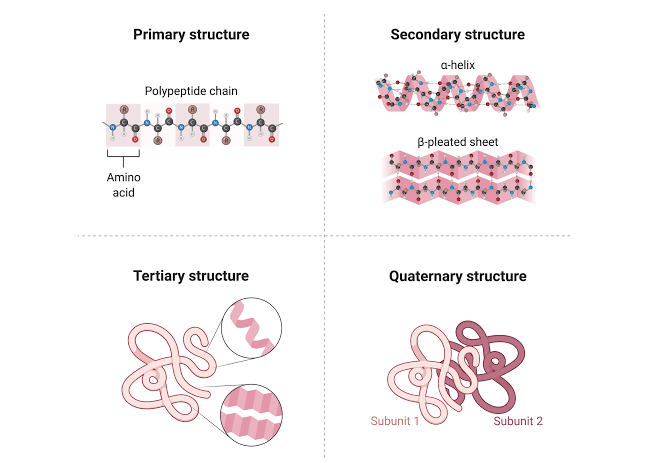
Proteins are organized into four distinct structural levels: primary, secondary, tertiary, and quaternary, each defined by specific types of chemical bonds and interactions.
1. Primary Structure: The Amino Acid Sequence
The primary structure of a protein is the most fundamental level, defined as the linear sequence of amino acid residues linked together by covalent peptide bonds. Each protein possesses a unique and precisely ordered sequence of the 20 common amino acids, akin to a specific string of letters forming a word.
Biochemical Features:
- Covalent Peptide Bonds: Amino acids are joined by amide linkages (peptide bonds) formed through a dehydration reaction between the carboxyl group of one amino acid and the amino group of another. These bonds are highly stable and define the polypeptide backbone.
- Genetic Determinant: The primary sequence is directly encoded by the genetic information in DNA via messenger RNA (mRNA) in a process known as translation. This direct link between the gene and the protein’s sequence highlights its critical role as the blueprint for all higher-order structures.
- Uniqueness and Specificity: Every protein has a characteristic primary sequence that determines its identity and, consequently, its ultimate three-dimensional shape and function. Even a single amino acid change in this sequence (a point mutation) can profoundly alter the protein’s structure and activity, as exemplified by sickle cell anemia, where a glutamic acid is replaced by a valine in hemoglobin.
- Foundation for Higher Structures: The primary sequence dictates how the polypeptide chain will fold into its complex native structure. The specific arrangement of amino acid side chains (R-groups) along the backbone determines the types of interactions possible, ultimately guiding the formation of secondary, tertiary, and, if applicable, quaternary structures.
- Evolutionary Insights: Conserved primary sequences across different species often indicate critical functional regions, while variations can provide insights into evolutionary relationships and adaptation.
2. Secondary Structure: Local Folding Patterns
Secondary structure refers to localized, recurring spatial arrangements of the polypeptide backbone, stabilized primarily by hydrogen bonds between atoms within the backbone itself, rather than between side chains. These structures are typically formed by segments of the polypeptide chain.
Biochemical Features:
- Hydrogen Bonding within the Backbone: The defining feature of secondary structures is the formation of hydrogen bonds between the carbonyl oxygen (C=O) of one peptide bond and the amide hydrogen (N-H) of another peptide bond within the same or adjacent polypeptide segments. These regular, repeating interactions provide stability to these localized folds.
- Common Motifs:
- Alpha-Helix (α-helix): A tightly coiled, right-handed helical structure where the polypeptide backbone forms a spiral. Hydrogen bonds occur between the C=O of residue n and the N-H of residue (n+4). The amino acid side chains project outwards from the helix, minimizing steric hindrance. Alpha-helices are remarkably stable and commonly found in globular proteins (e.g., myoglobin) and transmembrane proteins, where their amphipathic nature can be exploited. Certain amino acids (e.g., alanine, leucine) are strong helix formers, while others (e.g., proline, glycine) are helix breakers.
- Beta-Sheet (β-sheet): Formed by two or more polypeptide strands (β-strands) lying side-by-side, connected by hydrogen bonds between the backbone atoms of adjacent strands. These can be antiparallel (strands run in opposite N-to-C directions), which are more stable due to optimally aligned hydrogen bonds, or parallel (strands run in the same N-to-C direction). Beta-sheets provide rigid, extended structures and often form the core of many globular proteins (e.g., fatty acid binding proteins).
- Beta-Turns (β-turns) / Loops: Short, often four-residue segments that abruptly reverse the direction of the polypeptide chain, allowing for compact globular structures. They are typically found on the protein surface and are crucial for connecting elements of secondary structure, such as two antiparallel β-strands. Glycine and proline are frequently found in β-turns due to their conformational flexibility and rigidity, respectively.
- Building Blocks for Tertiary Structure: Secondary structural elements are the fundamental building blocks that assemble and pack together to form the more complex tertiary structure.
- Early Folding Events: The rapid formation of secondary structures is often one of the initial events in the protein folding process, guiding the subsequent collapse into the full 3D shape.
3. Tertiary Structure: The Overall 3D Conformation
Tertiary structure describes the complete, three-dimensional arrangement of all atoms in a single polypeptide chain, including the positions of amino acid side chains. It represents the full folding of the polypeptide into its functional, native conformation.
Biochemical Features:
- Interactions Between Side Chains (R-groups): Tertiary structure is stabilized by various non-covalent interactions and, occasionally, covalent bonds, primarily between the side chains of amino acids that may be distant in the primary sequence but brought into proximity by folding.
- Hydrophobic Interactions: The primary driving force for protein folding. Nonpolar amino acid side chains tend to cluster together in the interior of the protein, away from the aqueous environment, minimizing their contact with water. This hydrophobic core is critical for protein stability.
- Ionic Bonds (Salt Bridges): Electrostatic interactions between oppositely charged side chains (e.g., between a basic amino acid like lysine and an acidic amino acid like aspartate). These are strong interactions, but their strength is dependent on the local dielectric environment.
- Hydrogen Bonds: Formed between polar side chains (e.g., between hydroxyl groups of serine/threonine, amide groups of asparagine/glutamine, or carboxylic acid groups of aspartate/glutamate).
- Disulfide Bonds (Covalent): Strong covalent bonds formed by the oxidation of two cysteine sulfhydryl (-SH) groups to form a disulfide (-S-S-) bridge. These bonds are particularly important for stabilizing the structures of extracellular proteins, which encounter an oxidizing environment.
- Van der Waals Forces: Weak, transient attractive forces between all atoms that are close together, contributing to the overall stability of the tightly packed protein interior.
- Functional Significance: The unique tertiary structure creates specific binding sites (e.g., active sites of enzymes, ligand-binding sites of receptors, antigen-binding sites of antibodies), which are absolutely essential for the protein’s biological function.
- Protein Folding Process: A complex and often spontaneous process driven by thermodynamic principles, where the polypeptide chain transitions from a disordered state to a highly ordered native state. Molecular chaperones often assist in this process, preventing misfolding and aggregation. Misfolding can lead to many debilitating diseases (e.g., Alzheimer’s, Parkinson’s, prion diseases).
- Structural Domains: Many large proteins contain multiple, independently folding structural units called domains. Each domain often has a specific function (e.g., a DNA-binding domain, a catalytic domain).
- Environmental Sensitivity: Tertiary structure is highly sensitive to environmental factors such as temperature, pH, ionic strength, and the presence of denaturing agents. Extreme changes can disrupt these delicate non-covalent interactions, leading to denaturation (loss of native structure and function).
4. Quaternary Structure: Multi-Subunit Assemblies
Quaternary structure refers to the arrangement of multiple polypeptide chains (subunits or protomers) to form a functional protein complex. Not all proteins possess a quaternary structure; single-chain proteins (monomers) function effectively at the tertiary level.
Biochemical Features:
- Subunit Interactions: Subunits are held together by the same types of non-covalent interactions that stabilize tertiary structure (hydrophobic interactions, ionic bonds, hydrogen bonds) and, in some cases, inter-chain disulfide bonds. The interfaces between subunits are often complementary, maximizing these interactions.
- Oligomerization: The process of forming a multi-subunit complex. Proteins with quaternary structure are called oligomers. If the subunits are identical, it’s a homooligomer (e.g., many enzymes); if they are different, it’s a heterooligomer (e.g., hemoglobin, which has two alpha and two beta subunits).
- Increased Stability: Assembling multiple subunits can increase the overall stability of the protein complex, making it more resistant to denaturation or degradation.
- Enhanced Functionality and Complexity: Quaternary structure allows for the creation of more elaborate and sophisticated functional sites. For instance, the active site of some enzymes is formed by residues from multiple subunits.
- Allosteric Regulation: A major biochemical advantage of quaternary structure. The binding of a ligand to one subunit can induce conformational changes that affect the binding affinity or catalytic activity of other subunits within the complex. This allows for highly regulated and responsive control of protein function. Hemoglobin’s cooperative oxygen binding is a classic example: binding of oxygen to one subunit increases the affinity of other subunits for oxygen.
- Cooperativity: A specific type of allosteric regulation where binding of a ligand to one site enhances the binding of successive ligands to other sites.
- Assembly of Multi-enzyme Complexes: Many metabolic pathways involve multi-enzyme complexes where different enzymes are brought together to facilitate sequential reactions, increasing efficiency by channeling substrates directly from one enzyme to the next.
- Signal Transduction: Many receptors and signaling proteins form multi-subunit complexes, crucial for transmitting signals across cell membranes and within the cell.
- Disease Implications: Defects in subunit assembly or interactions can lead to various diseases, including some types of cancer and autoimmune disorders.
The Overarching Importance of Protein Structure
The exquisite detail in protein structure at each hierarchical level is not merely an academic curiosity; it is the fundamental determinant of protein function. Any disruption to this native three-dimensional architecture, from a single amino acid substitution (primary) to the complete unfolding of a domain (tertiary) or the dissociation of subunits (quaternary), can lead to a loss of function, known as denaturation or misfolding. This profound link underpins:
- Biological Function: Enzymes catalyze reactions, antibodies recognize antigens, channels transport ions, and structural proteins provide support—all due to their precise 3D shapes.
- Disease Mechanisms: Misfolding and aggregation of proteins are central to many neurodegenerative diseases like Alzheimer’s, Parkinson’s, and Huntington’s, as well as prion diseases.
- Drug Discovery and Design: Understanding protein structures, especially active sites and binding pockets, is crucial for rational drug design, allowing scientists to develop molecules that specifically interact with and modulate protein function.
- Biotechnology and Engineering: The ability to manipulate protein structure is key to engineering novel proteins with desired functions or enhancing the properties of existing ones, with applications in medicine, industry, and environmental remediation.
In conclusion, the structural levels of proteins—primary, secondary, tertiary, and quaternary—represent a marvel of molecular engineering. Each level builds upon the previous, with specific chemical bonds and interactions contributing to the overall stability and functional specificity. From the linear sequence of amino acids encoded by DNA to the intricate dance of multiple polypeptide chains, the precise architecture of a protein is the ultimate determinant of its role in the intricate machinery of life.
References:
- Nelson, D. L., & Cox, M. M. (2017). Lehninger Principles of Biochemistry (7th ed.). W. H. Freeman.
- Berg, J. M., Tymoczko, J. L., Gatto Jr., G. J., & Stryer, L. (2015). Stryer’s Biochemistry (8th ed.). W. H. Freeman.
- Voet, D., Voet, J. G., & Pratt, C. W. (2016). Fundamentals of Biochemistry: Life at the Molecular Level (5th ed.). Wiley.
- Creighton, T. E. (1993). Proteins: Structure and Molecular Properties (2nd ed.). W. H. Freeman.
- Fersht, A. (1999). Structure and Mechanism in Protein Science: A Guide to Enzyme Catalysis and Protein Folding. W. H. Freeman.