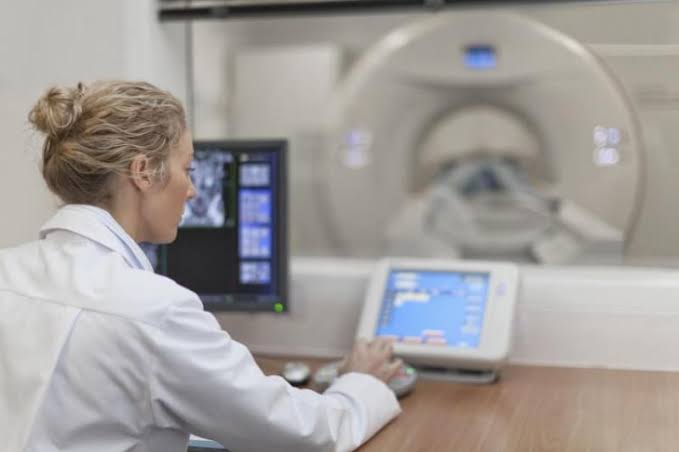
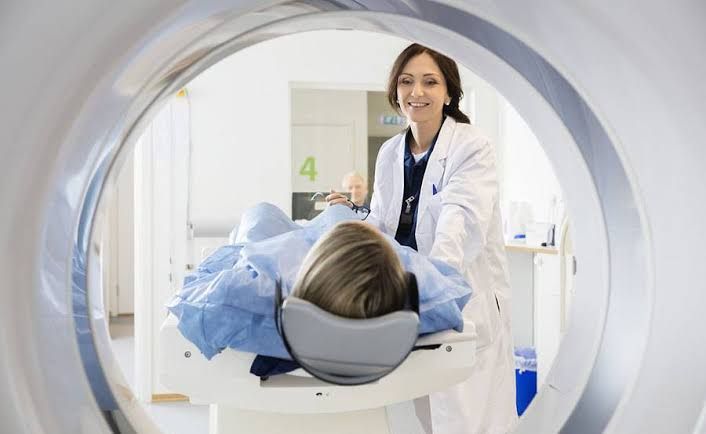
Tomography is a foundational imaging technique central to various scientific and medical disciplines, enabling the visualization of internal structures by producing cross-sectional images.
Definition of Tomography
The term “tomography” originates from the Greek words “tomos” (meaning slice or section) and “graphein” (meaning to write). In essence, tomography refers to any method of imaging a single plane or “slice” of a three-dimensional object while intentionally blurring or obscuring structures located outside that specific plane. This selective visualization allows for a clear and detailed examination of the chosen cross-section, free from the superimposition of overlying and underlying anatomy that can often obscure details in conventional two-dimensional projection radiography.
Initially developed in the mid-20th century primarily for medical X-ray imaging, the concept of tomography has since expanded significantly. It now encompasses a wide array of advanced imaging modalities, including Computed Tomography (CT), Magnetic Resonance Imaging (MRI), Positron Emission Tomography (PET), and Ultrasound Tomography, among others. While the underlying physical principles vary across these modalities, the core objective remains consistent: to reconstruct a detailed image of a specific section of an object, providing invaluable diagnostic and research insights that are unattainable through conventional projection imaging alone.
Basic Principle of Tomography
The fundamental principle behind conventional film-based tomography (also known as conventional tomography or plain film tomography) relies on the synchronized movement of an X-ray source and an image receptor (such as a film cassette or digital detector) in opposite directions around a fixed central point. This central point is known as the “fulcrum” or “pivot point,” and it defines the “focal plane” or “slice” where the image will appear sharp and in focus.
Here’s a breakdown of the basic principle:
- Synchronized Movement: The X-ray tube and the image receptor are rigidly connected and move simultaneously during the exposure. As the tube moves in one direction, the receptor moves in the opposite direction.
- The Fulcrum/Focal Plane: The patient or object being imaged is positioned so that the anatomical plane of interest lies precisely at the level of the fulcrum. Because everything in this focal plane remains stationary relative to the synchronized movement of the tube and receptor, its projection on the detector remains constant. Consequently, the structures within this plane are sharply recorded.
- Blurring of Out-of-Plane Structures: Structures located above or below the focal plane are outside the fulcrum. As the X-ray tube and receptor move, the projections of these out-of-plane structures shift across the image receptor. This continuous shifting or “smearing” of their shadows during the exposure results in their blurring or obfuscation on the final image. The farther a structure is from the focal plane, the greater its displacement and, thus, the greater the degree of blurring.
- Slice Thickness Control: The thickness of the tomographic slice (the depth of the in-focus plane) is inversely related to the “tomographic angle” or “arc of swing” of the X-ray tube and receptor. A larger tomographic angle (greater movement) results in more effective blurring of out-of-plane structures and, consequently, a thinner, more sharply defined slice. Conversely, a smaller tomographic angle results in less blurring and a thicker slice (as seen in zonography).
- Image Formation: The final tomographic image is a composite. It sharply depicts the structures within the defined focal plane while selectively blurring away the superimposing information from structures outside this plane, providing a clear cross-sectional view.
This ingenious method allows radiologists and clinicians to isolate and examine specific anatomical planes, making it invaluable for diagnosing conditions that might otherwise be obscured in conventional radiographs.
Different Moments and Planes of Tomography
The “moment” or “plane” in tomography refers to the specific path or trajectory that the X-ray tube and the image receptor follow during the exposure. Different movements are designed to achieve varying degrees and patterns of blurring, optimizing the visualization of specific anatomical structures or pathological conditions. Each movement has distinct characteristics, advantages, and limitations.
a. Linear Tomography
- Description: This is the simplest and earliest form of tomographic movement. The X-ray tube and the image receptor move in a straight line in opposite directions during the exposure. The fulcrum remains fixed, defining the sharp focal plane.
- Characteristics:
- Blurring Pattern: Blurring primarily occurs in one dimension, parallel to the direction of motion. Structures lying perpendicular to the movement path are blurred efficiently.
- Artifacts: A significant limitation is the presence of “linear streaks” or “ghost images” from structures that are parallel to the tube’s movement, as these are not effectively blurred.
- Slice Thickness: Generally produces relatively thick slices compared to more complex motions.
- Applications: While largely superseded by more advanced techniques, linear tomography was historically used for visualizing long bones, the spine, and certain skull structures. Its simplicity made it a good starting point for tomographic development.
b. Circular Tomography
- Description: In this movement, the X-ray tube and the image receptor move in synchronized circular paths around a fixed fulcrum.
- Characteristics:
- Blurring Pattern: Offers improved blurring efficiency compared to linear tomography because the motion occurs in multiple directions, reducing streaking artifacts. Structures are blurred more uniformly.
- Artifacts: Reduces, but does not entirely eliminate, blurring artifacts, as some complex structures might still align imperfectly with the circular motion.
- Slice Thickness: Produces thinner slices than linear tomography due to the multi-directional blurring.
- Applications: Widely used for complex anatomical regions where more uniform blurring was desired, such as the skull base, inner ear, and joints.
c. Elliptical Tomography
- Description: The tube and receptor follow an elliptical path during the exposure, again synchronized around a central fulcrum.
- Characteristics:
- Blurring Pattern: Provides a variation on circular blurring. The eccentricity of the ellipse can be adjusted, offering anisotropic blurring (i.e., varying degrees of blurring in different directions). This can be advantageous for specific anatomical shapes or orientations.
- Slice Thickness: Can produce thin to moderately thick slices depending on the specific elliptical parameters.
- Applications: Less common than circular or hypocycloidal but used in specialized instances where the specific blurring characteristics of an elliptical path were deemed beneficial for a particular anatomy or pathology.
d. Hypocycloidal Tomography
- Description: Considered one of the most effective and complex conventional tomographic movements, the X-ray tube and receptor trace a three-dimensional, cloverleaf-like or propeller-like path.
- Characteristics:
- Blurring Pattern: Provides highly efficient and uniform blurring in almost all directions. This complex motion significantly reduces streaking artifacts and superimposition from out-of-plane structures.
- Slice Thickness: Produces the thinnest possible slices achievable with conventional film-based tomography, often in the range of 1-3 mm.
- Image Quality: Known for superior image quality due to comprehensive blurring.
- Applications: Regarded as the “gold standard” for conventional tomography, particularly for high-resolution imaging of small, complex anatomical areas such as the internal auditory canals, sella turcica, temporomandibular joints (TMJs), and inner ear structures, where fine detail is critical.
e. Spiral Tomography (Helical Tomography)
- Description: This term is predominantly associated with Computed Tomography (CT) rather than conventional film tomography. In spiral CT, the X-ray tube and detector array continuously rotate around the patient while the patient table simultaneously moves linearly through the gantry. This combined motion results in a helical (spiral) data acquisition path.
- Characteristics:
- Data Acquisition: Acquires a volumetric dataset, meaning data from an entire volume of tissue is collected, not just individual slices.
- Image Reconstruction: Allows for the retrospective reconstruction of overlapping or non-overlapping slices in any desired plane (axial, coronal, sagittal, and oblique views) from the acquired volume data.
- Speed & Artifacts: Significantly faster than conventional sequential CT scanning, leading to reduced motion artifacts and greater patient comfort.
- Slice Thickness: Electronically determined during post-processing; virtual slices can be thin or thick depending on the reconstruction parameters.
- Applications: The cornerstone of modern medical imaging, spiral CT is indispensable for a vast range of diagnostic purposes, including trauma assessment, cancer staging, cerebrovascular imaging, pulmonary embolism detection, and many more, due to its speed, volumetric data acquisition, and multiplanar reformatting capabilities. While the principle of acquiring “slices” is shared with conventional tomography, the mechanism and capabilities are vastly different due to digital data acquisition and computational reconstruction.
f. Figure of 8 Tomography
- Description: The X-ray tube and image receptor move in a path resembling a figure ‘8’ (infinity symbol) during the exposure.
- Characteristics:
- Blurring Pattern: Offers good multi-directional blurring, providing an improvement over linear motion and often comparable to circular motion in terms of blurring efficiency.
- Slice Thickness: Produces relatively thin slices, generally thinner than linear but comparable to or slightly thicker than hypocycloidal, depending on the specifics of the movement.
- Applications: Used in various anatomical regions where its specific blurring profile was advantageous, providing a good balance between simplicity and blurring effectiveness. Similar to circular, it was employed for general anatomical investigations.
Zonography
Zonography is a specialized technique within conventional tomography that utilizes a very small tomographic angle or arc of swing, typically ranging from 5 to 10 degrees. This limited motion distinguishes it from standard thin-slice tomography, which employs much larger angles (e.g., 30-60 degrees for circular, 40-70 degrees for hypocycloidal).
Principle:
The key principle of zonography is that a small tomographic angle results in less blurring of structures outside the focal plane. While standard tomography aims for maximum blurring of out-of-plane structures to define a very thin slice, zonography intentionally produces a thicker slice or “zone” of interest. This “zone” is still clearer than a conventional radiograph (where all structures are superimposed) but less detailed than a true thin tomographic slice.
Purpose and Applications:
- Gross Pathology Visualization: Zonography is not intended for visualizing fine anatomical details but rather for obtaining a general overview of a larger anatomical region while still eliminating significant superimposition. It is particularly useful for identifying gross pathology, large lesions, or outlining the general shape and extent of organs.
- Screening and Initial Assessment: It can serve as an effective screening tool or initial assessment method when a precise, thin slice is not immediately necessary. For instance, in lung imaging, a zonogram might be performed to confirm the presence and approximate location of a lesion before proceeding to more detailed, thin-slice tomograms or CT scans.
- Reduced Radiation Dose: Because only a single, relatively quick exposure is often needed for a zonogram (compared to multiple thin slices to cover the same volume), it can result in a lower radiation dose to the patient.
- Common Applications:
- Chest Imaging: To visualize lung fields and detect large infiltrates or masses.
- Kidney Imaging (Urography): To evaluate the kidneys and surrounding structures for stones or other abnormalities.
- Abdominal Imaging: For assessing large masses or organ outlines.
- Joints: For a broader view of large joints.
Advantages:
- Wider Zone of Interest: Provides a broader view of the anatomy.
- Less Radiation: Often requires fewer exposures than multiple thin tomographic slices.
- Faster Acquisition: Generally quicker to perform.
- Reduced Patient Motion Artifacts: Due to shorter exposure times.
Disadvantages:
- Less Detail: Not suitable for resolving fine anatomical details or small lesions.
- Incomplete Blurring: Out-of-plane structures are blurred, but not completely eliminated, meaning some residual ghosting may be present, which can be confusing.
- Limited Diagnostic Specificity: Provides less specific diagnostic information compared to thin-slice tomography or modern CT.
In essence, zonography fills a niche between conventional radiography and detailed thin-slice tomography, offering a valuable intermediate level of imaging for specific clinical situations where a broad, yet de-superimposed, view is required.