The spleen, a vital lymphoid organ, plays a crucial role in the human immune system and blood filtration. Understanding its anatomical position, intricate relations with surrounding structures, and its vascular and neural supply is fundamental for medical professionals and students of anatomy.
1. Location, Surfaces, and Borders of the Spleen
The spleen is the largest lymphoid organ in the human body, characterized by its unique position and complex morphology.
1.1. Location: The spleen is situated predominantly in the left hypochondrium (upper left quadrant) of the abdomen, specifically within the supracolic compartment. It lies obliquely, with its long axis following the course of the 10th rib. Its position is deep to the 9th, 10th, and 11th ribs, and it is largely protected by the lower thoracic cage. The spleen is an intraperitoneal organ, meaning it is almost entirely enveloped by peritoneum, except at its hilum where vessels and nerves enter and exit.
- Clinical Relevance: The protection offered by the ribs makes the spleen less susceptible to minor superficial trauma. However, significant blunt trauma to the left upper abdomen or lower left chest can lead to splenic rupture, a life-threatening condition due to its rich blood supply. The spleen’s location also makes it susceptible to enlargement (splenomegaly) in various pathological conditions, where it extends inferiorly and anteriorly, often palpable below the left costal margin.
1.2. Size and Shape: Typically, the spleen is an ovoid, somewhat flattened organ, resembling a large coffee bean.
- Dimensions: Approximately 12-15 cm long, 7-8 cm wide, and 3-4 cm thick.
- Weight: Around 150-200 grams in adults, though this can vary significantly.
1.3. Surfaces: The spleen possesses two distinct surfaces:
- Diaphragmatic (Parietal) Surface:
- This surface is smooth, convex, and directed posterolaterally.
- It is related to the underside of the diaphragm, which separates the spleen from the pleura (specifically, the costodiaphragmatic recess), the base of the left lung, and the 9th, 10th, and 11th ribs.
- The diaphragm’s muscular fibers reflect the contours of these underlying structures.
- Visceral (Visceral) Surface:
- This surface is concave and irregular, facing anteromedially towards the abdominal viscera.
- It presents several impressions corresponding to the organs with which it is in direct contact. The hilum of the spleen, a fissure through which the splenic vessels and nerves enter and exit, is located on this surface, usually near its medial aspect.
- The impressions on the visceral surface are crucial for understanding the spleen’s intimate anatomical relations:
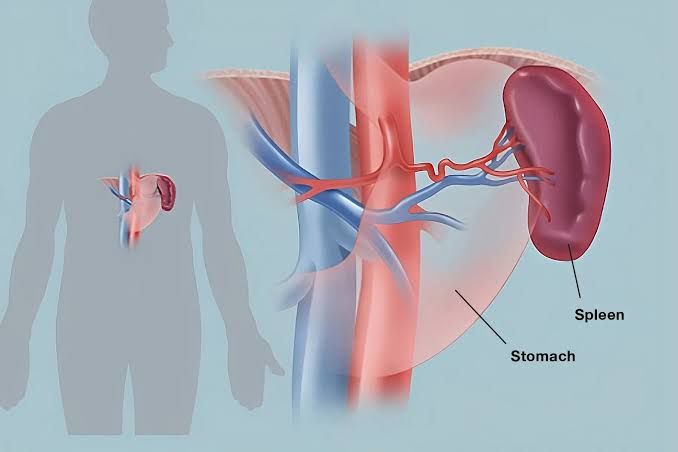
- Gastric Impression: The largest and most superior impression, concave and related to the fundus and greater curvature of the stomach.
- Renal Impression: Located inferior and medial to the gastric impression, concave and related to the anterior surface of the upper part of the left kidney.
- Colic Impression: A flattened impression located inferior to the hilum, related to the left colic (splenic) flexure of the large intestine.
- Pancreatic Impression: A small, triangular area, generally found between the hilum and the renal impression, related to the tail of the pancreas. This impression is not always distinctly visible but signifies a critical anatomical relationship.
1.4. Borders: The spleen has two primary borders and two poles:
- Superior Border: This border is sharp and typically marked by one or more notches, particularly near its anterior end. These notches are embryological remnants and serve as a useful diagnostic feature to distinguish the spleen from other masses during palpation.
- Inferior Border: This border is more rounded and blunt compared to the superior border.
- Anterior Pole (Anterior Extremity): Directed anteriorly and inferiorly, pointing towards the midaxillary line.
- Posterior Pole (Posterior Extremity): Directed posteriorly and superiorly, resting against the left crus of the diaphragm and the 10th and 11th ribs.
2. Important Relations with Surrounding Organs
The spleen’s location dictates its close anatomical relationships with several vital organs in the upper abdomen. These relations are critical for understanding the spread of disease, surgical approaches, and the interpretation of medical imaging.
- Superiorly and Posterolaterally:
- Diaphragm: The entire diaphragmatic surface of the spleen lies against the diaphragm.
- Left Pleura and Lung: Through the diaphragm, the spleen is indirectly related to the costodiaphragmatic recess of the left pleura and the base of the left lung.
- Ribs: The 9th, 10th, and 11th ribs provide bony protection to the spleen.
- Anteromedially and Superiorly (Visceral Surface):
- Stomach: The fundus and greater curvature of the stomach are intimately related to the superior and anterior parts of the spleen’s visceral surface, forming the prominent gastric impression. This close relationship is facilitated by the gastrosplenic ligament.
- Inferiorly and Medially (Visceral Surface):
- Left Kidney: The upper anterior surface of the left kidney lies posterior and medial to the spleen, corresponding to the renal impression. This proximity explains why renal pathology can sometimes affect the spleen or vice-versa.
- Inferiorly and Anteriorly (Visceral Surface):
- Left Colic (Splenic) Flexure: The spleen rests upon the left colic flexure of the colon, resulting in the colic impression on its inferior aspect. This relationship is maintained by the phrenicocolic ligament, which supports the spleen.
- Medially and Posteriorly (Hilum Region):
- Tail of Pancreas: The tail of the pancreas extends laterally from the body of the pancreas, often reaching, or lying in close proximity to, the hilum of the spleen, sometimes even entering the splenic hilum, lying within the lienorenal ligament. This intimate relation is significant; pancreatic diseases (e.g., pancreatitis, carcinoma) can directly affect the spleen or its vessels.
- Posteriorly:
- The posterior pole and some part of the visceral surface are related to the diaphragm, left crus of the diaphragm, and the left kidney.
3. Peritoneal Folds Connecting Spleen with Other Organs
The spleen is an intraperitoneal organ, almost entirely covered by peritoneum. This peritoneal covering reflects off its surface to form ligaments (or folds) that connect it to other viscera and the abdominal wall. These ligaments are remnants of the embryonic dorsal mesogastrium and play a crucial role in anchoring the spleen and providing pathways for its neurovasculature.
3.1. Gastrosplenic Ligament (Gastro-splenic Omentum):
- Attachments: This peritoneal fold extends from the greater curvature of the stomach (specifically, its fundus and upper part of the body) to the hilum of the spleen.
- Contents: It contains important neurovascular structures:
- Short Gastric Arteries and Veins: Supplying the fundus and upper part of the greater curvature of the stomach.
- Left Gastro-omental (Gastroepiploic) Artery and Vein: Vessels that run along the greater curvature of the stomach.
- Significance: This ligament is part of the greater omentum and represents a critical connection, allowing for the vascular supply to the stomach to pass through. Surgical procedures involving the spleen or stomach often require careful attention to this ligament.
3.2. Lienorenal Ligament (Splenorenal Ligament):
- Attachments: This peritoneal fold extends from the hilum of the spleen to the anterior surface of the left kidney.
- Contents: It contains the main neurovascular supply to and from the spleen:
- Splenic Artery: The main arterial supply to the spleen, usually tortuous.
- Splenic Vein: The main venous drainage from the spleen.
- Tail of Pancreas: Crucially, the tail of the pancreas extends laterally and often lies within the two layers of the lienorenal ligament, reaching or touching the splenic hilum.
- Lymphatic Vessels and Nerves: Associated with the splenic vessels.
- Significance: This ligament forms the posterior boundary of the lesser sac (omental bursa) and is vital for understanding the relationships between the spleen, pancreas, and left kidney. Damage to this ligament, particularly during splenectomy, can lead to pancreatic injury.
3.3. Phrenicocolic Ligament (Sustentaculum Lienis – “Support of the Spleen”):
- Attachments: This is a horizontal fold of peritoneum that extends from the diaphragm (specifically, the left hemidiaphragm) to the left colic flexure (splenic flexure) of the colon.
- Relation to Spleen: While not directly attached to the spleen, it forms a shelf or “support” beneath the inferior pole of the spleen. The spleen rests upon this ligament.
- Significance: It indirectly supports the spleen, preventing it from descending lower in the abdomen. Its presence is important in understanding the limits of splenic mobility and its fixed position relative to the left colic flexure.
4. Vessels and Nerves Supplying the Spleen
The spleen is a highly vascular organ, reflecting its functions in blood filtration and storage. Its rich blood supply and drainage are crucial for its physiological roles.
4.1. Arterial Supply:
- Splenic Artery: The sole arterial supply to the spleen.
- Origin: It is the largest and most tortuous branch of the celiac trunk, which arises from the abdominal aorta.
- Course: The splenic artery runs horizontally to the left, superior to the body and tail of the pancreas, often within the superior border of the pancreas or within the lienorenal ligament. It gives off numerous small branches to the pancreas (pancreatic branches).
- Terminal Branches: As it approaches the splenic hilum, the splenic artery typically divides into 5-6 (or more) segmental or terminal branches that enter the spleen independently. These branches are generally considered end-arteries, meaning there is little to no anastomosis between them within the spleen, making the spleen susceptible to infarction if one of these branches is occluded.
- Other Branches (before entering hilum):
- Pancreatic branches: Supply the neck, body, and tail of the pancreas.
- Short Gastric Arteries (5-7): Ascend through the gastrosplenic ligament to supply the fundus and upper part of the greater curvature of the stomach.
- Left Gastro-omental (Gastroepiploic) Artery: Runs along the greater curvature of the stomach within the gastrosplenic ligament, anastomosing with the right gastro-omental artery.
4.2. Venous Drainage:
- Splenic Vein: The main vein draining the spleen.
- Formation: Formed by several veins emerging from the splenic hilum.
- Course: Runs horizontally to the right, inferior to the splenic artery and posterior to the tail and body of the pancreas.
- Tributaries: Receives tributaries corresponding to the splenic artery’s branches:
- Short gastric veins
- Left gastro-omental vein
- Pancreatic veins
- Crucially, the Inferior Mesenteric Vein (IMV) typically drains into the splenic vein (or sometimes into the angle where the splenic and superior mesenteric veins meet).
- Termination: At the neck of the pancreas, the splenic vein joins the Superior Mesenteric Vein (SMV) to form the Hepatic Portal Vein, which then carries nutrient-rich, deoxygenated blood to the liver.
4.3. Lymphatic Drainage:
- Lymphatic vessels of the spleen generally originate from the splenic capsule and trabeculae.
- They traverse along the splenic vessels and drain into a few pancreaticosplenic lymph nodes located at the hilum of the spleen and along the superior border of the pancreas.
- From these nodes, the lymph ultimately drains into the celiac lymph nodes, which are part of the pre-aortic lymph node group.
4.4. Nerve Supply:
- The spleen receives its nerve supply from the celiac plexus, which is an autonomic (sympathetic and parasympathetic) nerve plexus located at the origin of the celiac artery.
- Sympathetic Innervation:
- Fibers primarily originate from the thoracic spinal cord segments T6-T8 (or T5-T9).
- They travel via the greater splanchnic nerve to the celiac ganglion, from where postganglionic fibers follow the splenic artery to the spleen.
- These sympathetic fibers are predominantly vasomotor, controlling the diameter of the splenic blood vessels and regulating blood flow. They also innervate the smooth muscle within the splenic capsule and trabeculae, causing contraction and expelling blood into the circulation in response to stress (though this is more pronounced in some animals than in humans). They also carry visceral afferent (pain) fibers.
- Parasympathetic Innervation:
- Fibers are derived from the vagus nerve (CN X), which also contributes to the celiac plexus.
- The precise role of parasympathetic innervation to the spleen in humans is not fully understood but is thought to be minor, perhaps influencing immune function or finely modulating blood flow.
Conclusion
The spleen, despite its often-overlooked status, is a critical organ with complex anatomical relationships and a robust vascular and neural supply. Its precise location, the distinct characteristics of its surfaces and borders, and its intimate connections via peritoneal folds underscore its vulnerability in trauma and its involvement in various systemic diseases. A comprehensive understanding of its anatomical framework is indispensable for clinicians, enabling accurate diagnosis, precise surgical intervention, and a deeper appreciation of its physiological significance within the human body.