1. Oral Cholecystography (OCG)
1.1 Definition
Oral Cholecystography (OCG) is a diagnostic radiological procedure designed to visualize the gallbladder. It involves the ingestion of a contrast medium that is selectively absorbed from the gastrointestinal tract, concentrated by the liver, excreted into the bile, and subsequently stored and concentrated within the gallbladder. This concentration of the radiopaque contrast agent allows the gallbladder to become visible on conventional X-ray images, enabling the detection of gallstones (cholelithiasis), inflammatory conditions (cholecystitis), or functional abnormalities. OCG historically served as the primary method for diagnosing gallbladder disease, particularly gallstones, before the widespread adoption of ultrasonography.
1.2 Contrast Media Used in Oral Cholecystography
The efficacy of OCG relies entirely on the proper absorption, hepatic excretion, and gallbladder concentration of specific iodine-containing contrast agents. These agents are derivatives of tri-iodinated benzoic acid.
- Iopanoic Acid (Telepaque®): Historically the most commonly used agent. It is a tri-iodinated derivative that is well absorbed orally. Its absorption rate can vary significantly among individuals.
- Tyropanoate Sodium (Bilopaque®): Another effective oral cholecystographic agent, structurally similar to iopanoic acid, offering comparable diagnostic quality.
- Ipodate Calcium (Oragrafin Calcium®) and Ipodate Sodium (Oragrafin Sodium®): These agents tend to be absorbed more rapidly than iopanoic acid, potentially leading to faster opacification of the gallbladder. They are often preferred for rapid studies or when a patient has difficulty absorbing other agents.
Mechanism of Action: Upon oral ingestion, these contrast agents are absorbed from the small intestine into the bloodstream. They are then transported to the liver, where they are conjugated with glucuronic acid. The conjugated contrast medium is then actively secreted by hepatocytes into the bile canaliculi and subsequently enters the bile ducts, ultimately reaching the gallbladder. Within the gallbladder, water and electrolytes are reabsorbed from the bile, leading to a significant concentration of the contrast medium, making the gallbladder radiopaque. The degree of opacification depends on adequate absorption, normal liver function, and a patent cystic duct.
1.3 Procedure/Technique for Oral Cholecystography
The OCG procedure requires meticulous patient preparation and precise timing for optimal diagnostic results.
Patient Preparation:
- Dietary Restriction (24-48 hours prior): Patients are advised to consume a low-fat diet for 24 to 48 hours leading up to the examination. This helps to minimize gallbladder contraction and ensure maximal filling with bile and subsequently, the contrast media.
- Bowel Preparation (Optional but Recommended): A mild laxative may be prescribed the evening before the study to ensure a clear colon, which minimizes overlying bowel gas and fecal material that can obscure the gallbladder.
- Contrast Medium Administration:
- Typically, 6 tablets (0.5g each, totaling 3g) of the chosen contrast agent (e.g., Iopanoic acid) are ingested with water, one tablet every 5-10 minutes, beginning 12-14 hours prior to the scheduled examination (usually the evening before).
- For agents like ipodate, a different dosage or timing might be prescribed, sometimes allowing for imaging as early as 4-6 hours post-ingestion.
- The patient is instructed to fast after taking the tablets, allowing only sips of water. Food intake can stimulate gallbladder contraction, emptying the contrast before imaging.
Radiographic Technique:
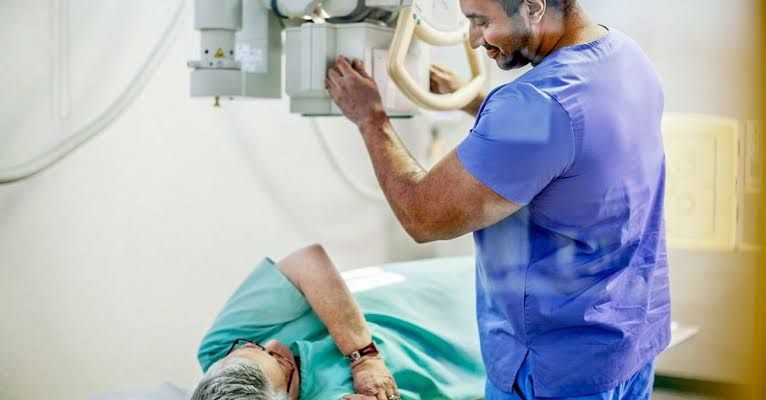
- Initial Scout Film: Upon arrival at the radiology department, a preliminary plain abdominal X-ray (scout film) is taken to check for proper patient positioning, assess for any calcifications (e.g., calcified gallstones or porcelain gallbladder), and ensure bowel cleanliness.
- Initial Radiographs (12-16 hours post-ingestion):
- Multiple projections are obtained to visualize the opacified gallbladder fully. Common views include:
- PA (Posteroanterior) or AP (Anteroposterior) supine: Standard view.
- Right Lateral Decubitus: Useful for demonstrating layering of stones or sludge.
- Right Posterior Oblique (RPO) or Left Posterior Oblique (LPO): To project the gallbladder away from the spine or other overlying structures.
- Upright/Erect: To demonstrate the layering of gallstones or air-fluid levels.
- Spot compression or angled projections may be utilized to better delineate the gallbladder and any filling defects.
- Multiple projections are obtained to visualize the opacified gallbladder fully. Common views include:
- Fatty Meal Challenge (Optional but Important for Functional Assessment):
- If the initial images show good gallbladder opacification, a fatty meal (e.g., a high-fat liquid, chocolate bar, or a commercial cholecystokinetic agent) is administered.
- After 30-60 minutes, repeat radiographs are taken to assess gallbladder contraction and emptying. This helps evaluate gallbladder function and cystic duct patency, and can reveal small stones that move after contraction.
- Delayed Views (if necessary): If the gallbladder does not opacify on the initial study, a “double-dose” study might be performed on a subsequent day, or delayed films might be taken up to 24 hours after contrast ingestion, especially if there’s a concern for partial obstruction.
1.4 Limitations of Oral Cholecystography
Despite its historical significance, OCG has several limitations that have contributed to its decline in routine use:
- Reliance on Patient Compliance: Successful opacification depends on the patient meticulously following dietary and contrast ingestion instructions.
- Dependence on Liver Function: Impaired liver function (e.g., elevated bilirubin > 2-3 mg/dL) significantly reduces the liver’s ability to excrete the contrast medium, leading to non-opacification and a non-diagnostic study.
- Dependence on Gastrointestinal Absorption: Conditions affecting intestinal absorption (e.g., malabsorption syndromes, vomiting, diarrhea) can prevent adequate contrast delivery to the liver.
- Non-Visualization of the Gallbladder: Non-visualization is often indicative of gallbladder disease (e.g., chronic cholecystitis, cystic duct obstruction), but it can also be due to patient non-compliance, impaired absorption, or liver dysfunction, requiring careful interpretation and correlation.
- Radiation Exposure: As an X-ray-based study, OCG involves ionizing radiation, though the dose is generally low for this specific procedure.
- Allergic Reactions: Though rare, patients can experience allergic reactions to the iodine-containing contrast media, ranging from mild (nausea, vomiting, skin rash) to severe (anaphylaxis).
- Limited Visualization of Biliary Ducts: OCG primarily visualizes the gallbladder and rarely provides adequate visualization of the common bile duct or intrahepatic ducts, making it unsuitable for direct evaluation of ductal pathology (e.g., choledocholithiasis, strictures).
- Time-Consuming: The procedure requires a 12-14 hour overnight preparation period, making it less convenient than immediate imaging modalities.
- Superseded by Ultrasonography: Abdominal ultrasonography has largely replaced OCG as the primary screening tool for gallbladder disease due to its non-invasiveness, lack of radiation, ability to directly visualize gallstones and the gallbladder wall, and independence from liver function and oral absorption.
2. Intravenous Cholangiography (IVC)
2.1 Definition
Intravenous Cholangiography (IVC) is a diagnostic radiological procedure designed to visualize the bile ducts (intrahepatic and extrahepatic) and, to a lesser extent, the gallbladder, following the intravenous administration of a contrast medium. Unlike OCG, which relies on oral absorption and concentration in the gallbladder, IVC involves direct intravenous injection, allowing for faster and more consistent delivery of the contrast agent to the liver for excretion into the biliary tree. Historically, IVC was used to diagnose conditions affecting the bile ducts, such as stones (choledocholithiasis), strictures, or tumors, particularly when the ducts were not adequately visualized by other means.
2.2 Contrast Media Used in Intravenous Cholangiography
The contrast agents used for IVC are water-soluble, iodinated compounds specifically designed for rapid hepatic excretion into bile.
- Iodipamide Meglumine (Cholografin Meglumine®): This was the primary contrast agent used for IVC. It is an ionic dimer with high iodine content, allowing for good opacification of the biliary tree.
- Meglumine Diatrizoate (Gastrografin®/Renografin®): While primarily used for other applications, certain formulations could be used for IVC, though less commonly than iodipamide.
Mechanism of Action: After intravenous injection, these agents are rapidly cleared from the bloodstream by the liver. Hepatocytes actively excrete the contrast medium into the bile canaliculi, from where it flows into the intrahepatic ducts, then the common hepatic duct, common bile duct, and finally into the duodenum or, if the cystic duct is patent, into the gallbladder. The concentration of the contrast medium defines the structures, allowing for their visualization on X-ray. The rate of excretion and concentration is heavily dependent on normal liver function and ductal patency.
2.3 Procedure/Technique for Intravenous Cholangiography
The IVC procedure demands careful patient preparation and precise timing for image acquisition.
Patient Preparation:
- Fasting: Patients are typically instructed to fast for 8-12 hours prior to the examination to minimize overlying bowel gas and avoid gallbladder contraction.
- Allergy Assessment: A thorough history of allergies, especially to iodine or previous contrast media, is crucial. Pre-medication with corticosteroids and antihistamines may be considered for patients with a history of contrast reactions.
- Renal Function Assessment: Since the contrast is excreted by the liver but can have renal side effects, baseline renal function tests (e.g., creatinine) may be checked, particularly in patients with pre-existing renal impairment.
- Bowel Preparation (Optional): A mild laxative the evening before may be used to reduce bowel gas, which can obscure the biliary tree.
Contrast Medium Administration:
- Intravenous Access: Secure intravenous access is established, typically in an arm vein.
- Slow Infusion: The contrast medium (e.g., Iodipamide meglumine) is administered via slow intravenous infusion over a period of 30-60 minutes. Rapid injection can lead to nausea, vomiting, or other side effects. The slow infusion allows for gradual excretion and optimal opacification.
- Test Dose (Optional): A small test dose might be administered initially to check for immediate severe allergic reactions, although this practice is less common now due to the low predictability of severe reactions from a test dose.
Radiographic Technique:
- Initial Scout Film: A plain abdominal X-ray is obtained before contrast administration to assess patient positioning, bowel gas, and any pre-existing calcifications.
- Serial Radiographs: Images are obtained at timed intervals after the completion of the contrast infusion, usually starting at 10-15 minutes and continuing up to 2 hours or more.
- Early Views (10-30 minutes): Primarily visualize the common hepatic and common bile ducts.
- Intermediate Views (30-60 minutes): Optimal visualization of the entire extrahepatic biliary tree and beginning opacification of the gallbladder.
- Later Views (60-120 minutes): Primarily for gallbladder visualization, if the cystic duct is patent.
- Tomography or Oblique Views: To minimize superimposition of bowel gas and other structures, tomography (a technique creating clear images of a specific plane by blurring out structures above and below it) was often employed. Various oblique projections (e.g., Right Anterior Oblique, Left Anterior Oblique, Right Lateral) might also be used.
- Post-Fatty Meal Views (less common than OCG): If the gallbladder is opacified, a fatty meal might be given, and repeat films taken to assess gallbladder emptying, though this was less of a primary goal for IVC.
2.4 Limitations of Intravenous Cholangiography
IVC, despite its ability to visualize the ducts directly, has significant limitations:
- Reliance on Liver Function: Like OCG, IVC is highly dependent on normal liver function. Elevated bilirubin levels (typically > 3-4 mg/dL) significantly impair hepatic excretion of contrast, leading to poor or non-visualization of the biliary tree.
- Risk of Allergic Reactions: Intravenous administration of iodine-based contrast agents carries a higher risk of systemic allergic reactions (ranging from mild urticaria to severe anaphylaxis) compared to oral administration.
- Renal Toxicity: Although less common with modern agents, there is a risk of contrast-induced nephropathy, especially in patients with pre-existing renal impairment.
- Poor Visualization of Intrahepatic Ducts: While it can visualize the main intrahepatic ducts, finer intrahepatic radicals are often not well seen, particularly compared to modern techniques like MRCP.
- Time-Consuming: The infusion time and subsequent multiple imaging intervals make the procedure lengthy.
- Radiation Exposure: Involves significant ionizing radiation, especially if multiple tomographic cuts are performed.
- Image Quality Issues: Bowel gas, patient motion, and subtle variations in contrast excretion can degrade image quality, making interpretation challenging.
- Superseded by Advanced Modalities: IVC has been largely replaced by non-invasive and more sensitive imaging techniques such as:
- Magnetic Resonance Cholangiopancreatography (MRCP): Provides excellent, non-invasive visualization of the entire biliary tree and pancreatic ducts without radiation or IV contrast (utilizing the fluid in the ducts as natural contrast).
- Endoscopic Retrograde Cholangiopancreatography (ERCP): A therapeutic as well as diagnostic procedure, allowing for direct visualization, biopsy, and intervention (e.g., stone removal, stent placement) but is invasive.
- Endoscopic Ultrasound (EUS): Provides high-resolution imaging of the bile ducts and surrounding structures.
- Computed Tomography (CT) Cholangiography: Utilizes CT with intravenous contrast, offering detailed anatomical views but involves higher radiation and requires contrast.
Conclusion
Oral Cholecystography and Intravenous Cholangiography were once cornerstones in the diagnostic evaluation of gallbladder and biliary tract diseases. OCG excelled at visualizing the gallbladder and assessing its function, primarily for cholelithiasis, while IVC provided a means to visualize the bile ducts for ductal pathologies. However, their inherent limitations, including reliance on organ function, radiation exposure, potential for allergic reactions, and the time-consuming nature of the procedures, led to their gradual decline. The advent of superior, safer, and more comprehensive imaging modalities such as ultrasonography, MRCP, ERCP, and EUS has effectively rendered OCG and IVC largely obsolete in routine clinical practice, reserving them only for very specific, rare clinical scenarios or as historical reference points in the evolution of diagnostic radiology. Understanding these foundational techniques, however, provides invaluable insight into the progression of medical imaging and the challenges overcome in diagnosing biliary system pathologies.