Generation of an Action Potential in the Heart
The generation of an action potential in the heart is a complex physiological process that involves the coordinated activity of cardiac myocytes (heart muscle cells) and specialized conducting tissues. The action potential is crucial for initiating and propagating the electrical impulses that lead to heart contractions.
- Resting Membrane Potential: Cardiac myocytes maintain a resting membrane potential of approximately -90 mV, primarily due to the permeability of the cell membrane to potassium ions (K+). This state is maintained by the Na+/K+ ATPase pump, which actively transports sodium ions (Na+) out of the cell and potassium ions into the cell.
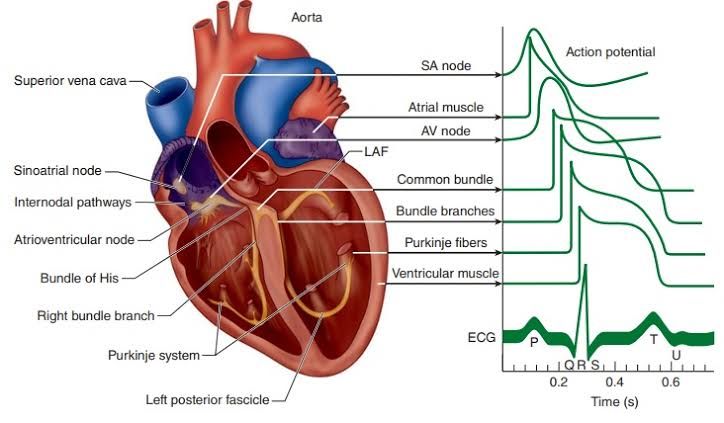
- Depolarization Phase: The action potential begins when a stimulus causes depolarization, typically initiated by pacemaker cells in the sinoatrial (SA) node. When threshold is reached (around -70 mV), voltage-gated sodium channels open rapidly, allowing Na+ to flow into the cell, causing further depolarization.
- Plateau Phase: Following rapid depolarization, there is a plateau phase characterized by a balance between inward calcium ion (Ca2+) currents through L-type calcium channels and outward potassium currents. This plateau phase is essential for preventing tetany in cardiac muscle and allows for effective contraction.
- Repolarization Phase: Eventually, calcium channels close while potassium channels remain open, leading to repolarization as K+ exits the cell. The membrane potential returns toward its resting state (-90 mV).
- Return to Resting State: After repolarization, ion pumps restore ionic gradients, returning the cell to its resting membrane potential.
Classification of Phases of Action Potential
The action potential can be classified into five distinct phases:
- Phase 0 (Rapid Depolarization): Characterized by a rapid influx of Na+ ions.
- Phase 1 (Initial Repolarization): A brief period where K+ exits and Na+ channels begin to inactivate.
- Phase 2 (Plateau Phase): Calcium influx balances K+ efflux, maintaining depolarization.
- Phase 3 (Repolarization): K+ efflux predominates as Ca2+ channels close.
- Phase 4 (Resting Membrane Potential): The cell returns to its resting state with stable ion gradients maintained by pumps.
Components of Conducting System of Heart
The conducting system consists of specialized cardiac tissues that generate and propagate electrical impulses throughout the heart:
- Sinoatrial Node (SA Node): Located in the right atrium, it serves as the primary pacemaker of the heart.
- Atrioventricular Node (AV Node): Positioned at the junction between atria and ventricles; it delays conduction from atria to ventricles.
- Bundle of His (Atrioventricular Bundle): Transmits impulses from AV node into ventricles via bundle branches.
- Right and Left Bundle Branches: Conduct impulses down either side along interventricular septum.
- Purkinje Fibers: Spread throughout ventricular myocardium; they facilitate rapid conduction throughout ventricular walls.
Conducting Pathway
The conducting pathway begins with spontaneous depolarization in the SA node, which generates an action potential that spreads through both atria causing them to contract simultaneously. The impulse then reaches the AV node where it is briefly delayed before being transmitted down through the Bundle of His into right and left bundle branches and finally into Purkinje fibers that distribute it throughout ventricular myocardium.
This sequential activation ensures efficient contraction patterns—first atrial contraction followed by ventricular contraction—allowing for optimal blood flow from heart chambers.
Rate of Conduction
The rate at which electrical impulses travel through different parts of this conducting system varies:
- SA Node firing rate typically ranges from 60-100 beats per minute under normal physiological conditions.
- AV Node conducts impulses at about 40-60 beats per minute if needed as a backup pacemaker.
- Bundle branches conduct at approximately 1 meter/second while Purkinje fibers can conduct up to 4 meters/second ensuring rapid transmission through ventricles.
In summary, these components work together harmoniously ensuring effective coordination between electrical signals and mechanical contractions necessary for proper cardiovascular function.