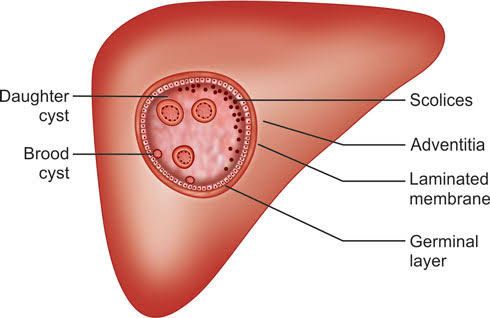
Hydatid disease, also known as cystic echinococcosis or hydatidosis, is a parasitic infection caused by the larval stages of cestodes (tapeworms) of the genus Echinococcus. The most common causative agent is Echinococcus granulosus (sensu lato). This disease primarily affects the liver and other organs, leading to the formation of hydatid cysts, which are liquid-filled growths. These cysts can grow large enough to impair organ function and cause serious health complications if left untreated.
Humans typically contract hydatid disease through accidental ingestion of tapeworm eggs, which can be present in contaminated food or water. The eggs are often spread via the feces of definitive hosts such as dogs that have consumed infected intermediate hosts like sheep. Hydatid disease is more prevalent in rural and underdeveloped areas where livestock farming is common.
Life Cycle of the Parasite
The life cycle of Echinococcus granulosus (sensu lato), which causes cystic echinococcosis, involves several stages and multiple hosts:
- Adult Stage in Definitive Host: The adult tapeworm resides in the small intestine of definitive hosts such as dogs. These adult worms are relatively small, measuring 2-7 mm in length.
- Egg Release: Gravid proglottids (segments of the tapeworm containing eggs) release eggs that are passed out with the feces of the definitive host. These eggs are immediately infectious upon excretion.
- Ingestion by Intermediate Host: Suitable intermediate hosts, such as sheep or other livestock, ingest these eggs while grazing on contaminated pastureland. Humans can also become accidental intermediate hosts by consuming contaminated food or water.
- Oncosphere Release and Migration: Once ingested by an intermediate host, the eggs hatch in the small intestine and release six-hooked oncospheres (larvae). These oncospheres penetrate the intestinal wall and enter the circulatory system.
- Cyst Formation: The oncospheres migrate to various organs—primarily the liver and lungs—where they develop into thick-walled hydatid cysts. These cysts gradually enlarge over time and produce protoscolices (immature tapeworm heads) and daughter cysts within their interior.
- Transmission to Definitive Host: The life cycle completes when a definitive host consumes organs from an infected intermediate host containing these hydatid cysts. After ingestion, protoscolices evaginate (turn inside out), attach to the intestinal mucosa of the definitive host, and mature into adult tapeworms within 32 to 80 days.
- Human Infection: Humans act as aberrant intermediate hosts when they ingest tapeworm eggs accidentally. In humans, oncospheres are released in the intestine and migrate to various organs where they form hydatid cysts similar to those found in natural intermediate hosts.
If a hydatid cyst ruptures within a human host, it can lead to secondary echinococcosis where liberated protoscolices form new cysts at different sites within the body.
Clinical Features and Complications of Hydatid Disease
The clinical features and complications of hydatid disease can vary depending on the size, location, and number of cysts. Here are the detailed clinical features and complications:
- Asymptomatic Phase:
- Many individuals may remain asymptomatic for years as the cysts grow slowly.
- Symptoms Due to Cyst Growth:
- Liver: Abdominal pain, hepatomegaly (enlarged liver), jaundice if bile ducts are obstructed.
- Lungs: Chest pain, cough, hemoptysis (coughing up blood), shortness of breath.
- Other Organs: Symptoms depend on the affected organ; for example, brain involvement can lead to neurological symptoms.
- Complications:
- Cyst Rupture: This can lead to anaphylactic shock due to the release of cyst fluid into the bloodstream.
- Secondary Infection: Ruptured cysts can become infected, leading to abscess formation.
- Obstruction: Large cysts can cause obstruction of bile ducts or other structures.
- Pressure Effects: Large cysts may exert pressure on surrounding tissues and organs, impairing their function.
- Dissemination: Rupture into body cavities like the peritoneum or pleura can lead to secondary echinococcosis.
- Signs of Ruptured Cysts:
- Sudden severe abdominal or chest pain
- Fever
- Allergic reactions including anaphylaxis
- Chronic Symptoms:
- Persistent abdominal discomfort
- Chronic cough or respiratory issues
- Laboratory Findings:
- Elevated eosinophil count
- Positive serological tests for echinococcal antibodies
- Imaging Findings:
- Ultrasound, CT scan, or MRI showing characteristic cystic lesions with specific features like daughter cysts within a larger mother cyst.
Treatment Options for Hydatid Disease
The treatment approach for hydatid disease depends on several factors including the size and location of the cysts, symptoms presented by the patient, and potential complications. Here are the different ways to treat this disease:
- Medication:
- Antiparasitic Drugs: Albendazole is commonly used either alone or in combination with other treatments to reduce the size of cysts and prevent recurrence after surgical intervention.
- Surgical Treatment:
- Surgical removal is often necessary for large or complicated cysts.
- Procedures include total pericystectomy (complete removal) or partial pericystectomy (partial removal).
- Careful handling during surgery is crucial to avoid rupture and spillage which could cause dissemination.
- Percutaneous Aspiration (PAIR Technique):
- PAIR stands for Puncture-Aspiration-Injection-Reaspiration.
- This minimally invasive technique involves puncturing the cyst under imaging guidance, aspirating its contents, injecting a scolicidal agent (e.g., hypertonic saline), and then re-aspirating it.
- It is suitable for certain types of uncomplicated liver hydatid cysts.
- Watchful Waiting/Observation:
- In cases where small asymptomatic cysts are present without significant risk factors for complications, a watch-and-wait approach with regular monitoring might be adopted.
- Post-Treatment Monitoring and Follow-Up:
- Regular follow-up with imaging studies is essential to monitor for recurrence or new cyst formation.
- Long-term antiparasitic therapy may be recommended post-surgery to prevent recurrence.
- Preventive Measures Post-Treatment:
- Educating patients about hygiene practices such as washing hands thoroughly after handling animals or soil.
- Ensuring pets receive regular anti-tapeworm treatment.